If you’re considering selling online, Wix and Etsy often appear side by side. Both allow you to sell products. Both are easy for beginners. And both promise a path to revenue.
That surface similarity is where the confusion starts. Wix and Etsy are not competing tools. They are two completely different business models.
Etsy is a marketplace that finds customers for you.
Wix is a website platform that gives you total ownership and control.
Choosing between them isn’t about which one is easier to start. It’s about how much control you want over your pricing, customers, and growth.
This guide breaks down Wix vs Etsy in practical terms: traffic, fees, profit margins, and scalability. By the end, you will know which option actually aligns with the business you are trying to build.
Key Takeaways
- Wix and Etsy serve fundamentally different business models: Etsy prioritizes marketplace discovery, while Wix prioritizes ownership and control.
- Etsy reduces friction at the start by providing built-in traffic, but limits branding, pricing flexibility, and access to customer data.
- Wix requires you to generate your own traffic, but offers full control over design, customer relationships, and long-term growth strategy.
- Profit margins tend to be higher on Wix as volume increases, while Etsy’s layered fees compound over time.
- Etsy is well suited for testing products and validating demand; Wix is better suited for scaling a brand and building durable assets.
- The right platform choice depends less on speed to first sale and more on how much control and scalability you want over the business you’re building.
Disclaimer: I am an independent Affiliate. The opinions expressed here are my own and are not official statements. If you follow a link and make a purchase, I may earn a commission.
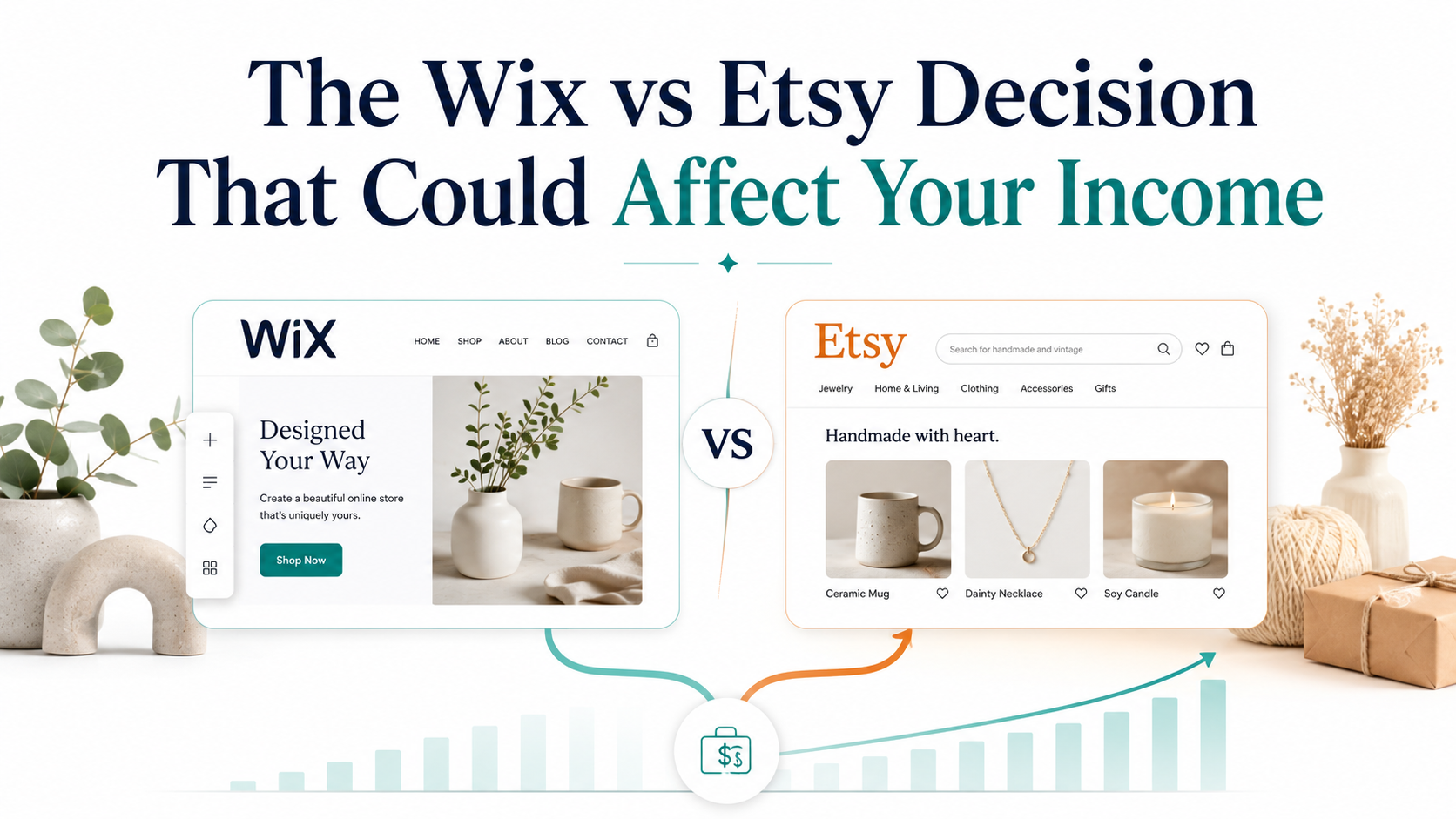
What Is Etsy? (And Who Is It For?)
Etsy is a massive online marketplace built for selling handmade goods, vintage items, and digital products with a unique or niche appeal.
You don’t build a website on Etsy, you open a shop within their platform. It’s more like renting a stall at a bustling digital market than owning a storefront.
That’s what makes it attractive: Etsy already has millions of shoppers looking for specific products.
You don’t have to drive traffic or set up a site. You just list your product, and if it fits the search, you show up.
But here’s what most beginners don’t realize:
You don’t control the rules. Etsy owns the platform, the traffic, and the customer relationship. You pay to list, to sell and to get found.
Etsy is ideal for sellers who:
- Want to launch quickly without building a full site
- Are selling handmade, craft-based, or trending physical products
- Prefer traffic provided by the platform rather than building an audience from scratch
- Are testing a product idea before committing to a full ecommerce setup
But that ease comes with limits: Your brand is secondary to Etsy’s. You don’t own your customer data. And your growth is capped by their algorithm, not your ambition.
Etsy is fast but it’s not flexible.
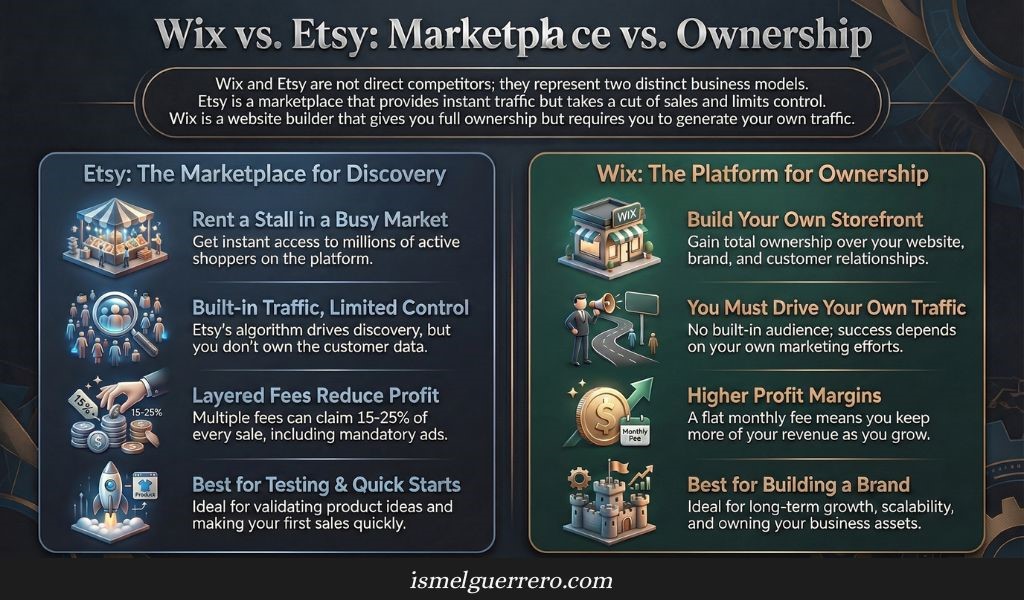
Wix vs Etsy: Side-by-Side Breakdown
If you’re still unsure which platform makes more sense for your goals, this breakdown makes it clear.
Each platform has strengths. Each has limits. The better choice depends on how much control you want and how much work you’re willing to put in.
Side-by-Side Comparison
| Feature | Wix | Etsy |
|---|---|---|
| Setup Difficulty | Moderate build your own site | Easy open a shop within minutes |
| Traffic Source | You drive all traffic | Built-in marketplace traffic |
| Customization | Full control over design and layout | Limited customization, follows Etsy branding |
| Customer Ownership | You own the customer and email list | Etsy controls buyer data |
| Fees | Monthly plans + transaction fees | Listing fees + transaction + ad fees |
| Best For | Long-term brand builders | Quick-start sellers and trending niches |
| Scalability | High you own the platform | Limited growth depends on Etsy algorithms |
| Profit Margins | Higher no marketplace cuts | Lower platform takes a portion of sales |
| Product Types | Physical, digital, services, memberships | Primarily physical and digital products |
| Marketing Tools | Built-in email, SEO, ads, automation | Minimal control, optional Etsy ads |
Wix gives you freedom but demands strategy.
Etsy gives you speed but takes a cut of everything.
The best platform isn’t just the easiest to start. It’s the one that aligns with how you want to grow and what kind of business you’re building.
Wix vs Etsy: Fees, Profit Margins, and Control
Here’s the part most beginners skip and later regret:
Just because a platform is easy to use doesn’t mean it’s built to make you money. Let’s talk about what really affects your bottom line: fees, margins, and ownership.
Etsy’s Fee Stack
Etsy feels cheap at first. Just $0.20 to list a product? Sounds great.
But once the sales roll in, here’s what you’re really paying:
- Listing fee: $0.20 per item
- Transaction fee: 6.5% of the sale price
- Payment processing: ~3% + $0.25
- Optional Etsy Ads: you pay per click, with no guarantee of conversion
- Offsite Ads (automatic for high sellers): Etsy keeps 12–15% of the sale if they drive traffic
The result? It’s common to lose 15–25% of every sale to platform fees. And since you don’t control pricing tiers, checkout flow, or upsells, increasing margins isn’t easy.
The 15% “Success Tax” You Can’t Escape
Most beginners miss this rule until it’s too late:
Once your shop earns $10,000 USD in a year, Etsy automatically enrolls you in their Offsite Ads program.
- The Cost: Etsy takes a 12–15% fee on any sale attributed to their ads.
- The Trap: You cannot opt out. It is mandatory for successful shops.
When you add this to the transaction and processing fees, you could lose nearly 25% of your revenue on a single sale just for using their platform.
Wix’s Flat Cost, Higher Profit Ceiling
Wix charges a monthly fee to run your store. Plans typically range from $17–$35/month for ecommerce features.
On top of that, you’ll pay standard payment processing (2.9% + $0.30 via Stripe or PayPal).
But here’s the difference:
- No listing fees
- No forced ad programs
- No cut taken from each sale
- No restrictions on what you can charge, bundle, or upsell
You keep more of every sale especially as volume increases. And you’re not at the mercy of someone else’s algorithm deciding if you get seen.
Control = Long-Term Profit
Wix gives you ownership. You control the:
- Pricing
- Design
- Sales funnel
- Email capture
- Customer relationship
Etsy gives you reach, but keeps the power. You rent space, play by their rules, and hand over a chunk of every sale even if you bring your own traffic.
So while Etsy may help you make money faster…
Wix gives you more control over how much you keep.
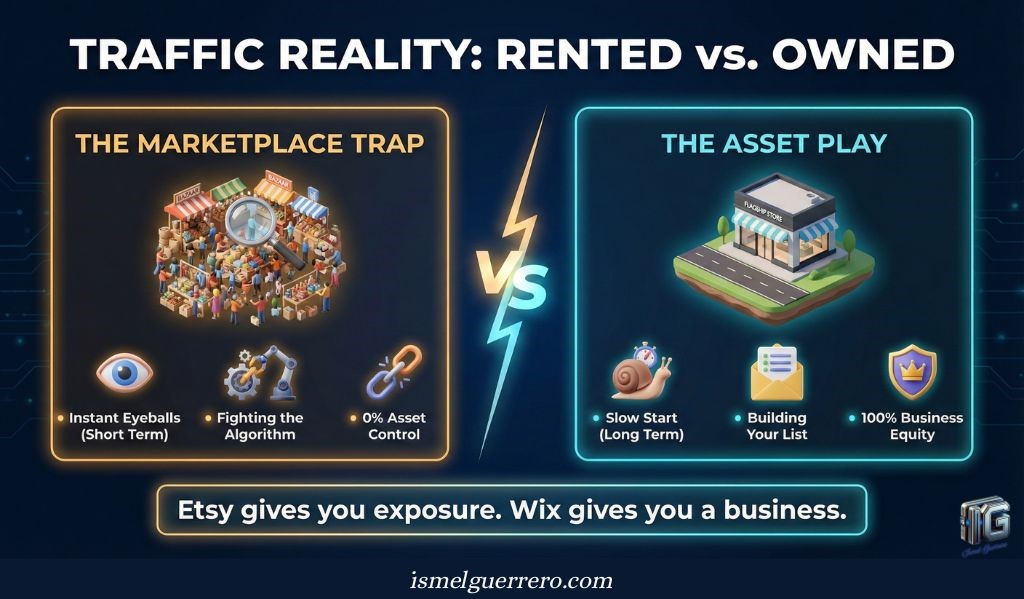
Traffic: Built-In vs Build-It-Yourself
Wix and Etsy are fundamentally different when it comes to traffic and that changes everything about how you grow your store.
Etsy: Instant Exposure, But No Guarantees
Etsy brings the audience to you. It’s a marketplace built on search traffic. Shoppers go there intending to buy, and your listings can show up right away.
That’s the advantage:
- You don’t need to learn SEO, run ads, or build a following
- Discovery is baked into the platform
- Your products appear alongside other sellers in categories, search results, and recommendations
But there’s a trade-off.
You’re one of thousands competing for visibility in the same marketplace.
You have limited control over how and when your listings show up. Etsy controls the algorithm, and your shop is just one part of their ecosystem.
When Etsy updates its rules or shifts its priorities? You feel it. And good luck building long-term traffic if you’re relying on their platform to do it for you.
Wix: You Own It, So You Build It
Wix gives you zero traffic by default. No built-in marketplace. No automatic visitors. It’s just you, your store, and the internet.
That sounds like a disadvantage until you realize what it gives you:
- You’re not competing with thousands of similar listings
- You control your own marketing strategy
- You can drive traffic through SEO, Pinterest, social media, email, or ads
- Every visitor you get is your visitor not Etsy’s
The result? Slower start, but higher ceiling. With Wix, the more traffic you bring in, the more control and profit you keep.
You’re not fighting for scraps in someone else’s feed. You’re building an audience that belongs to you. If you want fast, Etsy delivers exposure. If you want sustainable growth, Wix lets you build it.
Wix vs Etsy: Which Platform Is Better for Digital Products?
If you’re selling digital downloads like eBooks, templates, courses, printables, or guides your platform choice matters more than you think.
Because while both Wix and Etsy technically support digital products, only one of them gives you the tools to scale them.
Etsy: Fast Launch, But Limited Control
Etsy makes it easy to sell digital files. You upload your product, and buyers can instantly download it after purchase.
It’s simple. It works. And it’s beginner-friendly.
But beyond that? You’re boxed in.
You can’t:
- Offer upsells or bundles
- Capture email addresses automatically
- Build a content funnel or redirect traffic to your brand
- Control the delivery experience
You’re stuck within Etsy’s checkout system and if you want to grow beyond “one sale, one file,” it gets clunky fast.
Wix: Built for Full Control and Scalability
Wix gives you everything Etsy doesn’t. You can:
- Sell individual files or digital bundles
- Create custom checkout flows
- Automate product delivery via email
- Add email opt-ins before or after purchase
- Build lead magnets, tripwires, and funnels
- Set up gated content or digital memberships
In short: you’re not just selling a file you’re building a digital product business.
Yes, Wix takes longer to set up. Yes, you’ll have to drive your own traffic.
But once it’s running, it’s yours. No restrictions. No platform middleman. And no one deciding how you get paid or what you can charge.
If you want to test a product fast? Etsy wins.
If you want to scale a system that prints passive income? Wix dominates.
When You Should Start with Etsy
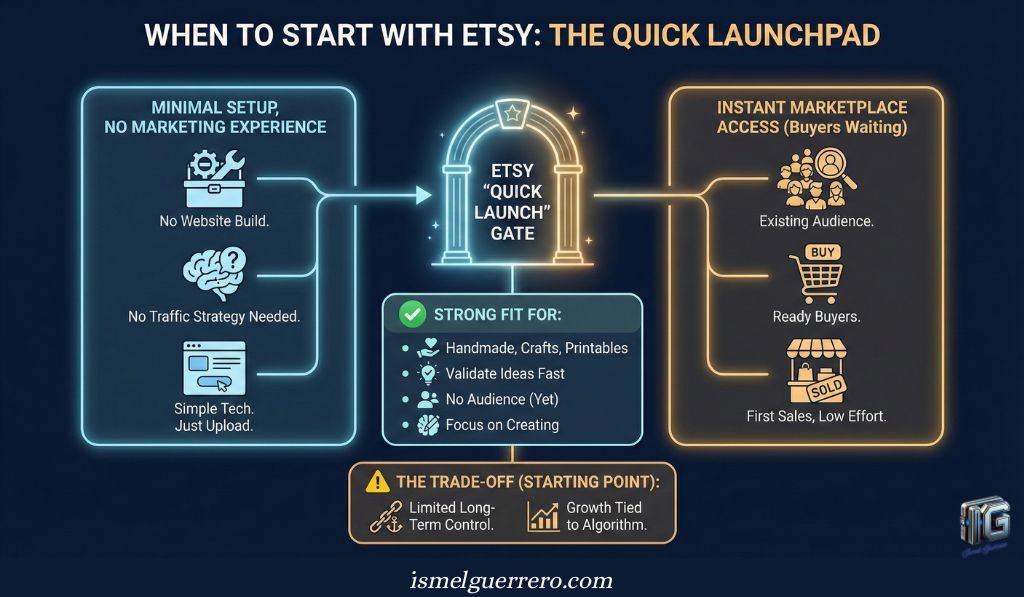
If you want to get up and running fast with minimal setup and no marketing experience, Etsy is the easier starting point.
It’s made for sellers who don’t want to build a website, learn traffic strategies, or deal with complex tech. You create a product, upload it, and start selling inside a marketplace that already has buyers.
Etsy is a strong fit if:
- You’re selling handmade goods, physical crafts, or unique printables
- You want to validate a product idea without investing in a full storefront
- You don’t have an audience or marketing strategy (yet)
- You want to make your first few sales with low upfront effort
- You prefer to focus on creating, not driving traffic
But the keyword here is starting.
Etsy gets you in the game quickly but it’s not built for long-term control or deep profit margins. You’re always playing by someone else’s rules, and your growth is tied to their algorithm.
If that’s a trade-off you’re okay with right now, Etsy can help you launch and prove that your product has potential.
When You Should Start with Wix
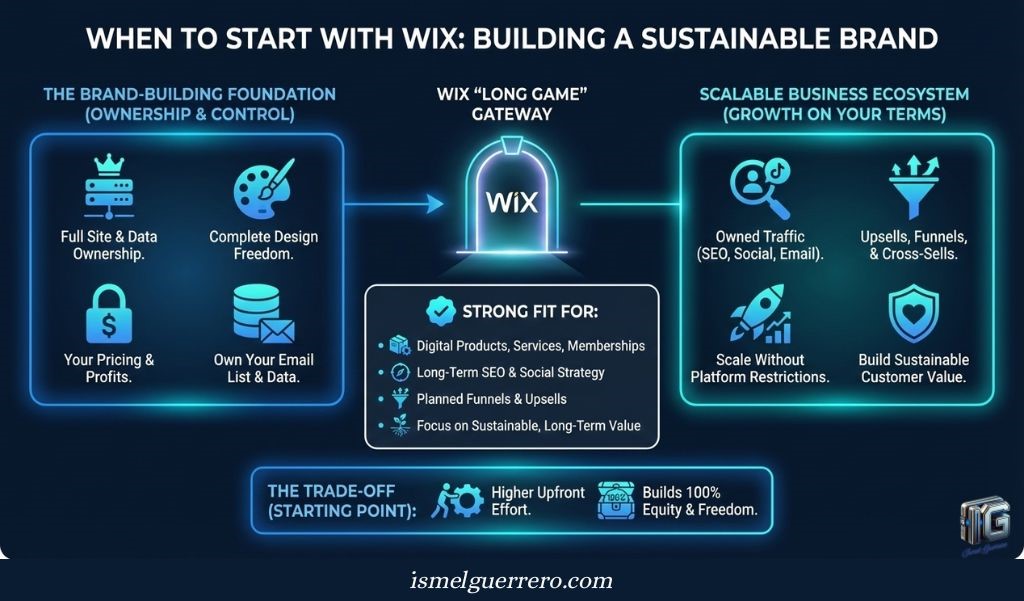
If you’re building more than a hobby if you’re building a brand, Wix is the better place to start.
Wix gives you full control over your site, your products, your pricing, your design, your email list, and your customer experience. There’s no marketplace dictating your visibility or cutting into your profits.
Wix is the right choice if:
- You’re selling digital products, services, memberships, or high-margin physical goods
- You want to own your traffic and build long-term SEO or social media strategies
- You plan to upsell, cross-sell, or run marketing funnels
- You want to scale without platform restrictions
- You’re focused on building something sustainable not just selling what’s trending
It takes more effort up front. But what you build is yours not rented space in someone else’s platform.
Wix is for creators who are serious about business, not just side hustle momentum. If you’re in this for the long game, Wix lets you play it on your terms.
Can You Use Both?
Wix and Etsy serve different purposes but if you understand their strengths, you don’t have to choose one forever.
Many sellers start on Etsy for exposure, then transition to Wix for growth.
Here’s how that works:
1. Validate your product on Etsy
Use Etsy’s built-in traffic to test what sells. Pay attention to your bestsellers, pricing sweet spots, and real customer feedback.
2. Build a brand on Wix behind the scenes
While Etsy brings in buyers, use Wix to create a branded store that you fully control your own site, your own checkout, your own email list.
3. Capture traffic from Etsy and redirect it
Include packaging inserts, email opt-ins, and “thank you” pages that point customers to your Wix store. Now you’re building long-term traffic from short-term exposure.
4. Shift your marketing to your own platform over time
As your Wix site gains SEO traction or social media visibility, you can rely less on Etsy and stop paying marketplace fees.
Using both isn’t about doing more work. It’s about doing smart work that compounds.
Etsy helps you start. Wix helps you scale.
The Bridge Strategy: Use Etsy for Traffic, Wix for Profit
Some sellers treat Etsy as their entire business. Smart sellers treat it as a lead source.
You can use Etsy to find customers, then guide them to your own site for bigger offers. This is called a Bridge Strategy.
1. Etsy is the Entry Point
List a simple, low-cost product on Etsy. Let their marketplace traffic do the work. You are looking for a buyer who needs a specific, small solution.
2. The Handoff (Safety Warning)
Etsy has strict rules. You cannot put a link to your website in your listing description or messages. That is “Fee Avoidance” and it will get you banned.
However, once a customer buys a digital file, that file belongs to them. You can include your branding and resources inside that file.
3. The Execution
Inside the PDF or download, include a simple branded page.
- Thank the customer.
- Explain the next logical step.
- Provide a link to your Wix store where the “Full Version” or “Bundle” lives.
Why This Works
You pay Etsy a fee to acquire the customer on the $5 item. But when they click the link inside the file and buy the $50 bundle on your site, you keep 100% of the profit.
Bottom Line: This is not a hack. It is a system. You respect Etsy’s rules for the first sale, then build a direct relationship for the second one.
Conclusion
Wix and Etsy both let you sell online but that’s where the similarity ends.
Etsy gives you speed. It gets you in front of buyers fast. Wix gives you ownership. It puts you in control of the entire business.
If you’re launching a handmade product, testing a niche, or just want to make a few quick sales without the hassle of building a website, Etsy gets the job done.
But if you’re playing the long game if you care about brand, margins, email lists, and building something that lasts, Wix gives you the tools to scale.
Don’t just ask which platform is easier. Ask which one actually supports the business you want to build.
That’s the difference between selling and growing.
If you’re leaning toward Wix because you’re selling digital products or services, there’s another battle worth seeing, Stan Store vs Shopify. Both platforms are built for creators, but take completely different approaches to selling online.
Frequently Asked Questions (FAQs)
Can I sell digital products on both Wix and Etsy?
Yes. Both platforms support digital downloads. Etsy is better for launching quickly, but Wix gives you more flexibility to scale, upsell, and automate delivery.
Which platform is cheaper for beginners?
Etsy feels cheaper upfront with pay-as-you-go fees, but takes a larger cut per sale. Wix has monthly costs but gives you higher profit margins and long-term savings if you’re making consistent sales.
Do I need marketing skills to use Wix?
Yes. Wix doesn’t come with built-in traffic. You’ll need to learn or apply basic strategies like SEO, Pinterest, or email marketing. The upside? You own the traffic and the customer.
Can I migrate from Etsy to Wix later?
Absolutely. Many sellers start on Etsy to test products, then build a Wix store once they’re ready to grow. You can direct Etsy customers to your new site and gradually shift your marketing.
Which platform is better for building a brand?
Wix. You control the entire experience your domain, your design, your email list, your upsells. Etsy prioritizes the marketplace and limits your branding control.

1 Comment
Stan Store vs Shopify: Creators, Read This First! - Ismel Guerrero. · April 17, 2025 at 10:32 pm
[…] Check out our Wix vs Etsy guide for a direct look at marketplace speed vs full […]