Most AI prompts fail because the expectation is never made explicit. The ERA framework prompt solves this by structuring any AI request around Expectation, Role, and Action.
This approach replaces vague instructions with clear direction, which leads to more consistent and usable outputs across tools. Instead of forcing the model to infer intent, the prompt defines the outcome, perspective, and task upfront.
This guide explains how to apply the ERA framework to write better AI prompts in three steps.
Key Takeaways
- The ERA framework prompt structures AI requests using Expectation, Role, and Action.
- Clear expectations reduce vague or generic outputs.
- Assigning a role guides tone, depth, and perspective.
- Defined actions remove ambiguity about what the AI should produce.
- ERA works across different AI tools, not one platform.
- The framework shortens workflows by reducing follow-up prompts.
Disclaimer: I am an independent Affiliate. The opinions expressed here are my own and are not official statements. If you follow a link and make a purchase, I may earn a commission.
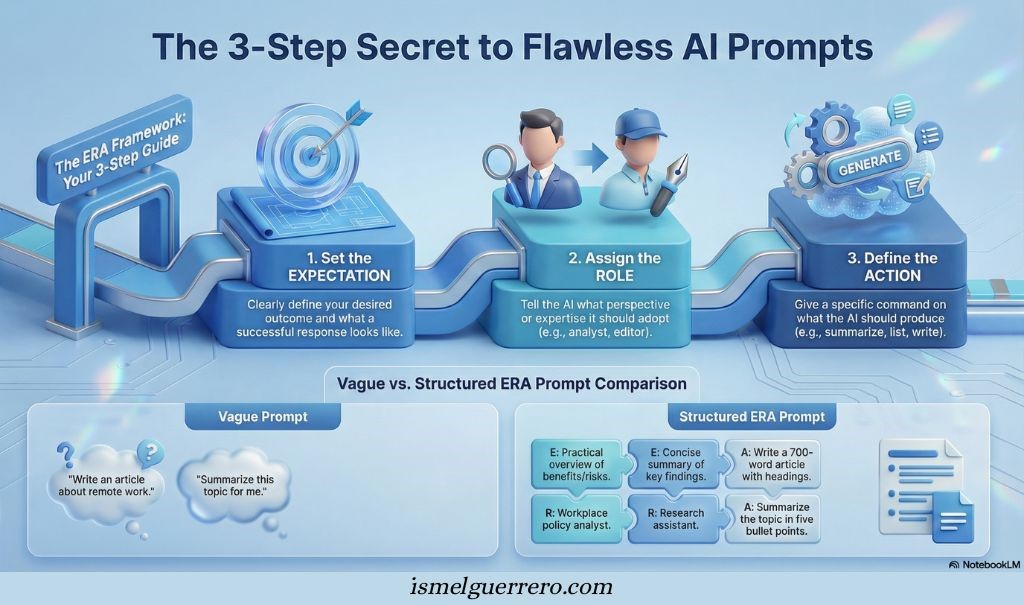
What the ERA framework prompt is
Why it matters: AI systems respond directly to how a request is framed. When a prompt lacks structure, the model fills in gaps with assumptions, which leads to inconsistent results.
What it means: The ERA framework prompt is a simple structure made up of three parts, Expectation, Role, and Action. Expectation defines the outcome you want. Role sets the perspective or expertise the AI should use. Action specifies what the AI should do with that context.
Practical implication: By providing these three elements upfront, the AI no longer has to guess intent. The result is clearer outputs, fewer revisions, and prompts that work reliably across different tools.

Why most AI prompts fail without structure
Most AI prompts fail because they rely on implication instead of instruction. A user may know what they want, but the prompt rarely states the outcome clearly, defines the perspective the AI should take, or explains what form the response should follow.
When those elements are missing, the model has to infer intent based on patterns, not priorities. That inference changes depending on wording, context, and even minor variations in phrasing.
This is why results often feel inconsistent rather than incorrect. The AI is responding logically to incomplete direction, not making mistakes. Without structure, the prompt leaves too much room for interpretation, which leads to generic answers or misaligned outputs. A structured approach removes that uncertainty before the response is generated.
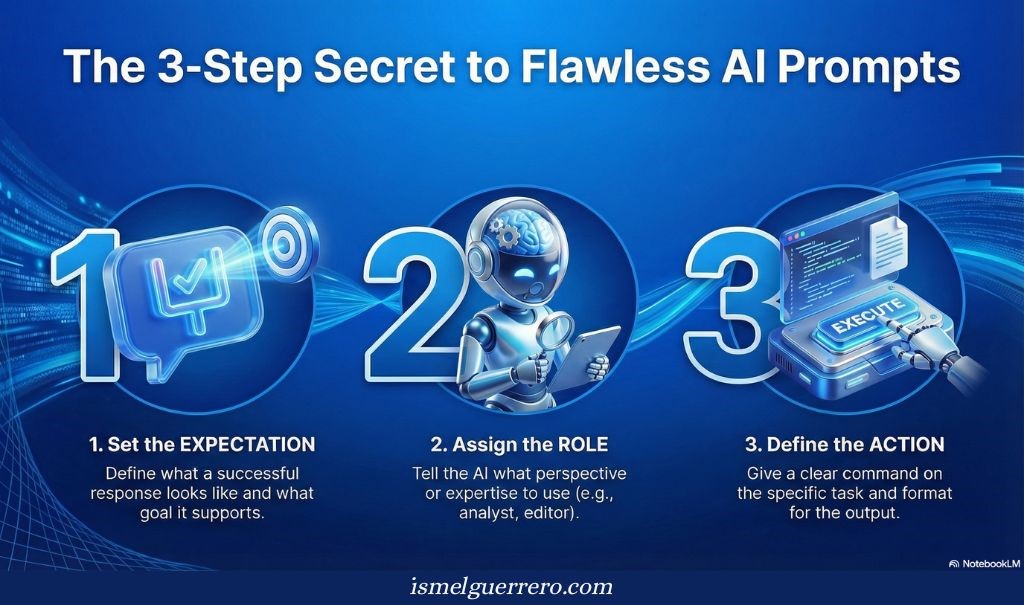
How to use the ERA framework step by step
The ERA framework works because it breaks a prompt into decisions the AI must make before producing an answer. Instead of compressing intent into one sentence, the framework separates outcome, perspective, and task. This gives the model a clear sequence to follow, which improves consistency across different tools and use cases. Each step builds on the previous one, so skipping or weakening a step reduces the quality of the final output.
Step 1: Set the expectation
Expectation defines what a successful response looks like in concrete terms. This is where you clarify the goal, scope, and level of detail you want, without explaining how the AI should get there. A strong expectation might specify the type of answer, the audience, or the decision the output should support. When the expectation is clear, the AI can prioritize relevance over volume.
Without an explicit expectation, the model defaults to general explanations because it has no signal for what matters most. This often leads to answers that are technically correct but not useful. Setting the expectation first prevents that drift by anchoring the response to a defined outcome.
Step 2: Assign the role
Role shapes how the AI approaches the problem. It defines the perspective, expertise, and reasoning style the response should reflect. This could mean thinking like an analyst, an editor, a planner, or a subject-matter expert, depending on the task.
Assigning a role is not about creativity, it is about control. The role helps the AI filter information, choose the right level of depth, and adopt an appropriate tone. When the role is missing or vague, the output often feels misaligned with the real-world context you had in mind.
Step 3: Define the action
Action tells the AI exactly what to do with the expectation and role you have set. This includes the task itself, the format of the response, and any constraints that affect execution. Examples include writing a summary, generating a list, comparing options, or outlining steps.
Clear actions reduce the need for follow-up prompts because they define what “done” looks like. When the action is specific, the output becomes immediately usable instead of requiring clarification or rework. This step turns a well-framed prompt into a practical result.
Real World Examples of ERA Framework Prompts
Seeing the ERA framework in use makes the structure easier to apply. Each example below shows how adding Expectation, Role, and Action changes the quality of the output without adding complexity. The difference is not length, it is clarity.
| Use Case | Unstructured Prompt | ERA Framework Prompt |
|---|---|---|
| Writing | Write an article about remote work. | Expectation: Produce a clear, practical overview of remote work benefits and risks. Role: Act as a workplace policy analyst. Action: Write a 700-word article with headings and examples. |
| Research | Summarize this topic for me. | Expectation: Provide a concise summary highlighting key findings and limitations. Role: Act as a research assistant. Action: Summarize the topic in five bullet points. |
| Planning | Help me plan a project. | Expectation: Create a realistic project plan with milestones. Role: Act as an experienced project manager. Action: Outline the plan with phases, timelines, and risks. |
| Ideation | Give me ideas for content. | Expectation: Generate practical content ideas for a business audience. Role: Act as a content strategist. Action: List ten ideas with a one-line explanation each. |
In each case, the ERA version removes ambiguity before the AI responds. The prompt defines what success looks like, how the model should think, and what it should deliver. This is why the framework produces more consistent results with fewer revisions.

ERA vs CREATE framework for AI prompts
The ERA and CREATE frameworks solve different problems, even though they are often compared. ERA focuses on speed and clarity by defining only what the AI needs to produce, how it should think, and what action to take. This makes it effective for everyday tasks where the goal is to get a usable result quickly.
The CREATE framework is designed for more complex prompting scenarios. It introduces additional layers such as context, refinement, and evaluation, which are useful when the task involves multiple stages or higher stakes decisions. That added structure can improve outcomes, but it also increases setup time.
In practice, ERA works best as a foundational framework. It helps you establish clear intent before adding more advanced elements when needed. For many workflows, ERA alone is sufficient, and for more complex ones, it serves as the base that other frameworks build on.
Conclusion
The ERA framework prompt works because it forces clarity before generation. By separating Expectation, Role, and Action, you remove ambiguity that normally leads to generic or misaligned outputs.
This structure does not require technical knowledge or complex setup, which makes it easy to apply across different AI tools and tasks. Over time, using ERA consistently trains you to think in terms of outcomes instead of guesses.
That shift alone improves prompt quality more than adding extra instructions. If you need more control later, ERA provides a clean foundation to build on. For most everyday use cases, it is enough to get reliable results on the first attempt.

Frequently Asked Questions
What does ERA stand for in AI prompting?
ERA stands for Expectation, Role, and Action. These three elements define what the AI should produce, how it should approach the task, and what specific action it needs to take. Together, they remove ambiguity before the response is generated.
Can the ERA framework be used with different AI tools?
Yes. The ERA framework is tool-agnostic and works with any AI system that responds to natural language prompts. Because it focuses on clarity rather than platform-specific features, it applies consistently across models.
Is the ERA framework better than standard prompting?
ERA is not more powerful, it is more deliberate. Standard prompting often relies on implied intent, while ERA makes intent explicit. This usually results in clearer outputs with fewer follow-up prompts.
When should I use ERA instead of more complex frameworks?
ERA works best for everyday tasks where speed and clarity matter more than layered control. For complex or multi-stage tasks, ERA can be used as the foundation before adding more advanced frameworks.

1 Comment
The CREATE Framework Prompt: Generate Complete AI Outputs - Ismel Guerrero. · January 17, 2026 at 12:43 pm
[…] ERA framework is usually the better choice when speed matters and the task is […]