Introduction
The phrase “human-sounding AI voice” gets used a lot, but it rarely comes with a clear explanation. One person might use it to describe a voice that sounds smooth and natural, while another might mean it simply doesn’t feel robotic.
As AI-generated voices have become more common, the phrase has turned into shorthand for something people recognize but don’t always define the same way.
A human-sounding AI voice isn’t about tricking someone into thinking a real person is speaking. It’s about how the voice feels to the listener as it flows, pauses, and emphasizes words.
This article breaks down what people usually mean when they describe an AI voice as “human-sounding,” and why that perception depends on more than just clear pronunciation.
Key Takeaways
- A human-sounding AI voice is defined by how natural it feels to listeners, not by how perfectly it imitates a real person.
- Rhythm, pacing, and emphasis play a bigger role in perceived realism than flawless pronunciation.
- Listening is subjective, so the same AI voice can sound human to one person and less natural to another.
- Context matters: what feels natural in one format may feel off in a different setting.
- Understanding what “human-sounding” really means makes it easier to interpret demos and quality claims accurately.
Disclaimer: I am an independent Affiliate. The opinions expressed here are my own and are not official statements. If you follow a link and make a purchase, I may earn a commission.
Why “Human-Sounding AI Voice” Means Different Things to Different People
When people describe an AI voice as human-sounding, they’re usually reacting to how it feels, not checking it against a strict definition. One listener might focus on whether the voice flows smoothly, while another notices pauses, emphasis, or how relaxed the delivery sounds. Because listening is subjective, two people can hear the same voice and come away with different impressions.
Personal expectations also play a role. Someone who has only heard older, robotic text-to-speech may be impressed by even small improvements, while someone familiar with high-quality narration may be more critical. What sounds human to one person can sound slightly off to another, depending on what they’re used to hearing.
Context matters too. A voice that feels natural in a short explainer video might feel less convincing in a long-form audiobook. When people use the phrase “human-sounding AI voice,” they’re often combining their expectations, past experiences, and the situation in which they heard the voice all into a single, convenient label.
What Listeners Usually Notice First When Hearing an AI Voice
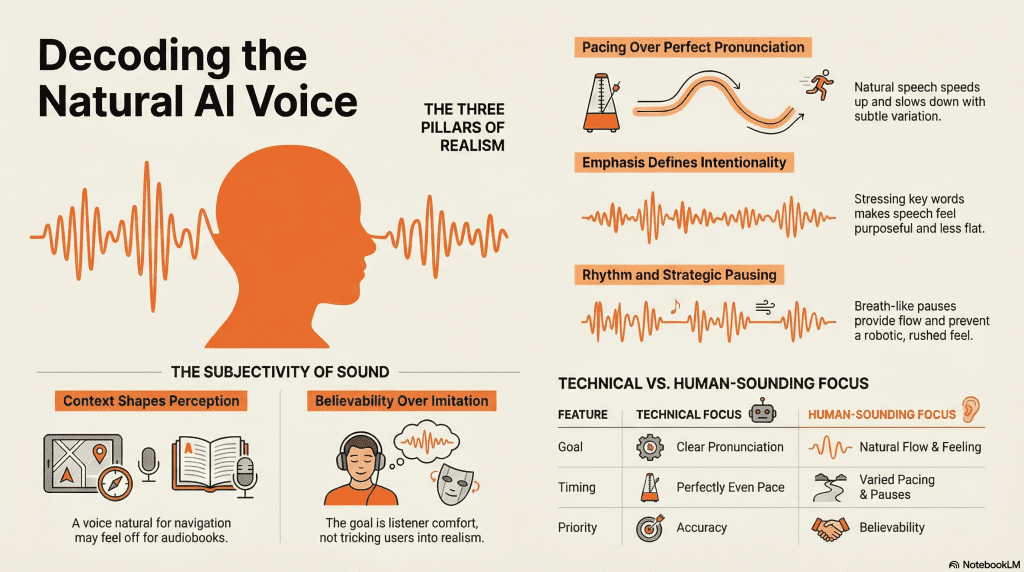
Most listeners don’t analyze an AI voice in detail when they first hear it. Instead, they react almost instantly to how the voice flows. Does it feel smooth or stiff? Does it pause in places that make sense, or does it rush through sentences without breathing room? These early impressions often shape whether a voice feels human or artificial.
Pacing is usually one of the first things people notice. Human speech naturally speeds up, slows down, and pauses in subtle ways. When an AI voice speaks at a perfectly even pace, it can sound controlled but unnatural. Small variations in timing help speech feel more relaxed and easier to follow.
Listeners also tend to notice emphasis, even if they can’t describe it clearly. When important words are stressed and less important ones fade into the background, speech feels intentional. When everything sounds equally weighted, the voice can feel flat. These details often register subconsciously, but they play a large role in whether a voice feels human-sounding.
The 5-Second Ear Test
You don’t need to be an audio engineer to judge a voice. When you are auditioning AI voices, close your eyes and listen to the first sentence. Then ask three questions:
- Does it breathe? (Good voices have micro-pauses between ideas, even if they don’t actually inhale).
- Does it rush? (Robotic voices speak at a constant, perfect speed. Human voices slow down for hard words and speed up for easy ones).
- Does it care? (Does the pitch go up or down to emphasize important words, or is everything flat?)
If the answer to any of these is “No,” the voice will fatigue your listeners quickly.
Why Clear Pronunciation Alone Doesn’t Make a Voice Sound Human
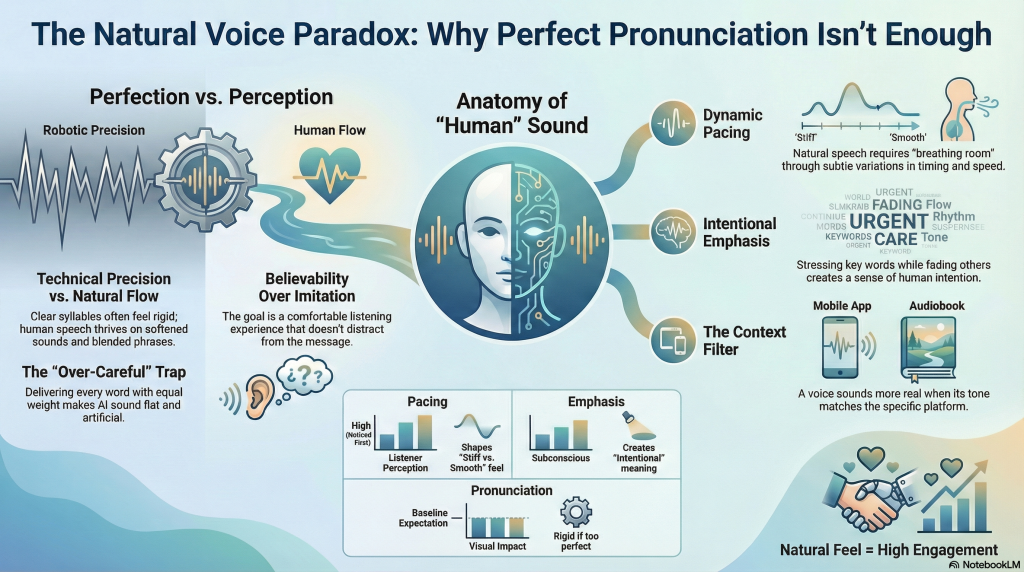
It’s easy to assume that if an AI voice pronounces every word correctly, it should sound human. In practice, clear pronunciation is only one small part of how speech is perceived. A voice can articulate every syllable perfectly and still feel unnatural to listeners.
Human speech isn’t perfectly consistent. People shorten words, soften sounds, and let certain phrases blend together. When an AI voice delivers every word with the same precision and clarity, the result can feel overly careful or rigid, even though nothing is technically “wrong.”
Natural-sounding speech relies on variation. Slight changes in speed, emphasis, and phrasing help listeners stay engaged and follow meaning without effort. When pronunciation is treated as the main goal, those subtler elements often get lost. That’s why a human-sounding AI voice depends more on how speech flows than on how cleanly each word is spoken.
How Context Changes Whether an AI Voice Feels Human
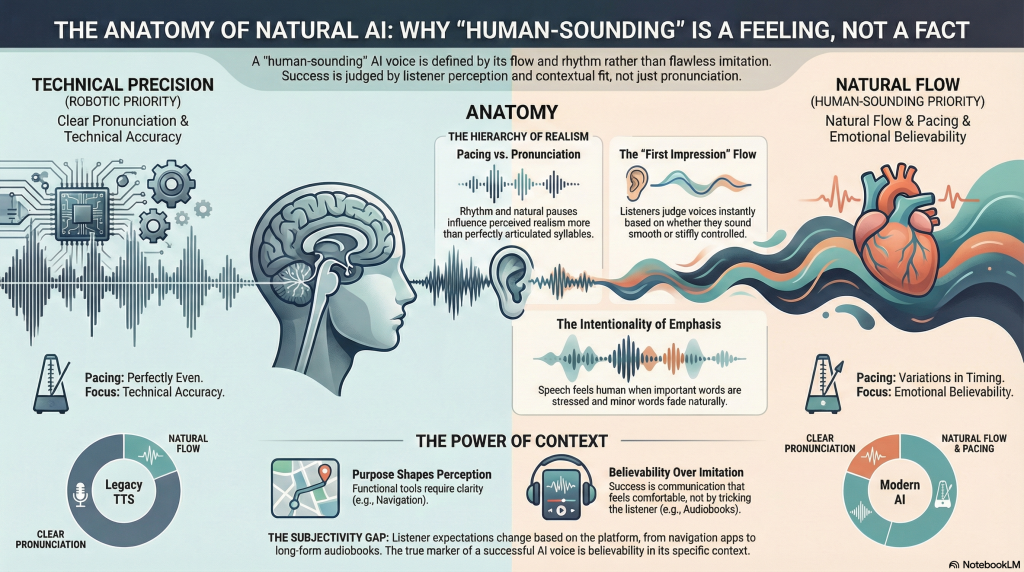
Whether an AI voice sounds human often depends on where and how it’s used. A voice that feels natural in a short explainer video might feel repetitive or flat in a long audiobook. The same voice can create very different impressions depending on how much listening time and attention the situation demands.
Context also shapes expectations. In a navigation app or software interface, listeners usually want clarity and consistency. In storytelling or educational content, they expect variation, emphasis, and a sense of pacing. When an AI voice doesn’t match those expectations, it can feel out of place even if the voice itself is well-produced.
This is why realism isn’t a fixed quality. A human-sounding AI voice is one that fits the moment it’s used in. Understanding this helps explain why people sometimes disagree about whether a voice sounds natural: they may be judging it against different contexts rather than different levels of quality.
Why “Human-Sounding” Doesn’t Mean Indistinguishable from a Real Person
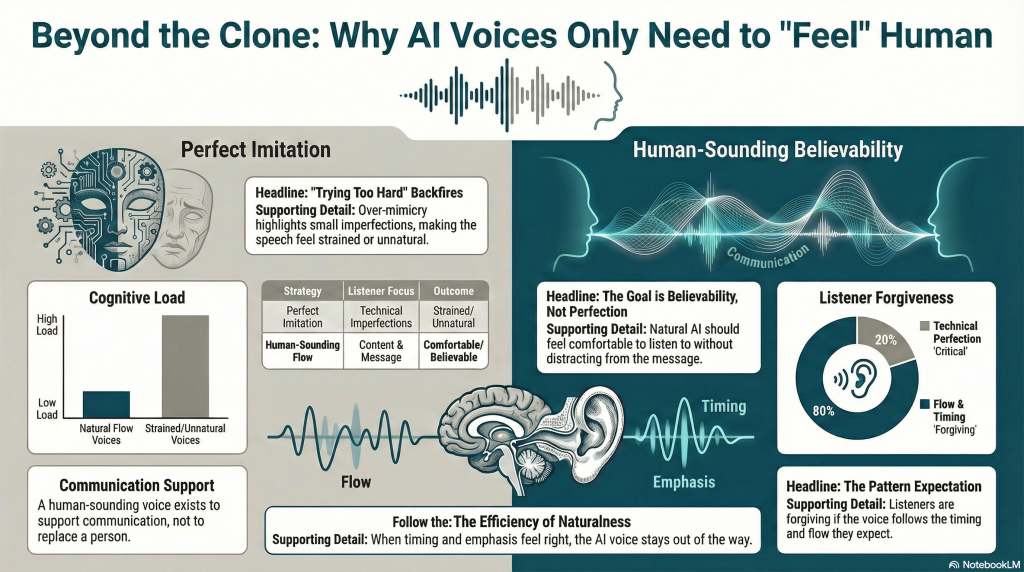
When people describe an AI voice as human-sounding, they don’t usually mean it’s impossible to tell apart from a real speaker. In most cases, they mean the voice feels comfortable to listen to and doesn’t distract from the message. The goal is believability, not imitation.
Human listeners are surprisingly forgiving. A voice doesn’t need to reproduce every nuance of real speech to feel natural, it just needs to follow the patterns people expect. When timing, emphasis, and flow feel right, listeners tend to focus on the content rather than the voice itself.
Trying to make an AI voice perfectly mimic a real person can sometimes have the opposite effect. Overemphasis on realism can highlight small imperfections and make speech feel unnatural or strained. In many situations, a voice that sounds clear, steady, and appropriately expressive feels more human than one that tries too hard to be indistinguishable.
Understanding this distinction helps reset expectations. A human-sounding AI voice isn’t about replacing a person, it’s about creating speech that feels natural enough to support communication without getting in the way.
Conclusion
A human-sounding AI voice isn’t defined by perfection or by how closely it imitates a real person. It’s defined by how natural it feels to listen to whether the speech flows smoothly, pauses make sense, and emphasis supports meaning. These qualities shape perception far more than flawless pronunciation or technical precision.
Because listening is subjective and context-dependent, the idea of “human-sounding” will always vary from one situation to another. What matters most is whether the voice fits its purpose and stays out of the way of the message. Understanding this makes it easier to interpret demos, examples, and claims about AI voice quality with a clearer perspective.
For a deeper look at the specific elements that influence realism such as rhythm, emotion, and delivery, those factors are explored in more detail in the broader discussion of AI voice quality and realism.

Frequently Asked Questions
What is a human-sounding AI voice?
A human-sounding AI voice is one that feels natural and comfortable to listen to rather than rigid or robotic. It doesn’t mean the voice is indistinguishable from a real person. Instead, it reflects how well the speech flows, pauses, and emphasizes words in ways listeners expect.
Why do some AI voices sound more human than others?
Differences in pacing, rhythm, and emphasis often shape how human a voice feels. Voices that vary their timing and stress key words tend to sound more natural than those that speak at a perfectly even pace. Perception also depends on listener expectations and context.
Does a human-sounding AI voice need to sound emotional?
Not always. While emotional cues can add realism in some situations, clarity and appropriate pacing matter more in others. A voice that matches the tone of its context usually feels more human than one that adds emotion where it isn’t needed.
Can the same AI voice sound human in one situation but not another?
Yes. Context plays a major role in how speech is perceived. A voice that works well in short instructional content may feel less natural in long-form narration, simply because listener expectations change.
Is “human-sounding” the same as high-quality AI voice?
Not exactly. Voice quality refers to technical clarity and consistency, while “human-sounding” describes how natural the speech feels to listeners. A voice can be technically clear but still feel unnatural if timing and emphasis are off.
Will AI voices ever sound completely indistinguishable from real people?
Some AI voices can sound very natural, but complete indistinguishability isn’t always the goal. In many cases, a voice that feels clear, believable, and easy to listen to is more effective than one that tries to perfectly imitate a real person.

0 Comments