Faceless digital marketing is not just about staying off camera. It is about building an online marketing system that can attract, convert, and serve customers without relying on a founder’s public identity.
Instead of personal visibility doing the selling, the business depends on digital assets such as content, landing pages, email, automation, and a clear offer.
That makes the model especially useful for brands that want more privacy, greater operational flexibility, or less dependence on one person constantly showing up.
This guide explains how faceless digital marketing works, which channels and systems support it, how trust is built online, and what it takes to turn the model into a reliable digital business.
- Faceless digital marketing relies on systems instead of personal visibility. Content, landing pages, email, automation, and customer experience do the work a founder’s presence might otherwise support.
- The right channels depend on the audience and offer. Search, social media, video, email, and paid campaigns can all support a faceless strategy when they fit the buyer journey.
- Trust has to be built into the digital experience. Clear messaging, proof, professional design, transparent policies, and reliable support become especially important.
- Automation should support a proven process, not replace strategy. Tools can improve efficiency, but they cannot fix weak positioning, poor content, or an unclear offer.
- Measurement matters more than visibility. Conversion rates, email engagement, retention, refunds, and customer behavior reveal whether the system is actually working.
- Faceless digital marketing is not a separate business model by itself. It is a way of executing online marketing without making a visible founder central to the process.
Disclaimer: I am an independent Affiliate. The opinions expressed here are my own and are not official statements. If you follow a link and make a purchase, I may earn a commission.
What Is Faceless Digital Marketing?
Faceless digital marketing is the use of online channels and systems to attract, convert, and serve customers without making a founder’s identity central to the strategy.
It applies the broader idea of faceless marketing specifically to digital execution.
Instead of relying on a visible person to build attention and trust, the business uses assets such as:
- Website content
- Search traffic
- Social media
- Video
- Landing pages
- Automation
- Digital offers
- Customer support systems
The goal is not to hide the business. It is to make the marketing work through the brand, message, offer, and customer experience rather than through constant founder visibility.
That makes faceless digital marketing less about anonymity and more about building an online system that can perform without depending on one person being publicly present.
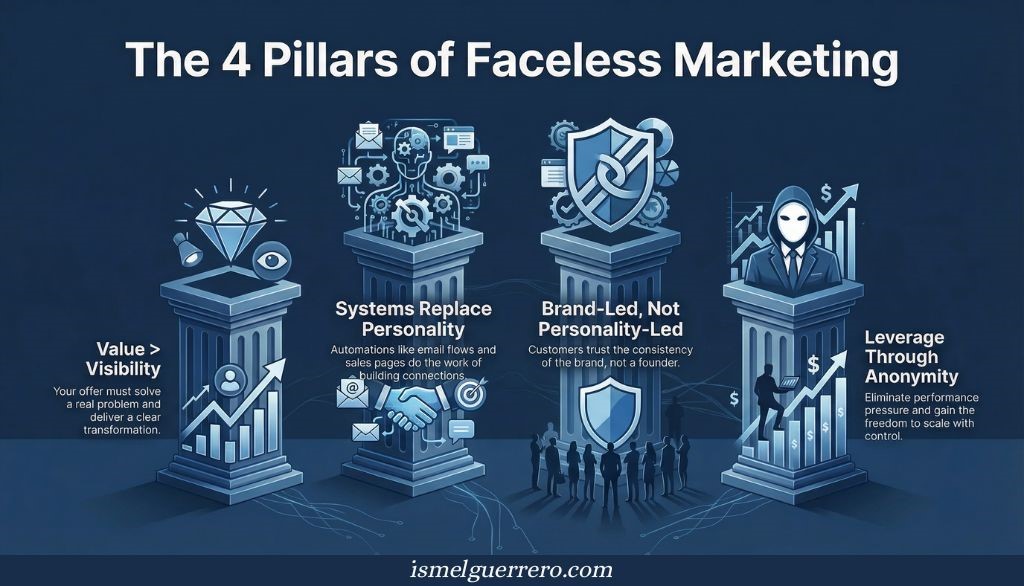
How Faceless Digital Marketing Works
Faceless digital marketing works by turning the customer journey into a system that does not depend on a founder being personally visible at each stage.
A simple version looks like this:
Traffic → landing page or content → lead capture → nurture → offer → conversion → delivery → retention
Each stage has a different job.
Traffic brings the right people into the system through channels such as search, social media, video, email, or paid campaigns.
The landing page or content gives them a reason to stay, learn more, or take the next step.
Lead capture and email help continue the relationship without requiring direct personal outreach.
The offer explains what the customer gets, why it matters, and what action to take.
After the sale, delivery, onboarding, support, and follow-up determine whether the experience reinforces trust.
The founder may still design and manage the strategy behind the scenes, but the customer journey is carried by the brand and its digital systems.
Key Insight
The strength of faceless digital marketing is not that it removes people from the business. It is that the marketing can keep working without requiring one person to personally carry every interaction.

Digital Channels for Faceless Marketing
Faceless digital marketing can work across several channels. The right mix depends on where the audience already spends time, how they search for information, and what kind of offer the business is promoting.
Search
Search-driven content works well for faceless brands because people often care more about getting a useful answer than knowing who created it.
Articles, tutorials, comparisons, and resource pages can attract visitors who are already looking for information or evaluating a decision.
Social Media
Social platforms can support faceless marketing through:
- Short-form videos
- Carousels
- Graphics
- Voiceovers
- Screen recordings
- Product demonstrations
- Branded educational content
The challenge is to create a recognizable style rather than relying on generic templates or copied formats.
Video
Video does not require a talking head.
Faceless brands can use screen recordings, narration, animations, demonstrations, slides, or product footage to explain ideas and build attention.
The format should match the subject. A software tutorial, for example, may be easier to understand through a screen recording than through a presenter speaking to the camera.
Email gives a faceless brand a direct way to continue the relationship after someone discovers the business.
It can be used to:
- Welcome new subscribers
- Deliver useful content
- Educate prospects
- Introduce offers
- Follow up after a purchase
- Re-engage existing customers
The strength of email is that the brand does not need to depend on a public platform every time it wants to reach the audience.
Paid Advertising
Paid campaigns can also support a faceless model when the offer, landing page, and targeting are strong.
The ad does not need to feature a founder. It can lead with the problem, product, benefit, demonstration, or customer proof instead.
Paid traffic works best when the business already understands what message and offer convert.
Key Insight
The best channel is not the one that makes staying faceless easiest.
It is the one that gives the brand the strongest way to reach the right audience and deliver the kind of content or message that helps them move forward.
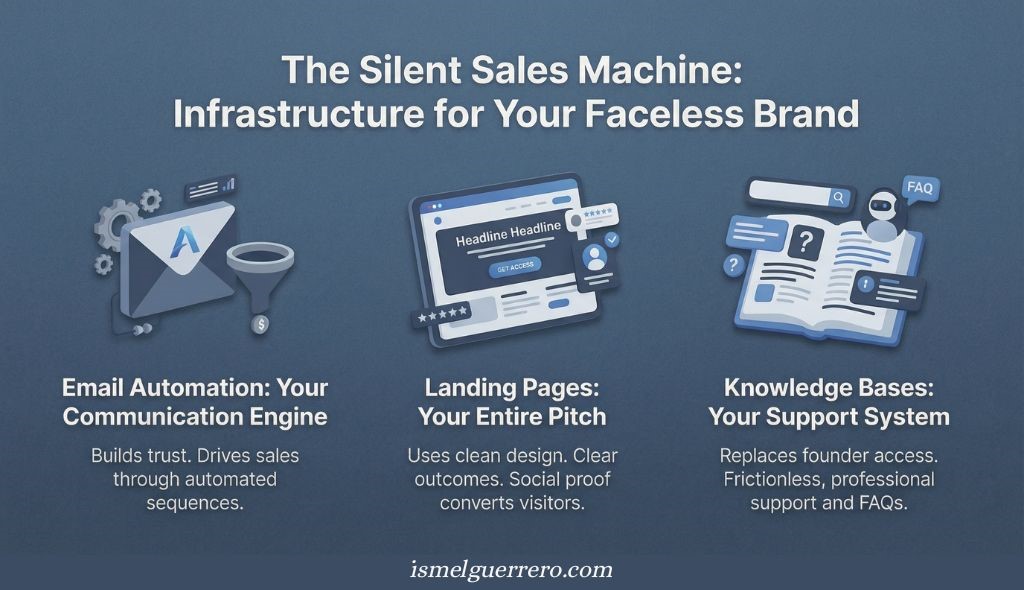
Essential Infrastructure for a Faceless Digital Brand
A faceless digital brand does not need a visible founder, but it does need a reliable system behind the customer experience.
The stronger the infrastructure, the less the business has to depend on personal involvement at every stage.
Website or Central Hub
A website gives the brand a stable place to explain what it does, publish content, capture leads, and present offers.
It should make it easy for visitors to understand:
- Who the brand serves
- What problem it solves
- What products or services are available
- How to take the next step
The goal is clarity, not complexity.
Landing Pages
Landing pages help turn attention into action.
A strong landing page should explain the offer, show why it matters, address important questions, and give the visitor a clear next step.
Without a founder personally selling the offer, the page has to do more of the persuasive work.
Email System
Email helps continue the relationship after someone first discovers the brand.
It can support:
- Welcome sequences
- Lead nurturing
- Product education
- Offer promotion
- Customer onboarding
- Follow-up
- Retention
A good email system reduces the need for manual communication while still keeping the experience useful and relevant.
Customer Support
Faceless should not mean difficult to reach.
Customers should know how to ask questions, report problems, and get help when they need it.
That might include:
- Support email
- Help center
- FAQ pages
- Ticketing system
- Chat support
Reliable support gives the brand another way to build confidence without relying on a visible founder.
Analytics and Tracking
Digital marketing needs feedback.
Tracking helps the business understand where people come from, what they engage with, where they leave, and which actions lead to conversions.
Without that information, it becomes difficult to know which parts of the system are actually working.
Key Insight
The infrastructure behind a faceless brand should make the customer experience feel clear and dependable without requiring the founder to step in constantly.
The goal is not to remove human involvement. It is to build a system that does not depend on one person carrying every interaction.
How to Create Content Without Showing Your Face
Faceless content still needs to be useful, recognizable, and suited to the platform where it appears.
The format can change, but the goal stays the same: give the audience a reason to pay attention without relying on a visible creator.
Use Screen Recordings
Screen recordings work especially well for:
- Software tutorials
- Product walkthroughs
- Process demonstrations
- Educational content
- Step-by-step guides
They let the audience see the actual process instead of simply hearing someone describe it.
Use Voiceovers or Narration
Voiceovers can add context and personality without requiring an on-camera presence.
They can support:
- Tutorials
- Explainer videos
- Product demonstrations
- Short-form content
- Storytelling
The narration should add meaning rather than simply repeat what is already visible on screen.
Use Graphics and Visual Explanations
Charts, diagrams, slides, animations, and branded graphics can make complex ideas easier to understand.
They are especially useful when the subject is easier to explain visually than through a talking head.
Publish Written Content
Articles, guides, newsletters, case studies, and resource pages are naturally suited to faceless marketing.
The reader is usually evaluating the usefulness and credibility of the information rather than the appearance of the person who wrote it.
Show the Product or Process
When possible, demonstrate instead of making broad claims.
That might mean showing:
- How a tool works
- What a product looks like
- Before-and-after examples
- A workflow
- A sample result
- A real use case
Evidence can make faceless content more persuasive because the audience has something concrete to evaluate.
Build a Consistent Content Style
Faceless content can easily become generic if every post uses different visuals, messaging, or formats.
Develop consistency around:
- Tone
- Visual identity
- Content structure
- Topics
- Editing style
- Brand voice
That consistency helps the audience recognize the brand even when there is no visible person attached to it.
Key Insight
Faceless content should not feel like content with the creator removed.
It should feel intentionally designed around the information, product, or experience the audience actually came for.

How Faceless Digital Brands Build Trust
A faceless digital brand cannot rely on a founder’s visibility to create confidence. Trust has to come from the experience people have with the business.
Make the Offer Clear
Visitors should quickly understand what the business provides, who it is for, and what result they can expect.
Confusing positioning creates friction, especially when there is no visible person available to explain the offer.
Use Proof
Give potential customers something concrete to evaluate.
That can include:
- Testimonials
- Reviews
- Case studies
- Product samples
- Demonstrations
- Screenshots
- Before-and-after examples
Proof helps replace vague claims with evidence.
Create a Professional User Experience
Small details affect credibility.
A clear website, consistent branding, working links, readable pages, and straightforward checkout or signup flows make the business feel more reliable.
Be Transparent
Explain important details clearly, including:
- What the customer receives
- Pricing
- Delivery
- Refund or cancellation terms
- Support options
- Important limitations
Faceless does not mean hiding information the customer needs to make a decision.
Make Support Easy to Find
Customers should know where to go when they have a question or problem.
A visible support email, help center, contact page, or ticketing system can make a faceless business feel more accountable.
Deliver What You Promise
Trust is reinforced after the conversion.
If the product works as described, onboarding is clear, support is responsive, and the experience matches the promise, customers gain a reason to return.
Key Insight
For a faceless digital brand, trust is built across the entire customer journey.
The landing page, content, checkout, delivery, support, and follow-up all contribute to whether the business feels credible.
How to Monetize Faceless Digital Marketing
Faceless digital marketing does not determine how the business makes money. It determines how the business attracts, converts, and serves customers without relying on a visible founder.
The revenue model still needs to match the audience, the problem being solved, and the type of value the brand can deliver.
Digital Products and Courses
Digital products are a natural fit because customers are buying a defined resource or outcome rather than access to a personality.
Examples include:
- Templates
- Guides
- Toolkits
- Calculators
- Checklists
- Resource libraries
- Online courses
- Micro-training programs
The stronger the product is at solving a specific problem, the less the sale needs to depend on founder visibility.
Memberships and Subscriptions
Recurring offers can work when the brand provides ongoing value.
That might include:
- Premium newsletters
- Membership communities
- Research or resource libraries
- Digital tools
- Exclusive content
- Ongoing training
The key is retention. Customers need a clear reason to continue paying after the initial signup.
Productized Services
Services can also be sold facelessly when the process and deliverable are clearly defined.
Examples might include:
- Audits
- Research
- Design packages
- Technical setup
- Content services
- Asynchronous consulting
A productized structure makes the service easier to understand because the customer knows what is included, how it is delivered, and what outcome to expect.
Ecommerce
Faceless digital marketing can support physical-product businesses through search, social media, email, paid campaigns, product pages, and customer reviews.
In this model, the product, brand, and buying experience carry more of the relationship than the founder.
Advertising and Sponsorships
Content-driven brands can monetize audience attention through advertising or sponsorships.
This model usually depends on building consistent traffic or reach around a defined topic.
The audience still needs to trust the publication or channel enough to keep returning, even if the person behind it remains in the background.
Affiliate Marketing
A faceless brand can earn commissions by recommending relevant third-party products or services.
This can work through:
- Reviews
- Comparisons
- Tutorials
- Resource pages
- Buying guides
- Email content
The recommendation should fit the audience and the content naturally. A separate faceless affiliate marketing strategy goes deeper into product selection, buyer intent, credibility, conversions, and disclosure.
Key Insight
The strongest monetization model is not the one that makes staying faceless easiest.
It is the one that fits what the audience already wants and allows the brand to deliver clear value without depending on a personal relationship with the founder.
Faceless digital marketing provides the system. The product, service, audience, and revenue model determine how that system makes money.
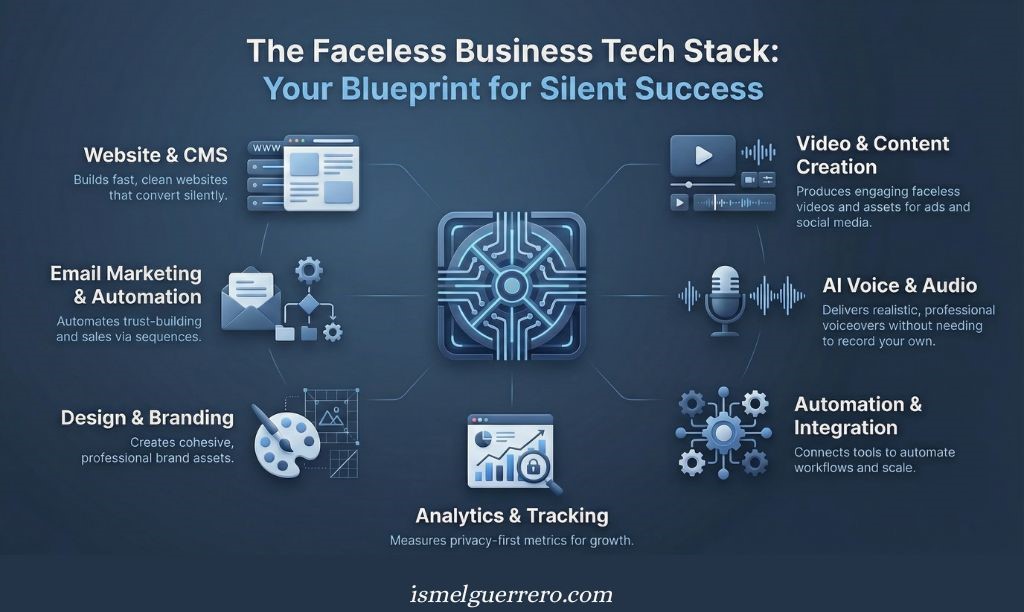
Tools for Faceless Digital Marketing
The right tools can make a faceless digital marketing system easier to manage, but the goal is not to build the largest possible tech stack.
Each tool should support a specific part of the customer journey or remove repetitive work without making the experience less useful.
Website and Content Management Tools
A website or content management system gives the brand a central place to publish information, capture leads, and present offers.
Look for a platform that supports:
- Fast, mobile-friendly pages
- Search-friendly content
- Landing pages
- Forms
- Product or service pages
- Analytics integrations
The right choice depends on whether the business is primarily content-driven, ecommerce-focused, or built around digital offers.
Email Marketing Tools
Email platforms help manage communication after someone joins the audience.
They can support:
- Welcome sequences
- Lead nurturing
- Segmentation
- Product education
- Promotions
- Customer onboarding
- Re-engagement
Automation is useful here because it allows the brand to deliver relevant communication without manually sending every message.
Design Tools
Design tools help maintain a consistent visual identity across:
- Social content
- Landing pages
- Presentations
- Lead magnets
- Thumbnails
- Product graphics
Templates can improve efficiency, but they should still reflect the brand rather than making every piece of content look generic.
Video and Audio Tools
Faceless video production may require tools for:
- Screen recording
- Video editing
- Captions
- Voiceovers
- Audio cleanup
- Animation
- Visual generation
Choose tools based on the content format rather than adding technology simply because it is available.
Automation Tools
Automation platforms can connect different parts of the marketing system.
For example, they can help:
- Move leads between tools
- Trigger follow-up emails
- Organize form submissions
- Deliver digital products
- Notify team members
- Reduce repetitive administrative work
Automate predictable tasks, not decisions that still require judgment.
Analytics and Testing Tools
Analytics help show what happens after someone interacts with the brand.
Depending on the business, useful tools may track:
- Traffic sources
- Conversions
- Landing-page performance
- User behavior
- Email engagement
- Sales
- Retention
Testing tools can also help compare different messages, layouts, or offers.
Key Insight
A strong faceless digital marketing stack is not defined by how many tools it uses.
The best setup is the one that supports the customer journey, reduces unnecessary manual work, and gives the business enough information to understand what is actually working.

What to Measure in Faceless Digital Marketing
The most useful performance signals show whether the right people are finding the brand, taking the next step, becoming customers, and continuing to receive value.
The exact metrics depend on the business model, but several areas can reveal where the digital system is working and where it may need improvement.
Traffic Quality
Traffic volume matters less when the visitors arriving have little interest in the offer.
Useful signals include:
- Where visitors come from
- Which pages or content attract them
- How long they stay
- What they do next
A smaller stream of relevant traffic can be more valuable than a much larger audience with weak intent.
Conversion Rate
Conversion rate shows how often visitors complete a meaningful action.
That action might include:
- Joining an email list
- Starting a trial
- Booking a call
- Buying a product
- Becoming a member
When traffic is strong but conversions remain weak, the problem may be the message, offer, trust signals, or customer experience.
Email Engagement
Email performance helps show whether the brand continues earning attention after the first interaction.
Relevant signals may include:
- Opens
- Clicks
- Replies
- Unsubscribes
- Purchases or other conversions
The goal is not simply to increase activity. It is to understand whether email is helping move the customer relationship forward.
Retention and Churn
For subscriptions, memberships, and recurring services, retention shows whether customers continue finding value after the initial purchase.
Churn can point to problems with:
- Expectations
- Onboarding
- Product quality
- Support
- Ongoing value
These signals help show whether the experience after conversion matches what the marketing promised.
Refunds and Support Issues
Refund requests, complaints, and repeated support questions can reveal where expectations or delivery are breaking down.
They can also highlight problems with:
- Messaging
- Product fit
- Instructions
- Onboarding
- Customer support
These are not only service issues. They are useful feedback about the entire customer journey.
Testing Results
Testing can help identify which messages, layouts, or offers perform better.
Common areas to compare include:
- Landing-page headlines
- Calls to action
- Email subject lines
- Offer positioning
- Page layouts
- Pricing presentation
Testing one meaningful variable at a time makes it easier to understand what influenced the result.
Key Insight
You do not need to track every available metric.
Focus on the signals that show whether the right audience is finding the brand, moving through the customer journey, converting, and continuing to receive value.

Common Mistakes in Faceless Digital Marketing
Faceless digital marketing becomes much harder when the business relies on tools and automation without first building a clear strategy.
Using Too Many Channels at Once
Trying to build search traffic, social media, email, video, and paid campaigns at the same time can spread attention too thin.
It is usually more effective to learn one or two channels well before expanding into additional ones.
Automating a Weak Funnel
Automation can make a customer journey more efficient, but it cannot fix an unclear offer, weak message, or poor landing page.
If the underlying process does not convert, automating it only makes the problem easier to repeat.
Creating Generic Content
Faceless content can quickly become interchangeable when it relies too heavily on templates, stock visuals, or unedited AI output.
The content still needs a clear purpose, useful information, and a recognizable point of view.
Ignoring the Customer Journey
A strong social post or article is not enough if the next step is confusing.
Make sure the path from content to landing page, email, offer, purchase, and delivery feels connected.
Every stage should answer the customer’s next question.
Choosing Tools Before Defining the Strategy
It is easy to build an expensive tech stack before knowing what the business actually needs.
Start with the customer journey first, then choose the tools required to support it.
Failing to Track Performance
Without measurement, it becomes difficult to know whether the problem is traffic, messaging, conversion, retention, or the offer itself.
Track the metrics that matter to the business so decisions are based on evidence rather than assumptions.
Overcomplicating the Offer
Faceless businesses often benefit from clarity.
If the product, pricing, delivery, or next step takes too much explanation, the customer may leave before understanding the value.
Make the offer easy to understand without requiring a founder to personally explain it.
Neglecting Support After the Sale
Automation should not make customers feel abandoned.
Clear onboarding, accessible support, and reliable follow-up are still part of the marketing experience because they influence retention, reviews, and future purchases.
Key Insight
The biggest mistake is assuming that faceless digital marketing succeeds because the founder is absent.
It succeeds when the digital system is clear enough, useful enough, and reliable enough that the customer does not need the founder to carry the experience.
Conclusion
Faceless digital marketing works when the business is built around a clear customer journey rather than a founder’s constant presence.
The channels, content, landing pages, email, automation, offers, and support systems all need to work together. When they do, the brand can attract attention, build trust, convert customers, and continue serving them without relying on one person to carry every interaction.
That does not make the model passive or effortless.
It still requires strong positioning, useful content, a clear offer, reliable infrastructure, and ongoing measurement.
The advantage is that those responsibilities can be built into the system instead of being tied to personal visibility.
A faceless digital business succeeds when the customer experience is strong enough to stand on its own.
Frequently Asked Questions
What is faceless digital marketing?
Faceless digital marketing is the use of online channels and systems to attract, convert, and serve customers without making a founder or creator the center of the marketing.
What is the difference between faceless marketing and faceless digital marketing?
Faceless marketing is the broader strategy of building a brand without relying on a visible individual. Faceless digital marketing applies that approach specifically to online channels such as search, social media, email, websites, landing pages, and digital campaigns.
Can faceless digital marketing work for beginners?
Yes. Beginners can start with a clear audience, one or two marketing channels, a simple offer, and a basic system for capturing and following up with leads.
The goal is to learn what works before adding more tools, channels, or automation.
Do you need to show your face to build trust online?
No. Trust can also come from clear messaging, useful content, proof, professional design, transparent policies, reliable delivery, and accessible customer support.
What channels work well for faceless digital marketing?
Search, social media, video, email, and paid advertising can all support a faceless strategy.
The best choice depends on where the audience is, how they discover information, and what kind of offer the business is promoting.
What can you sell with faceless digital marketing?
Faceless businesses can sell digital products, memberships, subscriptions, productized services, ecommerce products, courses, and other offers that do not depend heavily on direct access to a visible founder.
Do you need AI for faceless digital marketing?
No. AI can assist with tasks such as research, editing, content production, organization, and automation, but it is not required.
The strategy should still be built around the audience, offer, customer journey, and quality of execution.
Can faceless digital marketing be automated?
Parts of it can.
Email sequences, lead routing, product delivery, reporting, and other repeatable tasks can often be automated. Strategy, positioning, quality control, customer understanding, and important decisions still require judgment.
How do you know if faceless digital marketing is working?
Track metrics that reflect the customer journey, such as traffic quality, conversion rate, email engagement, sales, retention, churn, refunds, and support issues.
The right metrics depend on the business model.
Is faceless digital marketing passive income?
Not automatically.
A faceless digital business may reduce the need for constant personal visibility, but it still requires content, optimization, support, measurement, product improvement, and ongoing maintenance.

2 Comments
Faceless Marketing: The Strategy Taking Over the Internet - Ismel Guerrero. · May 20, 2025 at 5:14 pm
[…] For a hands-on guide to selling digital products and building faceless infrastructure, explore the full breakdown in Faceless Digital Marketing. […]
Marketing Digital: Lo Que Nadie Se Atreve a Contarte - Páginas Virales Online · June 30, 2025 at 10:27 pm
[…] Seguido: Lee este artículo acerca de Faceless Digital Marketing. […]