Choosing a platform to build your online presence can feel overwhelming, with a seemingly endless list of website builders all promising to be the best.
However, the most critical decision isn’t just about picking a builder; it’s about understanding what you truly need. Are you building a simple informational website, or are you creating a powerful e-commerce infrastructure designed from the ground up to sell products?
This distinction is the key to making the right choice. In the next five minutes, we will dissect this difference and help you decide if the Shopify store builder is the right engine for your business goals.
Key Takeaways
- Shopify is more than a website builder; it’s a complete platform for managing online sales.
- The primary decision for a new business is choosing between a basic website or a full e-commerce system.
- Shopify is ideal for businesses serious about selling products, including those with physical stores or dropshipping models.
- While platforms like Wix may offer more design freedom, Shopify excels in sales-focused features like checkout and inventory management.
- Be prepared for costs beyond the monthly plan, as premium themes and essential apps can increase your total investment.
- Shopify’s greatest strengths are its powerful sales tools and ability to scale with your business as it grows.
What Is the Shopify Website Builder, Really?
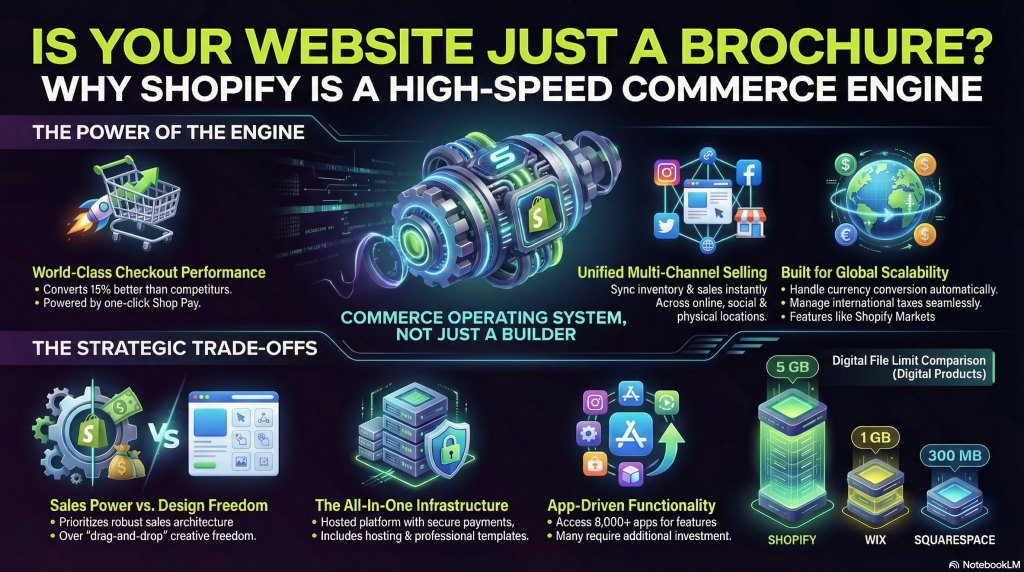
While many platforms can help you build a website, the term “Shopify website builder” is slightly misleading because the builder is just one component of a much larger, integrated system. This system is designed for a single purpose: commerce. Understanding this fundamental difference is the most important step in choosing the platform that will best serve your business in the long run.
Shopify is a hosted, all-in-one e-commerce platform. This means it provides everything you need to run an online store “out of the box,” including templates, secure payment processing, content management, and unlimited hosting. This is a crucial distinction when comparing it to general-purpose builders like Wix. While Wix is a versatile website builder that launched its e-commerce solution in 2020, Shopify was built from the ground up as a dedicated platform for online stores. Its entire architecture is optimized for selling.
Bottom line: Choosing Shopify isn’t just about designing a website; it’s about investing in a comprehensive infrastructure built to manage and scale a sales-focused business. The next crucial step is determining if your business model is the right fit for such a powerful investment.

Who Is the Shopify Store Builder For? (And Who It Isn’t For)
The platform you choose is not merely a tool; it’s a foundational strategic decision that dictates your operational capabilities and growth ceiling. Let’s identify which foundation Shopify’s or an alternative’s matches your business blueprint. This section will help you determine if you fit the profile of a typical Shopify user or if your needs would be better met by a different type of builder.
Ideal for Shopify
Shopify is built for businesses where commerce is the primary objective. The platform excels for the following user profiles:
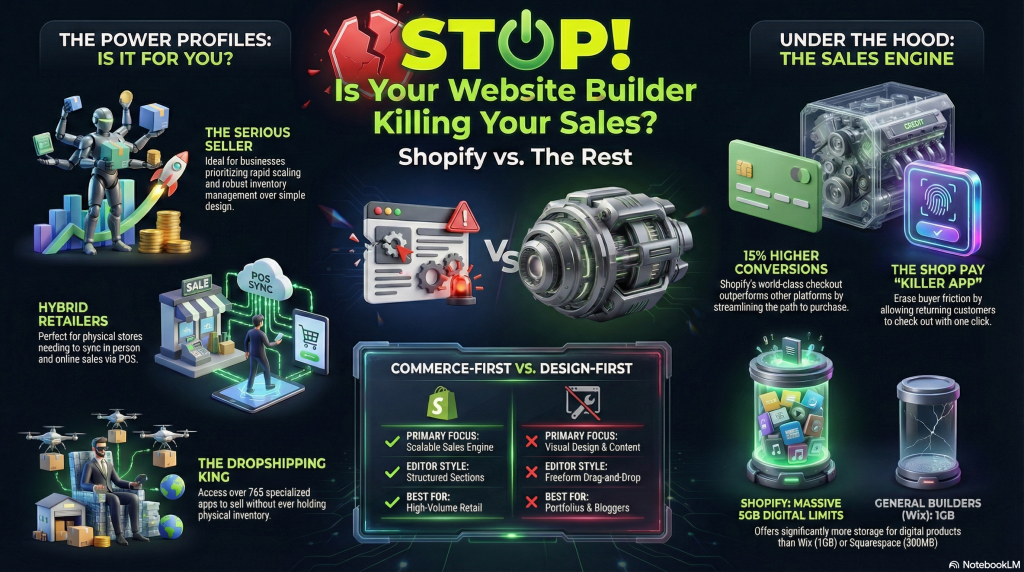
- The Serious Seller: If your main goal is to sell products online and scale your operations, Shopify is the definitive choice. Its robust inventory management, powerful sales tools, and infrastructure are designed to handle significant growth. The platform is built to support your business as it expands, ensuring you won’t outgrow its capabilities quickly.
- Brick-and-Mortar Retailers: Businesses with physical locations that want to expand online will find Shopify’s Point of Sale (POS) system to be a standout feature. It allows you to sell in person and online while keeping inventory, sales data, and customer information perfectly synchronized across both channels.
- Dropshippers and Print-on-Demand Businesses: For entrepreneurs using these models, Shopify’s massive app store is a critical advantage, with one review counting over 765 dropshipping apps and 695 for print-on-demand. It features seamless integrations with hundreds of services like Printful and Spocket, making it incredibly simple to source and sell products without holding any inventory.
Better Suited for Other Platforms
If selling products is a secondary function or not part of your plan at all, Shopify’s commerce-focused infrastructure might be more than you need. These users may find other platforms more suitable:
- Content-Creators and Bloggers: For individuals whose primary goal is publishing articles, Shopify’s blogging tools are often described as disappointing and “old fashioned.” Platforms like Wix offer stronger built-in content features, making them a better choice for a content-first strategy.
- Portfolio and Brochure Sites: Service businesses, artists, or consultants who need a simple, visually impressive website without e-commerce will find builders like Wix more aligned with their needs. Wix is frequently praised for its “drag-and-drop” editor, which offers greater creative freedom for designing custom, non-commercial pages.
- Sellers with Very Few Products: If you have a very small and simple product catalog (for example, fewer than nine items), the robust features of Shopify might be unnecessary. A simpler platform like Squarespace could provide a more straightforward and cost-effective solution for a narrow product offering.
Bottom line: Shopify is the definitive choice for commerce-first businesses. However, businesses that prioritize content creation or unique design over powerful sales features will find more value and ease of use in other builders.
How It Works: The Core Features That Power Your Sales
To understand Shopify’s value, it’s essential to look “under the hood” at the e-commerce engine that drives it. The features below are the core infrastructure that separates Shopify from basic website builders and justifies its reputation as a leading platform for online retail.
World-Class Checkout and Payments
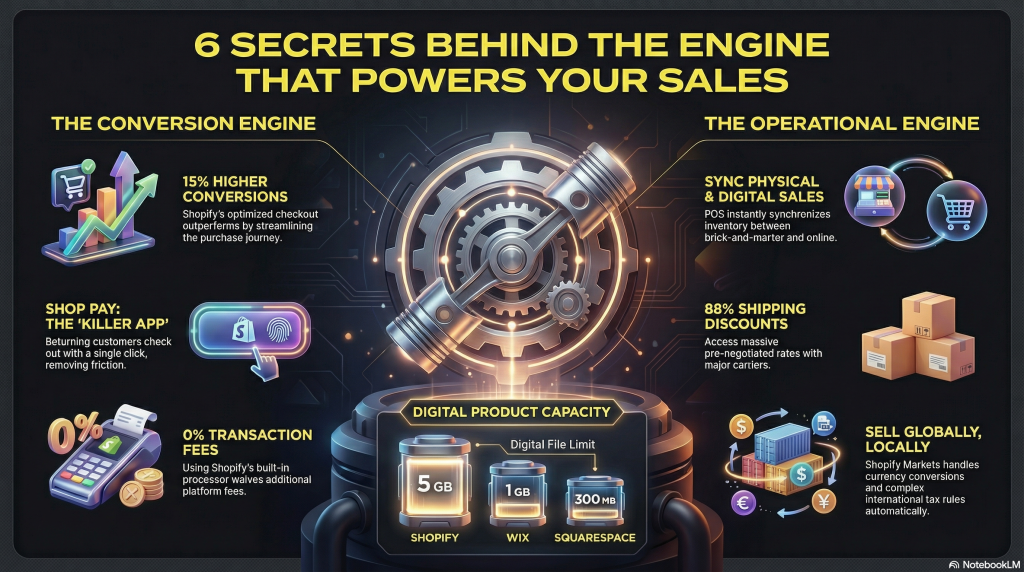
A smooth checkout is critical for converting visitors into customers, and this is where Shopify truly excels. Its checkout is optimized for conversions, performing an average of 15% better than other platforms. A key part of this is Shop Pay, which Reddit user ‘brightfff,’ a professional e-commerce site builder, calls the platform’s “killer app” for its ability to erase friction by allowing returning customers to check out with a single click.
For payments, merchants have two main options:
- Shopify Payments: Using Shopify’s built-in processor waives all of Shopify’s transaction fees, though standard credit card processing rates still apply.
- Third-Party Gateways: You can integrate one of over 100 other payment gateways (like PayPal or Stripe). However, if you choose this route, Shopify will charge an additional transaction fee on each sale, which is 2% on the Basic plan, 1% on the Grow plan, and 0.6% on the Advanced plan.
Comprehensive Product and Inventory Management
Shopify’s system is built to manage both physical and digital goods. To sell digital products like ebooks or music, you simply install the free “Digital Downloads” app. The platform offers a generous 5GB file limit for these products, which is significantly larger than competitors like Squarespace (300MB) or Wix (1GB).
However, there is one key limitation to be aware of: while you can create up to 2,048 variants of a single product, you are restricted to just three product options (e.g., Size, Color, Style). If you need more than three options for a product, you will have to use a paid third-party app to extend this functionality.
Multi-Channel Selling and Point of Sale (POS)
Shopify empowers merchants to sell wherever their customers are. This includes your online store, social media platforms like Facebook and Instagram, and marketplaces like Amazon. A particularly strong feature is its comprehensive Point of Sale (POS) system, which allows businesses with “brick and mortar” retail outlets to sell in person. The POS system seamlessly syncs online and offline sales and inventory, providing a single, unified view of your entire business.
Shipping and International Commerce
Shopify offers highly flexible shipping options. Merchants in certain countries can use “Shopify Shipping,” a service that provides significant discounts (up to 88%) with major carriers like USPS, UPS, and DHL. For businesses looking to sell globally, the “Shopify Markets” feature simplifies international commerce by automatically handling currency conversions and calculating local taxes, which is especially useful for managing EU VAT rules.
Bottom line: This integrated suite of sales tools demonstrates how Shopify is engineered to manage the entire commercial journey, from discovery to delivery. However, this commerce-first focus comes with specific trade-offs, particularly in design and cost, when compared to more versatile builders.
The Real-World Trade-Offs: Shopify vs. Other Builders
No platform is perfect for every business, and Shopify’s intense focus on e-commerce power comes with specific trade-offs. These become most apparent when comparing it to a versatile, design-focused builder like Wix.
Shopify vs Wix: Design, Features, and Cost
This section breaks down the key differences in design flexibility, features, and cost to help you make a balanced decision.
| Feature | Shopify | Wix |
|---|---|---|
| Primary Focus | A dedicated e-commerce platform built for selling and scaling. | A versatile website builder with added e-commerce capabilities. |
| Design & Ease of Use | More restrictive “section-based” editor. Less intuitive for custom page design. Harder to change themes. | Praised for its true “drag-and-drop” editor, offering more creative freedom for beginners. |
| Templates | Fewer free themes (24), but professionally designed for stores. Premium themes cost 100–500. | Over 2,000 templates total, with 500+ e-commerce-specific options included. |
| Core Strength | Advanced sales tools, inventory management, POS, multi-channel selling, and scalability. | All-in-one simplicity, user-friendly design tools, and strong built-in content features like blogging. |
| Pricing & Fees | Generally more expensive. Plans start at $29/mo, with rising costs from apps and staff limits. | More affordable e-commerce plans starting at $29/mo, with fewer add-on costs for core features. |
| App Ecosystem | Massive app store (8,000+), but reliance on paid apps for many functions. | Smaller app market, with more functionality built directly into the platform. |
Bottom line: The “best” platform depends entirely on your business priorities. If your primary goal is to build a powerful, scalable online store, Shopify’s trade-offs are well worth it. However, if your business needs a visually unique, content-rich website where e-commerce is just one component, Wix is the more practical and user-friendly choice.
Practical Limitations and Common Misalignment Risks
Shopify’s strengths are well-documented, but understanding where friction appears in real-world use is just as important as knowing what the platform does well.
Most dissatisfaction with Shopify does not come from poor performance, but from choosing it for the wrong type of business or underestimating how its structure affects long-term decisions.
Design Constraints in a Commerce-First Editor
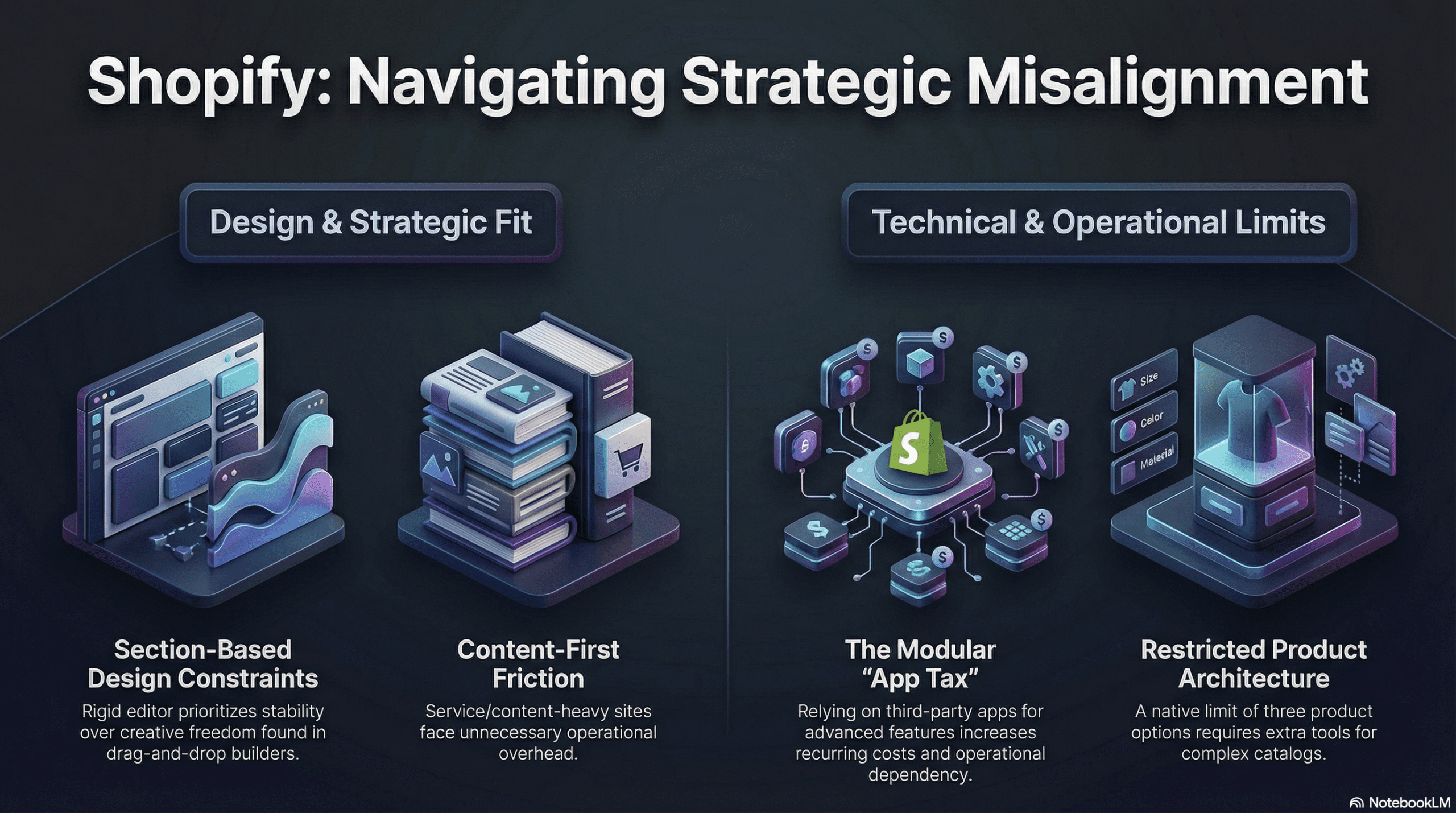
Shopify’s section-based editor is intentionally restrictive. This supports consistency, performance, and theme stability across stores, but it limits how freely pages can be structured compared to true drag-and-drop builders.
For commerce-first businesses, this trade-off is rarely an issue. Product pages, collections, and checkout flows benefit from predictable layouts. However, brands that rely heavily on custom page structures, editorial storytelling, or visually complex layouts may find the system constraining as content needs evolve.
Reliance on Apps for Extended Functionality
Shopify keeps its core platform narrowly focused on selling. As a result, many advanced capabilities such as subscriptions, complex product options, backups, or detailed reporting are handled through third-party apps.
This modular ecosystem is powerful, but it introduces two considerations: recurring costs and operational dependency. Over time, app subscriptions often become a meaningful part of the monthly budget, and store functionality becomes tied to multiple external providers rather than a single system.
Product Structure and Configuration Limits
Shopify is well suited for large catalogs and high transaction volumes, but its native product architecture favors standard configurations. The built-in limit of three product options is sufficient for many stores, yet businesses with highly customized or configurable products frequently rely on additional tools to bridge this gap.
This does not make Shopify unsuitable, but it does require planning. Stores with complex product logic should expect added setup and ongoing maintenance to support their catalog structure.
Misalignment for Content-First or Service-Based Businesses
Strategic friction often appears when Shopify is used in contexts where commerce is secondary. Content-heavy publications, education platforms, or service-based businesses that sell occasionally may find that Shopify’s infrastructure adds overhead without delivering proportional value.
In these cases, the platform’s strengths inventory systems, checkout optimization, sales tooling can become inefficiencies rather than advantages, especially when compared to more flexible content-oriented builders.
Bottom line: Shopify performs best when selling is the organizing principle of the business. Most limitations arise not from technical shortcomings, but from misalignment between what the platform is optimized to do and how the business actually operates.
Conclusion
Ultimately, selecting a platform is a strategic business decision, not just a design choice. The central argument is clear: the right tool depends on whether you need a website or an e-commerce operating system.
Shopify is unequivocally the latter a comprehensive, powerful infrastructure engineered to manage every aspect of online and in-person selling. In contrast, builders like Wix are designed to create a beautiful and functional online presence, with e-commerce serving as one of many available features.
To make the right decision, assess your core business model and long-term ambitions. Choose the tool that best aligns with your goal to either run a simple website or operate a full-fledged retail business.
Frequently Asked Questions
Is the Shopify website builder good for complete beginners?
Shopify is considered easy to use for day-to-day store management like adding products and fulfilling orders. However, its section-based editor has a steeper learning curve for design customization compared to the true drag-and-drop experience offered by platforms like Wix.
How much does Shopify really cost per month?
While the base plan starts at 29 per month, the true cost is often higher. You should budget for additional expenses such as premium themes (100-$500), transaction fees (if you don’t use Shopify Payments), and paid apps required for extra functionality like advanced product options or backups.
Can I sell digital products like ebooks or music on Shopify?
Yes, you can sell digital products by installing Shopify’s free “Digital Downloads” app. The platform offers a generous 5GB file size limit for each digital product, which is significantly larger than many competitors.
What’s the main difference between using Shopify and Wix for a store?
Shopify is a dedicated e-commerce platform built from the ground up for robust selling, inventory management, and scaling. Wix is a versatile website builder with strong design tools that has added e-commerce features, making it better suited for simpler stores or content-focused sites where commerce is not the sole priority.
Do I have to use Shopify Payments?
No, you are not required to use Shopify Payments. The platform supports over 100 third-party payment gateways. However, if you choose an external gateway, Shopify will charge an additional transaction fee on top of the fees from your chosen payment processor. Using Shopify Payments waives this extra fee.
Is Shopify good for a business with a physical store?
Yes, Shopify is an excellent choice for businesses with a physical presence. Its comprehensive Point of Sale (POS) system allows you to sell products in person while keeping your online and offline inventory, sales data, and customer information perfectly synchronized.

0 Comments