Introduction
Most product pages include written reviews. Few use them to their full potential.
Today, attention favors video. When potential customers see and hear a real person describe their experience, trust builds faster. A face, a voice, and a natural explanation reduce uncertainty in ways text alone cannot.
That is where UGC video testimonials stand out.
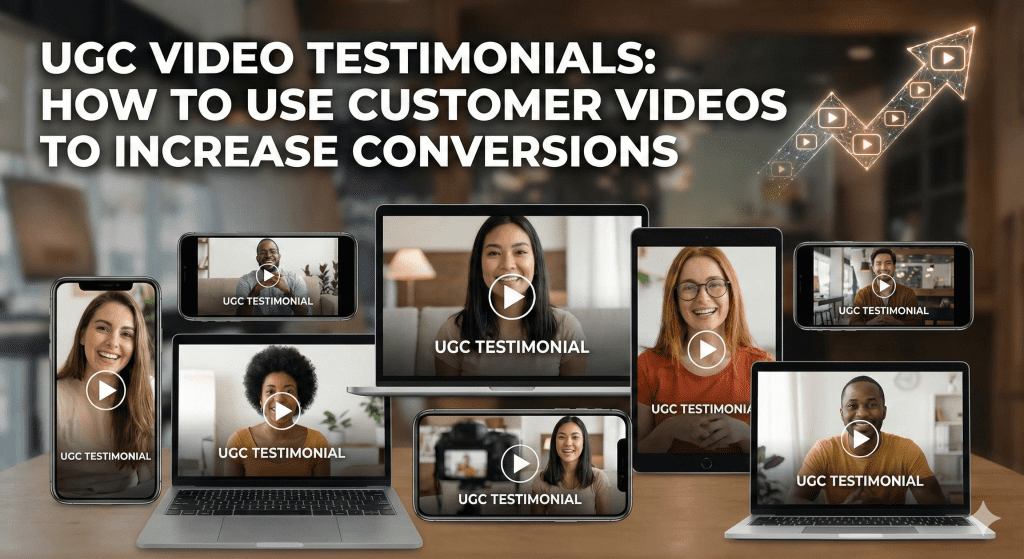
A UGC video testimonial is a short, customer-recorded video sharing a genuine experience with a product or service. It is not a studio production. It is not a scripted advertisement. It is a real person explaining what problem they had, how the product helped, and what changed as a result.
For small businesses and entrepreneurs, these videos can become one of the most powerful conversion assets available. They combine authenticity, social proof, and native content style in a format that audiences already trust.
In this guide, you’ll learn why UGC video testimonials convert so effectively, how to structure them properly, how to collect them, and where to use them for maximum impact.
Key Takeaways
- A UGC video testimonial is a customer-recorded video that shares a real experience with a product or service in a natural, unscripted way.
- Video testimonials convert better than text reviews because they combine facial expression, tone of voice, and visible proof.
- High-performing testimonials follow a simple structure: problem, discovery, experience, result, and recommendation.
- Small businesses can collect video testimonials through post-purchase emails, incentives, and clear, simple submission instructions.
- Placement matters. UGC video testimonials work best on product pages, landing pages, paid ads, and email campaigns.
- Over-scripting, heavy editing, or using inauthentic testimonials can reduce credibility and hurt performance.
Disclaimer: I am an independent Affiliate. The opinions expressed here are my own and are not official statements. If you follow a link and make a purchase, I may earn a commission.
What Is a UGC Video Testimonial?
A UGC video testimonial is a short video recorded by a real customer sharing their experience with a product or service in their own words.
The key distinction is authorship and tone.
It is created by the user, not by the business. It reflects a personal experience, not a corporate script. The production is usually simple. A phone camera, natural lighting, and conversational delivery are enough.
This simplicity is not a weakness. It is the advantage.
How It Differs From Traditional Testimonials
Traditional testimonials often look like this:
- Professionally filmed
- Scripted responses
- Controlled lighting and editing
- Formal tone
While these can still work, they often feel promotional.
A UGC video testimonial typically looks like:
- Self-recorded
- Conversational
- Lightly edited or unedited
- Casual but clear
It feels closer to a recommendation from a friend than a marketing message.
What Makes It “UGC”?
Three elements define it:
- A real person
- A real experience
- A personal voice
Compensation does not automatically disqualify it. Even if a customer receives an incentive, the content qualifies as UGC when the perspective remains authentic and personal.
Why It Matters for Small Businesses
Small businesses often lack massive advertising budgets. UGC video testimonials level the field.
They:
- Build credibility quickly
- Reduce buyer hesitation
- Humanize your offer
- Provide reusable content across channels
Instead of telling potential customers that your product works, you show them someone who experienced it.
That shift from claim to proof is what makes UGC video testimonials so powerful.
Why UGC Video Testimonials Convert Better Than Text Reviews
Written reviews still matter. But video changes how people process trust.
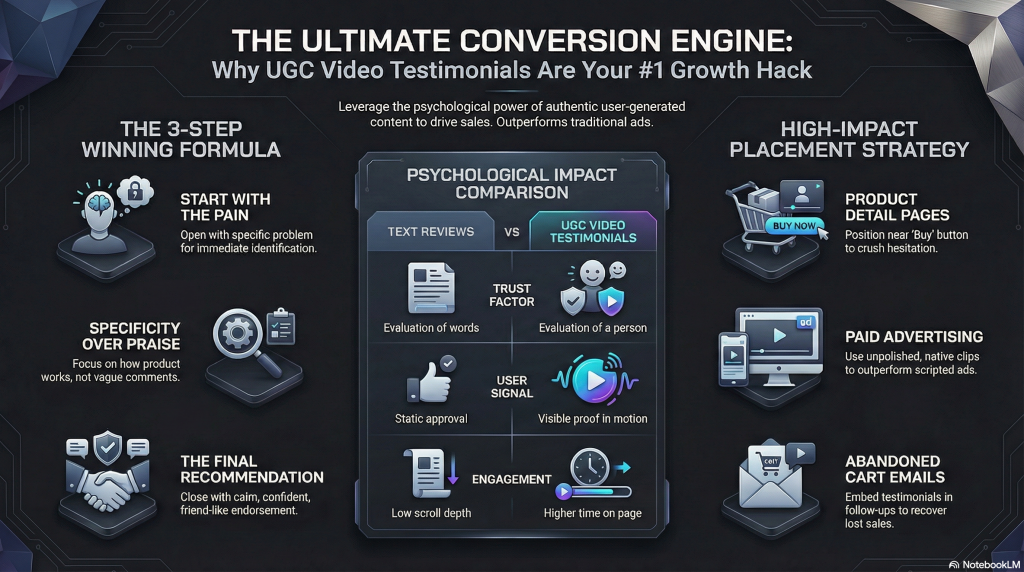
When someone reads a review, they evaluate words. When someone watches a video testimonial, they evaluate a person.
That difference impacts conversion.
1. Face and Voice Increase Credibility
Humans are wired to read facial expressions and vocal tone. Subtle cues such as hesitation, enthusiasm, and confidence signal authenticity.
In video testimonials, viewers can:
- See emotion
- Hear conviction
- Detect sincerity
These signals reduce skepticism faster than text alone.
2. They Reduce Buyer Uncertainty
Every purchase carries risk.
Will it work?
Will it fit my situation?
Will it deliver the promised result?
A strong UGC video testimonial addresses those doubts naturally. When a real customer explains:
- The problem they had
- What they tried before
- What changed after using the product
It answers objections without sounding defensive.
That reduces friction in the decision process.
3. They Feel Native to Modern Platforms
Short-form video dominates attention online. Audiences are used to:
- TikTok-style clips
- Instagram Reels
- YouTube Shorts
- Casual selfie videos
A UGC testimonial fits seamlessly into this environment. It does not feel like a commercial interruption. It feels like content.
When content feels native, resistance drops.
4. They Increase Time on Page
Video keeps people engaged longer than text in most cases.
When placed on:
- Product pages
- Sales pages
- Landing pages
UGC testimonials can increase:
- Time on page
- Engagement
- Scroll depth
Longer engagement often correlates with higher conversion probability.
5. They Create Social Proof in Motion
Text reviews show approval. Video testimonials demonstrate it.
Seeing someone physically use a product, explain the outcome, or show before-and-after results turns abstract claims into visible proof.
Movement, voice, and context create stronger psychological impact than static words.
The Conversion Advantage in Simple Terms
Text says: “This works.”
Video shows: “This worked for me.”
That shift from statement to demonstration is what makes UGC video testimonials one of the most powerful conversion tools available to small businesses.
The Structure of a High-Converting UGC Video Testimonial
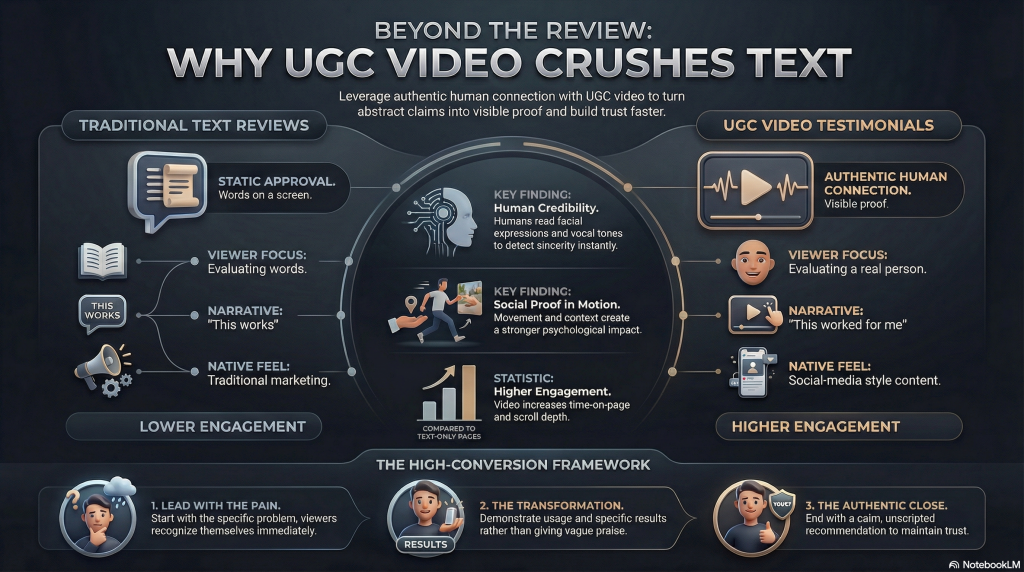
A random video saying, “I love this product” rarely moves the needle. High-performing UGC video testimonials follow a clear structure that guides the viewer from doubt to decision.
Here is a simple framework that works consistently.
1. The Problem
Start with the pain point.
The viewer should immediately recognize themselves in the situation. The first few seconds matter most.
Strong openings include:
- “I struggled with…”
- “I was frustrated because…”
- “Nothing seemed to work for…”
This creates identification. When the viewer thinks, “That’s me,” attention increases.
Avoid long introductions or greetings. Lead with the problem.
2. The Discovery
Next, explain how the product entered the picture.
This can include:
- How they found it
- Why they decided to try it
- What made them curious
Keep it natural. The goal is not to sell aggressively. It is to show a believable transition from problem to solution.
3. The Experience
Now demonstrate usage.
This is where credibility builds. The customer can:
- Show the product
- Describe how they used it
- Mention specific features
- Share what stood out
Specific details increase trust. Vague praise weakens impact.
Instead of saying, “It’s amazing,” say, “It absorbed quickly and didn’t leave my skin greasy.”
Specificity converts.
4. The Result
This is the turning point.
The testimonial should clearly answer:
What changed?
Results can be:
- Measurable outcomes
- Time saved
- Increased confidence
- Reduced stress
- Visible transformation
Clarity matters. The viewer must see the benefit.
5. The Recommendation
Close with a simple endorsement.
This does not need to be dramatic.
Examples:
- “I definitely recommend trying it.”
- “If you’ve been dealing with the same issue, this helped me.”
- “It’s worth checking out.”
A calm, confident recommendation feels more authentic than exaggerated enthusiasm.
Ideal Length
For most placements, 30 to 60 seconds performs best.
Long enough to establish credibility. Short enough to hold attention.
Why This Structure Works
It mirrors how people naturally tell stories:
Problem → Attempt → Solution → Outcome.
When your UGC video testimonials follow this structure, they stop being random praise and start functioning as conversion tools.

How to Collect UGC Video Testimonials (Without Making It Complicated)
Many small businesses assume collecting video testimonials is difficult. It is not. The biggest mistake is overcomplicating the process.
You do not need a studio. You do not need production crews. You need clarity, simplicity, and timing.
Here is how to do it effectively.
1. Ask at the Right Time
Timing determines response rate.
The best moments to request a video testimonial are:
- After a positive review is submitted
- After a customer support success
- After a visible result or milestone
- Shortly after delivery when satisfaction is high
Do not wait months. Momentum matters.
2. Start With Your Happiest Customers
Not every customer will record a video. Focus on those who already show satisfaction.
Look for:
- Five-star reviewers
- Repeat buyers
- Engaged email subscribers
- Customers who send thank-you messages
These people are far more likely to participate.
3. Give Simple Instructions
Most people hesitate because they do not know what to say.
Remove uncertainty by providing a short outline:
- What problem were you facing?
- How did you find the product?
- What changed after using it?
- Would you recommend it?
Keep instructions short. Avoid sending long scripts.
Clarity increases submissions.
4. Lower the Production Barrier
Tell customers explicitly:
- Use your phone
- Keep it under 60 seconds
- Record in natural light
- Speak naturally
When people think they need professional quality, they delay or decline. Make it feel easy.
5. Offer a Small Incentive
Incentives can increase participation.
Examples include:
- Discount codes
- Store credit
- Giveaway entries
- Small gift cards
The incentive does not need to be large. It simply signals appreciation.
Transparency matters if incentives are involved.
6. Secure Permission Clearly
Before using any testimonial publicly, secure usage rights.
This can be done through:
- A simple written agreement
- Clear email confirmation
- A submission form with consent language
Clarify where the video may be used, such as ads, website, or social media.
This protects your business and respects the customer.
7. Make Submission Easy
Avoid friction.
Allow customers to:
- Upload via a simple form
- Send via email
- Submit through a direct message
- Use a file-sharing link
The fewer steps required, the higher the completion rate.
Keep the Process Repeatable
Collecting testimonials should not be random.
Create a small system:
- Trigger email after purchase
- Follow up after positive feedback
- Store submissions in one organized location
When testimonial collection becomes part of your workflow, social proof grows consistently over time.
Where to Use UGC Video Testimonials for Maximum Conversion Impact
A strong testimonial is valuable. A strategically placed testimonial is powerful.
Placement determines how much influence your UGC video testimonial actually has. For small businesses and entrepreneurs, the goal is simple: reduce hesitation at key decision points.
Here is where they make the biggest difference.
1. Product Detail Pages
This is one of the highest-impact placements.
When someone visits a product page, they are already considering buying. A well-placed video testimonial can:
- Address objections
- Show real usage
- Reinforce benefits
- Increase time on page
Place the video:
- Near the purchase button
- Under the product description
- Within the reviews section
The testimonial should support the buying decision, not distract from it.
2. Sales and Landing Pages
Landing pages often rely heavily on written copy. Video testimonials break that pattern and add human proof.
Use them:
- After presenting the core offer
- Before pricing sections
- Near calls to action
This placement reinforces the message right before the visitor decides.
When a viewer sees someone else succeed, perceived risk decreases.
3. Paid Advertising
UGC video testimonials perform well in paid ads because they feel native.
Instead of polished commercials, use:
- Short problem-solution clips
- Real customer reactions
- Snippets from longer testimonials
These often outperform studio-style ads because they blend into the feed.
For small businesses with limited ad budgets, this format can improve efficiency.
4. Email Campaigns
Testimonials work well in:
- Post-purchase nurture sequences
- Abandoned cart emails
- Promotional launches
- Re-engagement campaigns
Embedding a short testimonial inside an email adds credibility without overwhelming the reader.
It reinforces that others have already benefited.
5. Social Proof Sections
Create a dedicated testimonial section on your website.
This may include:
- A grid of short clips
- Before-and-after videos
- Highlighted success stories
A collection of testimonials builds cumulative trust. One video is persuasive. Multiple consistent experiences are convincing.
6. Retargeting Campaigns
Visitors who viewed your product but did not purchase often need reassurance.
Using testimonial videos in retargeting ads reminds them:
- Others have tried it
- Others have succeeded
- Their hesitation is normal
Retargeting combined with social proof is especially effective.
The Placement Principle
UGC video testimonials work best where doubt exists.
Place them:
- Near decisions
- Near pricing
- Near calls to action
They should answer the question the customer is silently asking: “Will this actually work for someone like me?”
When positioned strategically, testimonials move from decoration to conversion tools.

Common Mistakes to Avoid With UGC Video Testimonials
UGC video testimonials are powerful, but small execution mistakes can reduce their impact or damage credibility.
For small businesses and entrepreneurs, avoiding these errors is just as important as collecting the testimonials themselves.
1. Over-Scripting the Customer
Providing structure is helpful. Writing a full script is not.
When customers sound rehearsed or corporate, the testimonial loses authenticity. Audiences quickly detect unnatural delivery.
Instead of giving a script, provide prompts:
- What problem were you facing?
- What changed after using the product?
Let them answer in their own words.
Natural beats polished.
2. Over-Editing the Video
Heavy editing, cinematic transitions, dramatic music, or aggressive text overlays can make the testimonial feel like an ad.
Keep editing minimal:
- Trim unnecessary pauses
- Improve audio clarity
- Adjust brightness if needed
The goal is clarity, not production spectacle.
3. Using Vague Praise
Statements like:
- “It’s amazing.”
- “I love it.”
- “Best product ever.”
Do not convert well on their own.
Strong testimonials include specifics:
- What improved
- How long it took
- What made it different
Specificity builds trust. General enthusiasm does not.
4. Placing Testimonials Too Late
If testimonials appear only at the very bottom of a page, many visitors will never see them.
Place video testimonials:
- Near pricing
- Near the purchase button
- After benefit sections
- Inside retargeting ads
Placement directly affects performance.
5. Ignoring Audio Quality
People tolerate imperfect video. They do not tolerate poor audio.
If the voice is hard to understand, viewers scroll away.
Encourage customers to:
- Record in a quiet space
- Speak clearly
- Avoid background noise
Clear sound increases perceived professionalism immediately.
6. Skipping Legal Permission
Using a customer’s video without explicit permission creates risk.
Always confirm:
- Where the video will be used
- How long it will be used
- Whether it will appear in ads
Clear consent protects both parties.
7. Using Fake or Staged Testimonials
Fabricated testimonials may produce short-term gains. They destroy long-term trust.
Modern audiences are skeptical. If credibility breaks, it is difficult to recover.
Authenticity is the foundation of UGC. Compromising it defeats the purpose.
The Pattern Behind These Mistakes
Most mistakes happen when businesses try to control the testimonial too tightly.
UGC video testimonials work because they feel real. When you force them into a traditional advertising mold, you remove their advantage.
Keep them:
- Structured
- Clear
- Authentic
- Strategically placed
When done correctly, they become one of the highest-leverage conversion tools available to small businesses.
Conclusion
UGC video testimonials are not just social proof. They are conversion assets.
When a real customer explains a real experience in their own words, hesitation drops. Buyers see themselves in the story. Doubt becomes reassurance. Claims become proof.
For small businesses and entrepreneurs, this matters.
You do not need expensive production. You do not need complex funnels. You need:
- Clear structure
- Strategic placement
- Simple collection systems
- Authentic voices
A strong UGC video testimonial follows a simple path: problem, discovery, experience, result, recommendation. When placed near decision points, it reduces friction and increases confidence.
The goal is not perfection. The goal is credibility.
When used intentionally, UGC video testimonials can outperform polished ads because they feel real. And in today’s attention economy, real converts.

Frequently Asked Questions
How long should a UGC video testimonial be?
For most placements, 30 to 60 seconds works best. It should be long enough to explain the problem and result clearly but short enough to hold attention.
Do customers need professional equipment?
No. A smartphone, natural lighting, and clear audio are enough. Authenticity and clarity matter more than production value.
Can I use video testimonials in paid ads?
Yes, if you have proper usage permission. Many small businesses use testimonial clips in social media ads, retargeting campaigns, and landing pages.
Should I offer incentives for video testimonials?
Incentives are allowed and often helpful. Discount codes, store credit, or small rewards can increase participation. Transparency is important if incentives are involved.
How do I get legal permission to use a testimonial?
Use a simple written agreement or consent form that explains where and how the video will be used. Email confirmation with clear terms can also work for small businesses.
What makes a testimonial feel authentic?
Specific details, natural delivery, and visible experience with the product increase credibility. Avoid heavy scripting or exaggerated claims.
How many testimonials should I use?
One strong testimonial can help. Multiple consistent testimonials build stronger cumulative trust. A collection increases overall impact.

0 Comments