UGC video testimonials give potential customers something a written review cannot provide in the same way: the ability to see and hear a customer describe their experience.
That additional context can be useful when someone is evaluating a product or service. A video may show the product in use, explain a specific problem, demonstrate an outcome, or answer questions that a short written review leaves open.
The important part is authenticity.
A genuine UGC video testimonial reflects a customer’s actual experience. It should not turn into a scripted advertisement disguised as an ordinary customer recommendation. Paid or incentivized testimonials also introduce disclosure and advertising considerations that businesses need to understand.
This guide explains what UGC video testimonials are, what video can add beyond written reviews, how to structure and collect useful customer stories, where to use them, and how to avoid legal and credibility problems.
- A UGC video testimonial is a customer-created video describing a genuine experience with a product or service.
- Video can add facial expression, voice, product demonstrations, and additional context that written reviews cannot communicate in the same format.
- A useful testimonial usually focuses on a specific problem, experience, detail, or outcome rather than broad praise.
- Businesses can guide customers with prompts without writing the customer’s opinion for them.
- Incentives should not be conditioned on positive sentiment, and material relationships may need to be disclosed.
- Permission should clarify where the business can use the video, particularly when paid advertising is involved.
- Testimonials cannot make unsupported product claims simply because a real customer said them.
- The best placement depends on what question or uncertainty the testimonial helps address.
Disclaimer: I am an independent Affiliate. The opinions expressed here are my own and are not official statements. If you follow a link and make a purchase, I may earn a commission.

What Is a UGC Video Testimonial?
A UGC video testimonial is a video in which a customer describes their genuine experience with a product or service.
The customer might explain what they purchased, why they chose it, how they used it, what stood out, or what happened afterward.
Production can be simple.
Many testimonials are recorded with a smartphone, natural lighting, and ordinary surroundings. Professional production is not what determines whether the testimonial is useful.
The experience behind it matters more.
A convincing testimonial should represent what the person actually thinks and experienced.
Customer Testimonials and Paid UGC-Style Content Are Not the Same
The term UGC is sometimes used loosely enough to include almost any casual-looking creator video.
That can create confusion.
A genuine customer testimonial comes from someone who has actually used the product or service and is describing that experience.
Paid UGC-style content is commissioned from a creator as marketing material. The creator might demonstrate a product, explain features, film lifestyle footage, or deliver an advertising script.
Those roles can overlap when the paid creator genuinely uses the product.
Problems begin when a creator is presented as a satisfied customer despite never having the experience described in the testimonial.
The FTC’s Consumer Reviews and Testimonials Rule guidance makes clear that businesses cannot use testimonials that misrepresent whether the person actually used the product or misrepresent that person’s experience.
For this article, UGC video testimonial means a testimonial grounded in a real customer or user’s experience.
How UGC Video Testimonials Differ From Traditional Testimonial Production
UGC video testimonials are often simpler than professionally produced customer stories.
A traditional filmed testimonial might involve:
- Professional cameras
- Studio lighting
- Interviews
- Multiple camera angles
- Extensive editing
- A planned production schedule
A UGC-style testimonial might involve:
- A smartphone
- A customer filming themselves
- Natural surroundings
- Conversational delivery
- Light editing
Neither format is automatically better.
Professional production may be appropriate for a detailed customer case study, corporate website, or complex service.
A simpler customer-recorded video may fit naturally on a product page or social channel.
Choose the format according to the message, customer, and placement rather than assuming casual production always performs better.
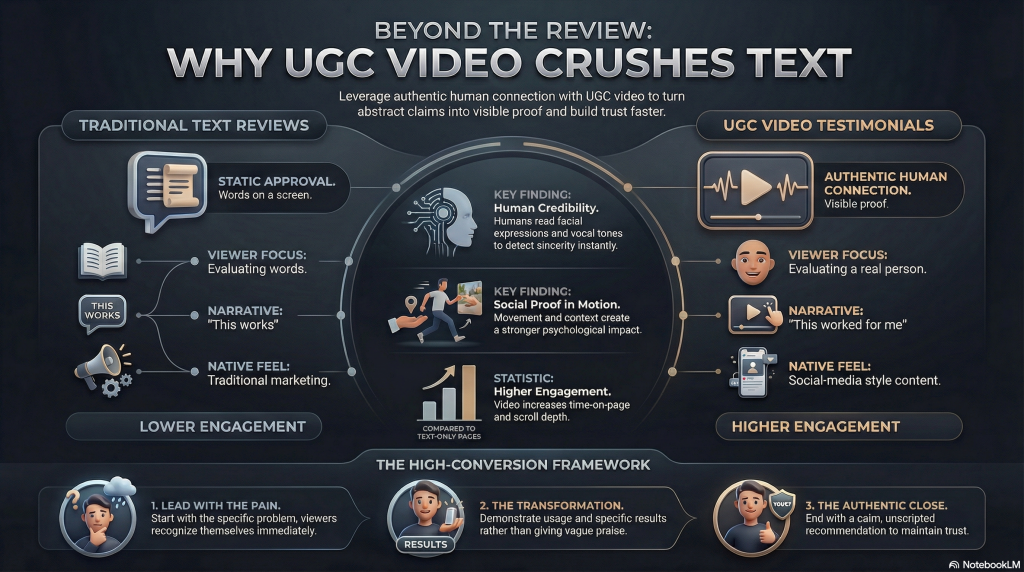
What Video Testimonials Add Beyond Written Reviews
Written reviews remain useful.
A short review can communicate satisfaction quickly, and a large collection of written feedback can show patterns across many customers.
Video provides different information.
The strongest reason to use both formats is not that one universally converts better. Each helps the buyer evaluate the experience in a different way.
Customers Can Explain Their Experience in More Detail
A star rating says very little by itself.
Even a short written review may leave important questions unanswered.
Video gives customers room to explain:
- What problem they were trying to solve
- Why they selected the product
- How they used it
- What surprised them
- Which feature mattered most
- What limitation they encountered
- What changed afterward
Specific experiences are generally more informative than generic praise.
Compare:
“Great product. Highly recommended.”
with a customer explaining exactly how they use the product and which part solved their problem.
The second gives the buyer more information to evaluate.
Video Can Show the Product in Use
Some products benefit from demonstration.
A customer might show:
- How a kitchen tool works
- How clothing fits
- How furniture looks in a normal room
- How a software workflow functions
- How a beauty product is applied
- How quickly a product can be assembled
The viewer receives information through both explanation and demonstration.
That can make video particularly useful when appearance, setup, process, or usability matters.
Voice and Expression Add Context
Written language removes vocal tone and facial expression.
Video restores those elements.
A customer can explain why something mattered to them, emphasize a particular frustration, or describe an experience with more nuance than a star rating allows.
Those cues do not prove that the customer is truthful.
They simply give the viewer more information.
The testimonial still needs to be evaluated alongside the product claims, other reviews, and the customer’s individual circumstances.
Customer Stories Can Address Specific Questions
A good testimonial does not need to convince everyone.
It can answer one important question.
For example:
- Was setup difficult?
- Did the product work for a beginner?
- How large is it in real life?
- What does the software look like during daily use?
- What happened after switching from another solution?
- How responsive was customer support?
A collection of focused testimonials can cover several questions without asking one customer to explain everything.
Video Can Be Used Across Multiple Channels
With appropriate permission, the same customer story may be useful in several places.
Potential uses include:
- Product pages
- Landing pages
- Social media
- Email campaigns
- Advertising
- Case-study pages
- Sales materials
The business should secure the necessary usage permission before assuming a customer submission can be reused everywhere.
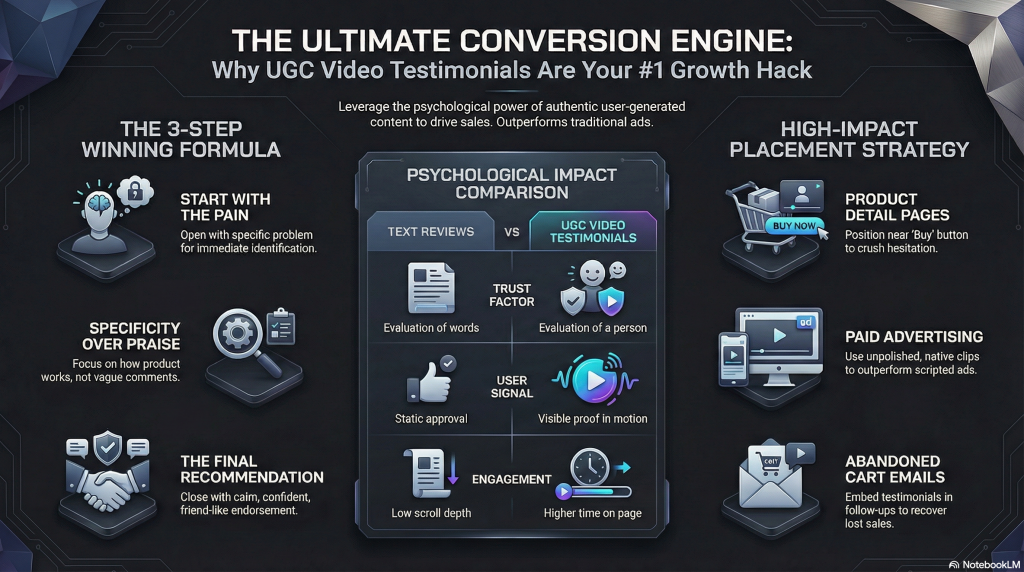
What Makes a Useful UGC Video Testimonial?
A testimonial does not need a rigid script.
Structure still helps.
Without direction, customers may produce several minutes of broad praise without explaining anything another buyer would find useful.
The goal is to give the customer prompts that help organize their real experience.
Start With the Situation or Problem
Context helps viewers understand whether the experience is relevant to them.
A customer might explain:
- What they were trying to do
- What was frustrating
- What they had already tried
- Why the issue mattered
The opening does not need manufactured drama.
A specific situation is enough.
For example:
“I manage five client projects at once, and I kept losing track of which invoices were overdue.”
That tells the viewer much more than:
“You need this product.”
Explain Why the Customer Chose the Product
The next useful question is what led to the purchase.
A customer may mention:
- A recommendation
- A feature they needed
- An alternative they considered
- A previous solution that was not working
- A specific reason the product stood out
This part establishes how the product entered the customer’s decision process.
Not every testimonial needs it.
Include it when the information helps another buyer understand the choice.
Describe the Actual Experience
Specific details make the testimonial useful.
Instead of asking customers to say whether the product was “amazing,” encourage them to describe what happened.
They might discuss:
- A feature they used
- The setup process
- How often they use the product
- Something that was easier than expected
- A limitation they noticed
- How the experience compared with their previous method
The business can prompt for detail without telling the customer what opinion to express.
Keep Results in Context
Results can make a testimonial more informative, but they also create greater responsibility.
A customer might discuss time saved, improved organization, increased convenience, or another outcome they genuinely experienced.
More consequential claims require greater care.
Health outcomes, weight loss, income, financial returns, business growth, and dramatic transformations can communicate objective advertising claims. A business cannot avoid substantiation requirements simply by putting those claims in a customer’s mouth.
The FTC’s Endorsement Guides explain that endorsements must reflect honest experience and cannot communicate claims the advertiser could not substantiate directly. The guidance also addresses testimonials featuring exceptional results and what consumers can generally expect.
Review significant result claims before publishing them.
Let the Recommendation Be Genuine
A testimonial does not always need a direct recommendation.
Sometimes the customer’s experience is enough.
When an endorsement is included, it should reflect what that person actually thinks.
Avoid requiring phrases such as:
- “This is the best product ever.”
- “Everyone needs this.”
- “I guarantee this will work.”
- “You won’t regret buying it.”
A calm, specific customer experience is usually more informative than exaggerated language.
Match the Length to the Message
There is no universal ideal length for a video testimonial.
A simple product experience might take 20 or 30 seconds to explain.
A detailed B2B customer story may need several minutes.
Choose the length according to:
- Placement
- Complexity
- Customer story
- Number of points being covered
- How the video will be edited or repurposed
Do not force every testimonial into a 30-to-60-second rule simply because short-form video is popular.

How to Collect UGC Video Testimonials
The easier the process is to understand, the easier it becomes for customers to decide whether they want to participate.
A repeatable system also helps businesses collect testimonials consistently instead of remembering to ask only occasionally.
Ask After a Meaningful Customer Experience
Timing should follow the experience rather than an arbitrary number of days.
Useful moments can include:
- After a customer leaves detailed positive feedback
- After successful onboarding
- After a support issue is resolved
- After a repeat purchase
- After the customer reaches a relevant milestone
- After someone voluntarily shares a detailed experience
Avoid asking someone to describe results before they have had enough time to evaluate the product.
Look for Customers With Something Specific to Say
The best candidates are not simply the people most likely to praise the company.
Look for customers who can explain a real experience.
They might have:
- Submitted a detailed review
- Shared useful product feedback
- Explained a specific use case
- Compared the product with another option
- Asked thoughtful questions
- Used the product over a meaningful period
A specific story gives the testimonial substance.
Use Prompts Instead of Scripts
Most customers need some direction.
Give them a few questions rather than a finished speech.
Useful prompts include:
- What problem were you trying to solve?
- What made you choose this product?
- How have you used it?
- What stood out during the experience?
- What changed for you?
- Who do you think the product would suit?
They do not need to answer every question.
Prompts provide structure while leaving the opinion with the customer.
Make Recording Simple
Do not create unnecessary production requirements.
For many customer testimonials, a smartphone can be enough.
Ask for basics such as:
- Clear audio
- Adequate lighting
- Stable framing
- A quiet environment
- The product in view when relevant
Give technical requirements only when they matter to how the video will be used.
Handle Incentives Carefully
Businesses can offer incentives for customer feedback in some circumstances, but the incentive should not depend on the person giving a positive opinion.
For example, offering a gift card only to customers who submit a five-star testimonial creates a very different arrangement from offering the same incentive regardless of sentiment.
The FTC’s Consumer Reviews and Testimonials Rule Q&A states that incentives for reviews are not prohibited when they are not expressly or implicitly conditioned on a particular sentiment. The FTC also notes that failure to disclose an incentive can raise separate issues under its endorsement guidance.
Do not instruct customers to be positive in exchange for the reward.
Secure Usage Permission Before Publishing
Submitting a testimonial does not automatically answer every question about commercial use.
Get written permission that matches what the business intends to do.
Relevant terms might address:
- Website use
- Organic social media
- Paid advertising
- Editing
- Length of use
- Geographic use where relevant
- The customer’s name or likeness
- Whether excerpts can be created
A customer may be comfortable appearing on a product page but not in paid advertising.
Resolve those expectations before launching the campaign.
Make Submission Easy
The customer should not need to understand your internal workflow.
Provide a straightforward way to send the video.
Options might include:
- A dedicated upload form
- A file-sharing link
- A testimonial collection platform
- Another secure submission method
Explain what happens after submission so the customer knows whether the video will be reviewed, edited, published, or used in advertising.

Where to Use UGC Video Testimonials
Placement should follow the question the testimonial helps answer.
A video about ease of setup belongs where potential customers are worried about setup.
A story about switching from a competitor may be more useful on a comparison or landing page.
The strongest placement is contextual rather than universal.
Product Pages
Product pages are a natural location because visitors are already evaluating the purchase.
A testimonial may help explain:
- Product use
- Fit
- Setup
- Quality
- Customer experience
- A specific feature
Position the video close to the information it supports.
A testimonial about sizing, for example, may be more useful near fit information than at the very bottom of the page.
Landing and Sales Pages
Longer pages often introduce several questions before the visitor reaches a decision.
Testimonials can provide customer perspective alongside those claims.
Possible placements include:
- After explaining a major use case
- Near a common objection
- Beside a relevant product benefit
- Before a decision section
- Within a customer-story section
Do not add testimonials randomly just because a page has empty space.
Each video should contribute information.
Social Media
Short customer stories can work naturally in social feeds.
A business might share:
- A customer demonstration
- A short experience
- An unboxing
- A specific use case
- A customer answer to a common question
Get appropriate permission and preserve the context of the original statement.
Avoid editing the testimonial so aggressively that the customer’s meaning changes.
Paid Advertising
Customer testimonial footage can also become advertising creative when the business has the appropriate rights.
Some platforms support ads connected directly to creator posts. TikTok’s Spark Ads documentation explains that advertisers can use authorized organic posts from other creators in Spark Ads.
Paid advertising adds another layer of scrutiny.
Claims that might seem casual in an organic customer post can become advertising claims when the business selects and promotes them commercially.
Review the testimonial, disclosure, and usage terms before putting customer footage behind an advertising budget.
Email Campaigns
Email can use customer testimonials to add context around a product.
Possible approaches include:
- A video thumbnail linked to the full testimonial
- A short customer quote beside a video
- A customer story during a product launch
- A relevant testimonial in a follow-up sequence
Choose a testimonial that supports the subject of the email rather than inserting generic praise into every campaign.
Retargeting
Someone who already visited the product page may have different questions from someone seeing the company for the first time.
Retargeting creative can use customer experiences to address those later-stage concerns.
For example, testimonials could discuss:
- Ease of setup
- Product quality
- Switching from another solution
- Customer support
- A specific use case
The business still needs to test whether the creative actually improves campaign performance.
Do not assume testimonial ads will outperform another format simply because they feature customers.
How to Evaluate Whether Video Testimonials Are Helping
A testimonial should have a purpose.
Without one, businesses can collect videos indefinitely without learning whether they improve the customer experience or marketing.
Start by defining what the testimonial is supposed to accomplish.
Match the Metric to the Placement
A product-page testimonial might be evaluated alongside:
- Video plays
- Video completion
- Add-to-cart behavior
- Conversion rate
- Customer questions
- Page interaction
An advertising testimonial may be evaluated using:
- Click-through rate
- Cost per click
- Conversion rate
- Cost per acquisition
- Revenue or other campaign outcomes
An email placement could be evaluated through:
- Video or thumbnail clicks
- Product-page visits
- Conversions
- Engagement with the relevant email
No single metric proves that the testimonial caused the result.
Use the available data to compare placements, creative approaches, and customer stories over time.
Test Different Customer Stories
One testimonial may speak to beginners.
Another may resonate with experienced users.
A third could focus on convenience, while another explains a specific feature.
Testing different stories helps determine which concerns matter most to the audience.
The goal is not to find one universal winning testimonial.
It is to learn which customer experiences are useful in which contexts.
Truth, Disclosure, and Testimonial Compliance
UGC video testimonials are advertising assets when a business selects and uses them commercially.
That makes accuracy more important, not less.
The following discussion is general U.S.-focused information and is not legal advice.
Testimonials Must Reflect Genuine Experience
A business should not invent a customer, fabricate an experience, or hire someone to pretend they achieved a result they never experienced.
The FTC’s current Consumer Reviews and Testimonials Rule addresses fake or false testimonials, including misrepresentations about whether the testimonialist actually used the product or what their experience was.
Paid actors and creators can appear in advertising.
The problem arises when advertising presents a fictional experience as a genuine testimonial.
Material Relationships May Need Disclosure
Payment is not the only relationship that can matter.
Free products, discounts, employment, family relationships, and other benefits may affect how consumers interpret an endorsement.
The FTC’s Disclosures 101 guidance explains that material connections should be disclosed when they are not otherwise obvious to the audience.
The disclosure needs to be understandable and appropriately placed.
A hidden statement or vague label may not give viewers the information they need.
A Genuine Testimonial Can Still Make a Misleading Claim
Truthful personal experience does not automatically make every advertising claim appropriate.
Suppose one customer achieved an extraordinary financial, health, or performance result.
The customer may be telling the truth.
The business still needs to consider what message the advertisement communicates to other consumers and whether the underlying claim can be supported.
Testimonials should therefore be reviewed as advertising, not merely as customer stories.
Editing Should Preserve the Customer’s Meaning
Businesses often need to shorten testimonial footage.
Reasonable editing can remove pauses, repetition, or irrelevant material.
The final version should not change the substance of what the customer said.
Combining sentences or removing qualifications can create a stronger claim than the customer originally intended.
Preserve context.

Common UGC Video Testimonial Mistakes
Writing the Customer’s Opinion for Them
Guidance and scripting are not the same thing.
Prompts help customers organize their thoughts.
A script telling them exactly what result to claim removes the independence that makes the testimonial meaningful and can create accuracy problems.
Ask questions.
Let the customer supply the experience.
Collecting Only Vague Praise
Comments such as “I love it” may be positive, but they provide little information to a prospective buyer.
Specificity is more useful.
Ask customers about:
- Their situation
- What they used
- What stood out
- A particular feature
- A relevant outcome
- Who they think the product suits
The goal is not stronger praise.
The goal is more useful information.
Editing Until the Testimonial Feels Like a Commercial
Cleaning up audio or shortening a video can improve usability.
Excessive production can change the character of the content.
More importantly, editing should never alter the customer’s actual meaning.
Use production to improve clarity rather than manufacture enthusiasm.
Using Testimonials Without Clear Permission
A customer sending a video does not necessarily mean the business has unlimited permission to use their image and statements anywhere forever.
Define the intended use.
Paid advertising, broad distribution, and long-term usage deserve particular attention.
Conditioning Incentives on Positive Feedback
An incentive should not become payment for praise.
Avoid offers such as:
“Receive a $25 gift card for sending us a five-star testimonial.”
If compensation is offered, the arrangement should allow honest sentiment and comply with applicable disclosure requirements.
Publishing Unsupported Results Claims
A dramatic testimonial can create marketing risk when the business focuses on the excitement of the story rather than the claim being communicated.
Review claims involving:
- Health
- Weight loss
- Income
- Financial returns
- Business growth
- Performance
- Guaranteed outcomes
Customer enthusiasm does not replace substantiation.
Assuming Every Testimonial Belongs Everywhere
One testimonial does not need to appear on the homepage, product page, emails, ads, social feeds, and every landing page.
Match the story to the question being asked in that location.
Relevance is more useful than repetition.
Conclusion
UGC video testimonials can add a valuable customer perspective to the buying process.
Their strength is not that video automatically converts better than text or that casual content always beats professional advertising.
Video simply gives customers another way to explain their experience. Viewers can hear the story, sometimes see the product in use, and understand details that a short rating or quote may not capture.
For businesses, the process should begin with genuine customer experiences.
Ask at an appropriate moment. Provide prompts rather than opinions. Make recording easy. Secure permission for the intended use. Review important product claims before publishing. Disclose incentives or other material relationships when required.
Placement should follow purpose.
A testimonial about setup belongs near setup concerns. A story about switching from another product may fit a comparison page. Customer footage used in advertising should be treated as advertising.
The goal is not to collect the most enthusiastic testimonial possible.
It is to capture a truthful, specific customer experience and place it where that experience helps another person make a more informed decision.

Frequently Asked Questions
What Is a UGC Video Testimonial?
A UGC video testimonial is a customer-created video describing a genuine experience with a product or service.
It may include the customer’s original problem, how they used the product, what stood out, and what happened afterward.
How Long Should a UGC Video Testimonial Be?
There is no universal ideal length.
A simple customer experience may fit into 20 to 60 seconds, while a detailed story may need several minutes.
Choose the length according to the story and where the video will be used.
Do Customers Need Professional Equipment?
No.
A smartphone can be enough when the recording has clear audio, adequate lighting, stable framing, and a useful message.
Production quality should make the testimonial easier to understand rather than make it look like a studio advertisement.
Can You Use UGC Video Testimonials in Paid Ads?
Yes, when you have the appropriate permission and the testimonial complies with applicable advertising requirements.
Make sure the agreed usage covers paid advertising rather than assuming permission for one channel applies everywhere.
Can You Incentivize Customers to Give Video Testimonials?
Incentives can be used in some circumstances, but they should not be conditioned on the customer providing positive sentiment.
The incentive or other material relationship may also need to be disclosed when the testimonial is used as an endorsement.
Should You Give Customers a Testimonial Script?
Prompts are generally more useful than scripts.
Ask customers about their problem, product experience, specific details, and outcome while allowing them to answer in their own words.
A testimonial should reflect the customer’s real experience.
What Makes a Video Testimonial Useful?
Specificity.
A useful testimonial explains something another buyer may want to know, such as how the product works, what problem it addressed, what the customer noticed, or who the product may suit.
Generic praise provides much less information.
How Many Video Testimonials Should You Use?
There is no ideal number.
Use enough testimonials to answer meaningful customer questions without overwhelming the page or repeating the same message.
Several distinct experiences are usually more useful than numerous testimonials making the same point.
Can a Paid UGC Creator Make a Testimonial?
A paid creator can provide a testimonial when they have genuinely used the product and the testimonial accurately reflects their experience.
A creator should not be presented as a real customer describing results they never experienced.
Where Should UGC Video Testimonials Be Used?
Common placements include product pages, landing pages, social media, email campaigns, and advertising.
Choose the location according to the question or concern the particular customer story helps address.

0 Comments