Most businesses do not suffer from a lack of content. They suffer from a lack of direction.
Articles are published without a clear audience. Videos are created without a distribution plan. Social posts disappear within hours. Marketing teams stay busy, but the work does not form a coherent system.
Content marketing solves that problem by connecting useful information to a defined audience and a measurable business objective.
It is not limited to blogging. It can include videos, emails, podcasts, research, webinars, social media, courses, templates, tools, and customer stories. The format may change, but the principle remains the same: provide something valuable enough to earn attention and guide the audience toward a relevant next step.
This guide explains what content marketing is, why it matters, how the system works, and how to build a strategy that supports real business goals.
- Content marketing uses valuable information to attract, educate, and retain a defined audience while supporting a business objective.
- Content marketing is a coordinated system that includes research, creation, distribution, conversion, and measurement, not just publishing content.
- A strong strategy begins with the audience and the business goal, not with a content format or publishing schedule.
- Content should support different stages of the customer journey, from awareness through purchase and retention.
- Distribution is as important as production because content cannot create value if the intended audience never discovers it.
- Performance should be measured through business outcomes, not traffic or engagement alone.
- Artificial intelligence can improve research, production, and analysis, but it does not replace original insight, editorial judgment, or subject expertise.
- Content marketing works best as a long-term business capability, not a series of disconnected campaigns.
What Is Content Marketing?
Content marketing is the strategic creation and distribution of useful information for a clearly defined audience.
Its purpose is not simply to attract attention. It aims to help people solve problems, make decisions, or understand a subject while moving them toward an outcome that matters to the organization.
That outcome may be:
- Joining an email list.
- Requesting a consultation.
- Starting a free trial.
- Purchasing a product.
- Renewing a subscription.
- Referring another customer.
- Developing greater confidence in a brand.
The Content Marketing Institute describes content marketing as a strategic approach based on creating and distributing valuable, relevant, and consistent material to attract and retain an audience and influence profitable customer action.
The word strategic is important.
A company may publish hundreds of articles without practicing effective content marketing. Content only becomes part of a marketing system when it serves a defined audience, supports a clear objective, and has a deliberate path to discovery and action.
Content Is Not the Same as Content Marketing
Content is any information or experience created for an audience.
A product page is content. A sales presentation is content. A customer service email is content. An advertisement is also content.
Content marketing is narrower. It organizes selected content around a marketing objective and an audience relationship.
For example, an accounting software company might publish a guide to managing cash flow. The guide becomes content marketing when it is created for a specific business audience, distributed through appropriate channels, connected to a relevant offer, and measured against a defined objective.
The distinction is simple:
Content is the asset. Content marketing is the system around the asset.

Why Content Marketing Matters
Customers rarely move from first contact to purchase without questions.
They want to understand the problem, compare possible solutions, evaluate risks, and decide whether a provider is credible. Content can support each of those decisions before a salesperson becomes involved.
A useful article may introduce a problem. A comparison page may clarify the available options. A case study may reduce uncertainty. A product tutorial may help a customer succeed after purchase.
This makes content useful throughout the customer relationship, not only at the top of the marketing funnel.
It Helps Customers Make Better Decisions
Effective content reduces confusion.
It explains unfamiliar ideas, answers practical questions, corrects false assumptions, and shows how a solution works in context. That educational value can make a business easier to understand and easier to evaluate.
The goal is not to hide the commercial purpose. The goal is to create a fair exchange.
The audience receives information that helps them. The business earns attention, consideration, or another meaningful action.
It Creates Reusable Business Assets
Paid advertising usually stops producing exposure when the spending stops.
A useful article, guide, video, course, or tool can continue supporting discovery, sales, onboarding, and customer service after its initial publication. The asset still requires maintenance and distribution, but its value is not limited to a single campaign period.
This does not make content free. Research, expertise, editing, design, technology, and promotion all require resources.
The advantage is that one strong asset can serve several functions over time.
It Supports Search And AI Discovery
Search visibility depends on more than publishing pages around keywords.
Google recommends creating helpful, reliable, people-first material rather than content made primarily to manipulate rankings. Its current guidance for AI features also emphasizes unique, expert-led, non-commodity content that contributes something beyond information already available elsewhere.
Content marketing and search optimization therefore overlap, but they are not identical.
Search optimization helps content become discoverable. Content marketing determines what should be created, who it should serve, and how it contributes to the wider business.
It Connects Marketing Channels
Content is often the substance carried through other marketing channels.
Email needs something worth sending. Social media needs something worth sharing. Search needs a useful destination. Sales teams need materials that clarify value. Public relations needs credible stories and evidence.
The Content Marketing Institute identifies content as an integrated part of areas including email, social media, SEO, public relations, paid search, inbound marketing, and digital marketing.
Content marketing does not replace these channels. It gives them useful material to deliver.

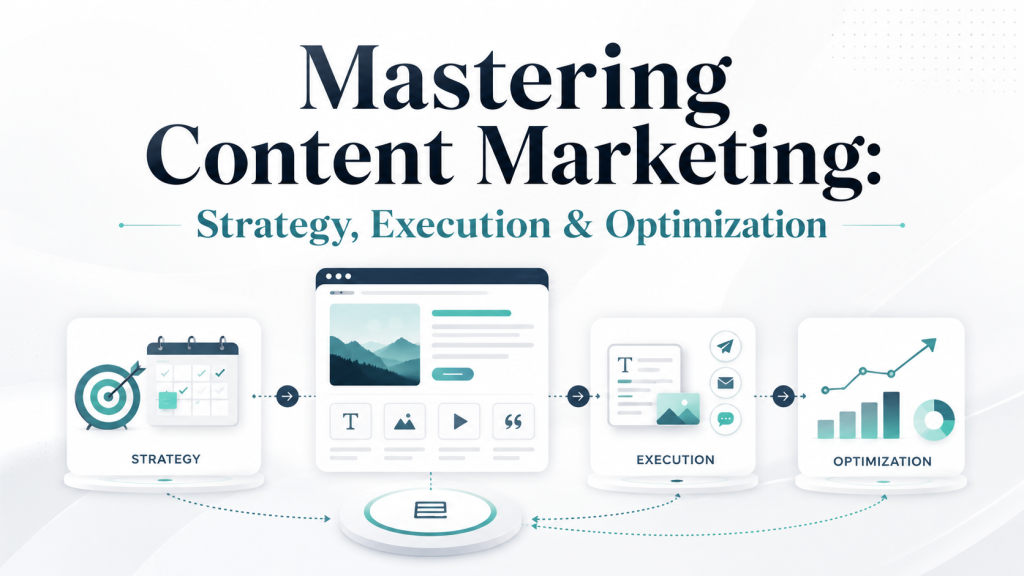
How Content Marketing Works
Content marketing works through a connected sequence.
Each stage depends on the one before it. Weakness in one area can reduce the value of the entire system.
- Define the audience. Identify the people the business needs to reach and understand their situation, priorities, vocabulary, and concerns.
- Identify a meaningful problem. Select questions or needs that are important to the audience and relevant to the business.
- Create a useful content asset. Choose the format that explains the subject most effectively.
- Distribute the asset. Make the content discoverable through search, email, social media, partnerships, communities, advertising, or direct outreach.
- Provide a relevant next step. Help the audience continue its journey through another resource, subscription, trial, consultation, or product action.
- Measure the result. Evaluate whether the content reached the right people and influenced a meaningful outcome.
- Improve the system. Update the asset, refine its distribution, strengthen the offer, or change the approach based on evidence.
This process is rarely linear for the customer.
A person may discover a brand through a video, leave, return through search, subscribe to an email, read a comparison, and purchase several weeks later. The strategy must account for that movement rather than assigning every conversion to the final page viewed.

The Core Elements of Content Marketing
A complete content marketing program requires more than a list of topics.
| Element | Question It Answers | Typical Output |
|---|---|---|
| Business objective | What result should the program support? | Defined goals and priorities |
| Audience | Who must the content help or influence? | Audience profiles and research |
| Positioning | Why should the audience listen to this organization? | Clear expertise and point of view |
| Topic architecture | What subjects should the brand own? | Pillars, clusters, and content themes |
| Formats | How should each idea be presented? | Articles, videos, tools, emails, or events |
| Distribution | How will the intended audience find it? | Search, email, social, paid, and partner plans |
| Conversion path | What should the audience do next? | Calls to action and connected resources |
| Operations | How will the work be produced and maintained? | Roles, workflows, standards, and calendars |
| Measurement | How will value be evaluated? | Metrics, reporting, and review cycles |
These elements should reinforce one another.
A strong topic with no distribution plan may remain unseen. High traffic with no conversion path may produce little business value. Efficient production without editorial standards may create a large volume of weak content.
The system must work as a whole.
Different Types of Content Marketing
There is no universally superior content format.
The right choice depends on the audience, subject, channel, available expertise, and desired action.
| Format | Best Used For | Main Limitation |
|---|---|---|
| Articles and guides | Search discovery and detailed education | Require strong research and maintenance |
| Videos | Demonstration, explanation, and emotional engagement | Can require more production resources |
| Email newsletters | Ongoing audience relationships and distribution | Depend on list quality and relevance |
| Social content | Conversation, reach, and repeated exposure | Often has a short useful lifespan |
| Case studies | Evidence, credibility, and decision support | Need specific and verifiable details |
| Research reports | Original insight and authority | Require reliable data and analysis |
| Webinars and events | Live education and direct interaction | Depend on attendance and promotion |
| Podcasts | Sustained discussion and audience loyalty | Discovery and measurement can be difficult |
| Templates and tools | Practical utility and lead generation | Must solve a real task to remain useful |
| Courses and tutorials | Product education and skill development | Require clear structure and maintenance |
A business should not adopt every format.
It should choose the smallest useful combination that matches its audience and resources.
A company with complex software may benefit from tutorials, webinars, and implementation guides. A consumer brand may rely more heavily on video, social media, email, and community content. A professional services firm may prioritize research, articles, case studies, and expert commentary.
Format follows purpose.

How Content Supports the Customer Journey
Different stages of the customer journey create different information needs.
Awareness
At the awareness stage, the person is identifying a problem, opportunity, or interest.
Useful content includes introductory guides, educational videos, original research, trend analysis, and diagnostic tools.
The content should help the audience understand the situation without forcing a premature sales decision.
Consideration
At the consideration stage, the person understands the problem and is evaluating possible approaches.
Useful content includes comparisons, frameworks, webinars, buyer guides, case studies, and detailed explanations of available solutions.
The central question changes from “What is happening?” to “What should I do about it?”
Decision
At the decision stage, the person is evaluating specific providers, products, or commitments.
Useful content includes product demonstrations, implementation information, pricing explanations, customer stories, objection-handling resources, and consultations.
The content should reduce uncertainty rather than introduce unnecessary pressure.
Retention
Content marketing does not end with the sale.
Onboarding guides, knowledge bases, tutorials, newsletters, advanced courses, and customer communities can help users obtain more value from what they purchased.
This can support satisfaction, continued use, retention, and advocacy.

How to Build a Content Marketing Strategy
A strategy explains where the organization will focus, what it will create, why those choices make sense, and how success will be evaluated.
It should provide direction without becoming so complicated that the team cannot use it.
Step 1. Define the Business Goal
Begin with the result the organization needs.
Possible goals include increasing qualified demand, supporting a new market, shortening the sales process, improving customer retention, reducing support requests, or strengthening recognition in a defined category.
Avoid goals such as “publish more content” or “increase engagement.”
Those are activities or intermediate signals. They do not explain the business purpose.
A useful goal connects content activity to an organizational outcome.
Step 2. Define the Audience
A broad audience produces broad content.
Identify the group the strategy is designed to help. Understand what they are trying to accomplish, what prevents progress, how they describe the problem, and what evidence they require before acting.
Audience research may include:
- Customer interviews.
- Sales and support conversations.
- Search behavior.
- Community discussions.
- Survey responses.
- Product usage data.
- Lost-deal analysis.
- Competitor reviews.
Demographic information may be relevant, but it is rarely sufficient. The strategy needs to understand the audience’s context, motivations, constraints, and decision criteria.
Step 3. Choose a Clear Position
The internet already contains explanations of most common subjects.
A content strategy therefore needs a credible reason for the audience to choose one source over another.
That reason may come from:
- Specialized expertise.
- First-hand experience.
- Original data.
- A distinctive method.
- Better examples.
- Greater clarity.
- A specific industry focus.
- Access to practitioners or customers.
A position is not a slogan. It is the perspective and evidence that make the content difficult to replace with a generic summary.
Google’s current guidance for search and generative AI visibility similarly recommends original, useful content with a distinct point of view rather than recycled information that could come from any source.
Step 4. Build a Topic Architecture
A topic architecture organizes the subjects the business needs to cover.
Begin with broad pillar topics that represent important areas of expertise. Then identify narrower cluster topics that answer specific questions within each pillar.
For example, a content marketing pillar could connect to clusters about:
- Content strategy.
- Content creation.
- Distribution.
- Measurement.
- Content audits.
- Search optimization.
- Artificial intelligence.
- B2B content marketing.
- Case studies.
- Content operations.
The pillar provides conceptual breadth. The clusters provide focused depth.
This structure helps readers move between connected questions and prevents the site from becoming a collection of unrelated posts.
Step 5. Match Formats to Information Needs
Do not begin with “We need a podcast” or “We should publish four blog posts each week.”
Begin with the information need.
A process may require a tutorial. A visual concept may need a diagram or video. A detailed comparison may work best in a table. A complex decision may require a guide, webinar, and consultation.
The audience should not have to struggle with the format to obtain the answer.
Step 6. Create a Sustainable Production System
Consistency depends on operations.
Define who is responsible for research, subject expertise, writing, editing, design, approval, publication, promotion, and maintenance.
The workflow should also include editorial standards for:
- Accuracy.
- Sourcing.
- Tone.
- Brand consistency.
- Legal or compliance review.
- Accessibility.
- Search optimization.
- Artificial intelligence use.
- Updating and archiving.
A publishing calendar is useful only when the team has the capacity to execute it properly.
A smaller number of strong assets is often more valuable than a large volume of repetitive material.
Step 7. Build the Distribution Plan Before Publishing
Distribution should be part of content planning, not an afterthought.
Identify the channels where the intended audience already looks for information.
These may include:
- Organic search.
- Email.
- Social platforms.
- Professional communities.
- Industry publications.
- Partner networks.
- Influencers or experts.
- Sales outreach.
- Paid promotion.
- Events and webinars.
The same asset may be adapted for several channels.
A research report could produce an article, webinar, email series, short video, sales presentation, and social discussion. Repurposing is useful when each version is adapted to the expectations of its channel.
Simply copying the same material everywhere is duplication, not distribution strategy.
Step 8. Design the Next Step
Every piece of content should have a purpose beyond consumption.
The next step does not always need to be a purchase. It should match the reader’s readiness.
A beginner may need another explanatory article. A more informed reader may be ready for a checklist, webinar, product demonstration, or consultation.
Calls to action should continue the reader’s progress rather than interrupt it.
Step 9. Measure and Improve
Measurement begins with the original business goal.
Review whether the content reached the intended audience, held attention, encouraged progression, and contributed to a meaningful result.
Use the findings to improve topics, formats, distribution, conversion paths, and production priorities.
Strategy is not a document that remains fixed. It is a set of choices that should be tested and refined.
How Content Marketing Relates to Other Disciplines
Content marketing overlaps with several marketing functions, but each has a different primary role.
| Discipline | Primary Role | Relationship to Content Marketing |
|---|---|---|
| Content strategy | Governs the planning, creation, management, and maintenance of content | Provides the broader operating discipline |
| SEO | Improves discovery and performance in organic search | Helps relevant content reach search audiences |
| Social media marketing | Builds reach, interaction, and community on social platforms | Distributes and adapts content for social environments |
| Email marketing | Communicates directly with subscribers and customers | Distributes content and supports ongoing relationships |
| Digital advertising | Purchases targeted exposure | Can promote content and accelerate reach |
| Copywriting | Uses persuasive language to influence action | Strengthens headlines, offers, pages, and calls to action |
| Public relations | Manages reputation and earned attention | Extends the reach and authority of stories or research |
These disciplines work best when coordinated.
Content marketing without SEO may miss existing search demand. SEO without useful content may attract visitors without satisfying them. Social distribution without a deeper destination may create attention that quickly disappears.
The objective is not to choose one discipline. It is to understand the function each one serves.

How to Distribute Content
Publishing makes content available. Distribution makes it visible.
A balanced distribution plan usually combines four channel types.
Owned Distribution
Owned channels are controlled by the organization.
They include the website, email list, customer portal, mobile app, podcast feed, and branded community.
These channels give the organization more control over the audience relationship, but they still require sustained attention and audience development.
Earned Distribution
Earned distribution occurs when other people or organizations share, reference, discuss, or link to the content.
It may come from journalists, industry publications, customers, experts, communities, or other websites.
Earned attention cannot be guaranteed. It is more likely when content contains original evidence, useful tools, a strong point of view, or expertise worth citing.
Shared Distribution
Shared distribution happens through social networks and communities.
It may include company posts, employee participation, customer sharing, group discussions, or creator collaborations.
The content must be adapted to the behavior and expectations of each platform.
Paid Distribution
Paid distribution purchases access to a selected audience.
It may include search ads, social advertising, newsletter sponsorships, promoted posts, native advertising, or content discovery platforms.
Paid promotion can extend reach, but it cannot repair weak positioning or unhelpful content.
How to Measure Content Marketing
No single metric can explain content marketing performance.
Traffic may show discovery. Engagement may show attention. Leads may show progression. Revenue may show business impact. Each answers a different question.
| Measurement Level | Core Question | Example Metrics |
|---|---|---|
| Reach | Did the intended audience find the content? | Impressions, rankings, views, subscribers |
| Engagement | Did people consume or interact with it? | Engaged sessions, completion, saves, replies |
| Progression | Did the content move people forward? | Newsletter sign-ups, return visits, downloads |
| Conversion | Did users complete a valuable action? | Trials, inquiries, purchases, registrations |
| Retention | Did content support continued value? | Renewals, product adoption, repeat engagement |
| Efficiency | Was the result worth the resources used? | Cost per lead, cost per acquisition, production cost |
| Business impact | Did content contribute to organizational goals? | Pipeline, revenue, retention, support reduction |
Metrics should be interpreted together.
A page with modest traffic may be valuable when it helps qualified buyers make a decision. A popular article may have limited commercial value if its audience has little connection to the business.
Attribution also requires caution.
People often interact with several channels before converting. Google Analytics supports cross-channel conversion reporting and can assign credit across paid and organic sources, but the result still depends on tracking quality, attribution settings, and the customer journey being measured.
Measurement should improve decisions, not manufacture certainty where none exists.

The Role of Artificial Intelligence in Content Marketing
Artificial intelligence can support many parts of the content process.
It can help organize research, identify patterns, develop outlines, summarize internal material, generate variations, repurpose approved content, and analyze performance data.
These uses can reduce repetitive work and give teams more time for strategy and judgment.
AI does not remove the need for expertise.
A system can produce fluent language without knowing whether the information is accurate, original, appropriate, or commercially useful. Human oversight remains necessary for source verification, factual accuracy, positioning, examples, legal risk, brand voice, and editorial quality.
Google does not prohibit content simply because AI assisted its creation. Its guidance focuses on accuracy, quality, relevance, and added value. It also warns that generating large numbers of pages without meaningful value may violate its policy on scaled content abuse.
Recent Content Marketing Institute research involving 1,015 B2B marketers also framed strong fundamentals, strategic alignment, and measurable outcomes as more important than increasing output through AI alone.
The practical principle is clear:
Use AI to strengthen a sound content system, not to avoid building one.
Common Content Marketing Mistakes
Publishing Without a Defined Goal
A calendar filled with topics can create activity without direction.
Every major content initiative should connect to an audience need and a business purpose.
Creating Content for the Company Instead of the Audience
Internal teams often focus on the features, messages, and announcements they want to promote.
Audiences focus on their own problems.
Effective content begins where those interests overlap.
Covering Topics Too Broadly
Generic content is easy to produce and easy to replace.
Specific audiences, examples, evidence, and experience make content more useful and more credible.
Ignoring Distribution
Publishing is not a distribution strategy.
The team should know how each asset will reach the intended audience before production begins.
Measuring Attention Without Progress
Views and engagement may be useful, but they do not show whether content contributed to a meaningful outcome.
Measurement should include the next stages of the journey.
Using the Same Call to Action Everywhere
A person reading an introductory guide may not be ready for a sales conversation.
The next step should match the reader’s level of awareness and intent.
Prioritizing Volume Over Value
More pages do not automatically create more authority, traffic, or revenue.
Google’s guidance for AI search explicitly warns against producing separate pages for every possible query variation and states that a high quantity of pages does not make a site more relevant or useful.
Neglecting Existing Content
Older assets can become inaccurate, redundant, or disconnected from the current strategy.
Regular audits help teams update useful material, consolidate overlapping pages, improve internal links, and remove content that no longer serves a purpose.
When Content Marketing Makes Sense
Content marketing is particularly useful when customers need education before making a decision.
This often applies when the product is complex, the purchase involves risk, the sales process is long, the market is unfamiliar, or the organization has meaningful expertise to share.
It also makes sense when the same customer questions appear repeatedly. Turning those answers into useful resources can support marketing, sales, onboarding, and customer service.
Content marketing is less suitable as an isolated response to an immediate revenue problem.
A new program may need time to build an audience, earn visibility, and accumulate useful evidence. Businesses that need demand immediately may require advertising, direct outreach, partnerships, or sales activity alongside content.
It is also difficult to sustain when the organization has no clear expertise, no distribution capacity, or no willingness to maintain what it publishes.
Content marketing does not require a large team. It does require focus, patience, and editorial discipline.

Real-World Content Marketing Examples
The strongest examples do not merely publish frequently. They connect useful information to a clear audience and a relevant business context.
Cleveland Clinic Health Essentials
Cleveland Clinic’s Health Essentials publishes health and wellness information informed by its medical expertise. The content helps readers understand conditions, treatments, prevention, and everyday health decisions. Cleveland Clinic also connects the publication with a broader Health Library containing thousands of detailed resources.
The strategic lesson is not that every organization should build a health publication.
It is that institutional expertise can be translated into accessible information that addresses real audience questions.
Canva Design School
Canva Design School provides courses and learning resources covering design, video editing, brand systems, templates, and Canva’s visual tools.
The content teaches skills that are valuable on their own while helping users become more capable with Canva’s product.
This is a strong example of content supporting both education and product adoption.
American Express Business Intel
American Express Business Intel publishes guidance for business owners on areas such as cash flow, financing, operations, expenses, and business growth. It also includes stories about business customers and links relevant subjects to American Express products and services.
The content is commercially connected, but it begins with practical business questions.
That balance is central to effective content marketing. The material should be useful before the reader reaches the offer.
Conclusion
Content marketing is not the act of filling a website, social feed, or publishing calendar.
It is a strategic system for turning expertise and audience insight into useful experiences that support customer decisions and business goals.
The system begins with a defined audience and a clear objective. It continues through topic selection, content creation, distribution, conversion, measurement, and improvement.
Each part matters.
Good production cannot compensate for weak positioning. Strong content cannot create results without distribution. High traffic cannot prove success without a meaningful next step. Artificial intelligence cannot replace judgment, originality, or expertise.
The most effective content marketing programs do not attempt to publish everywhere or answer every possible query.
They choose the audience they can serve, the topics they can address credibly, and the channels they can sustain. They create useful assets, connect those assets into a coherent journey, and improve the system through evidence.
That is what turns content from a collection of materials into a marketing capability.

Frequently Asked Questions
What Is Content Marketing in Simple Terms?
Content marketing is the use of helpful information to attract, educate, and retain a defined audience while supporting a business goal.
It may use articles, videos, emails, podcasts, research, courses, tools, or other formats.
What Is the Main Purpose of Content Marketing?
Its main purpose is to help an audience make progress while creating a relevant business opportunity.
That opportunity could involve awareness, demand generation, sales, retention, product adoption, or customer loyalty.
Is Content Marketing the Same as Digital Marketing?
No. Digital marketing is the broader use of digital channels to promote a business. It includes advertising, search marketing, email, social media, affiliate marketing, and other methods.
Content marketing is one approach within that broader system.
Is Content Marketing the Same as SEO?
No. SEO improves a website’s visibility and performance in organic search. Content marketing determines what information should be created, who it should serve, and how it contributes to business goals.
The two disciplines frequently work together.
What Is the Difference Between Content Marketing and Content Strategy?
Content strategy governs how content is planned, created, managed, maintained, and retired across an organization.
Content marketing focuses specifically on using content to attract, engage, and influence an audience in support of marketing objectives.
What Are the Most Common Types of Content Marketing?
Common formats include articles, videos, emails, social posts, podcasts, webinars, case studies, research reports, templates, online tools, courses, and customer stories.
The right format depends on the audience and the task the content must perform.
How Long Does Content Marketing Take to Work?
There is no fixed timeline.
Results depend on the competitiveness of the topic, the strength of the content, existing brand awareness, distribution capacity, publishing consistency, sales cycle, and chosen objective.
Some assets may support sales immediately. Organic search and audience development usually require a longer period of sustained work.
How Often Should a Business Publish Content?
A business should publish as often as it can produce and distribute useful material without reducing quality.
A rigid publishing frequency is less important than relevance, consistency, differentiation, and maintenance.
Can Small Businesses Use Content Marketing?
Yes. Small businesses can compete by focusing on a specific audience, local market, specialized problem, or area of first-hand expertise.
They do not need to publish at the same volume as large organizations. They need to produce information that is more relevant to the customers they are positioned to serve.
How Is Content Marketing Success Measured?
Success should be measured against the original objective.
Relevant metrics may include qualified traffic, subscriptions, inquiries, trials, sales, retention, product adoption, and customer support outcomes.
Traffic and engagement are useful signals, but they are not complete measures of business value.
Will Artificial Intelligence Replace Content Marketers?
AI can automate or accelerate parts of research, production, repurposing, and analysis.
It cannot independently guarantee accurate information, original insight, sound strategy, brand judgment, or responsible editorial decisions.
Its strongest role is supporting skilled teams rather than replacing the need for expertise.

0 Comments