Introduction
Direct sales is one of the most debated business models in the modern marketplace. Some people describe it as a flexible path to entrepreneurship. Others dismiss it as risky or misleading. If you’re considering joining a direct sales company, the noise can make it hard to know what’s real.
So let’s step back from opinions.
What is direct sales, how does it actually function, and why does this model still exist despite criticism? Those are the questions that matter before you commit time or money.
In this article, we’ll break down how direct sales works, where the money comes from, why companies use it, and what determines whether it succeeds or fails for individuals.
Key Takeaways
- Direct sales is a distribution model where products are sold directly to customers through independent representatives instead of retail stores.
- Income is primarily generated from product sales, not from simply joining or recruiting.
- Some direct sales companies use multi-level compensation structures, but not all do.
- The model survives because it reduces retail costs and relies on relationship-based selling.
- Success depends on product demand, sales skill, consistency, and realistic expectations.
- Before joining, it is critical to understand how the compensation plan actually works.
Disclaimer: I am an independent Affiliate. The opinions expressed here are my own and are not official statements. If you follow a link and make a purchase, I may earn a commission.
What Direct Sales Actually Is
Direct sales is a business model where a company sells products or services directly to customers without using traditional retail stores.
In a typical retail system, products move through several layers: manufacturer, distributor, wholesaler, retailer, and then finally the customer. Each layer adds cost and takes a margin.
In direct sales, that chain is shortened.
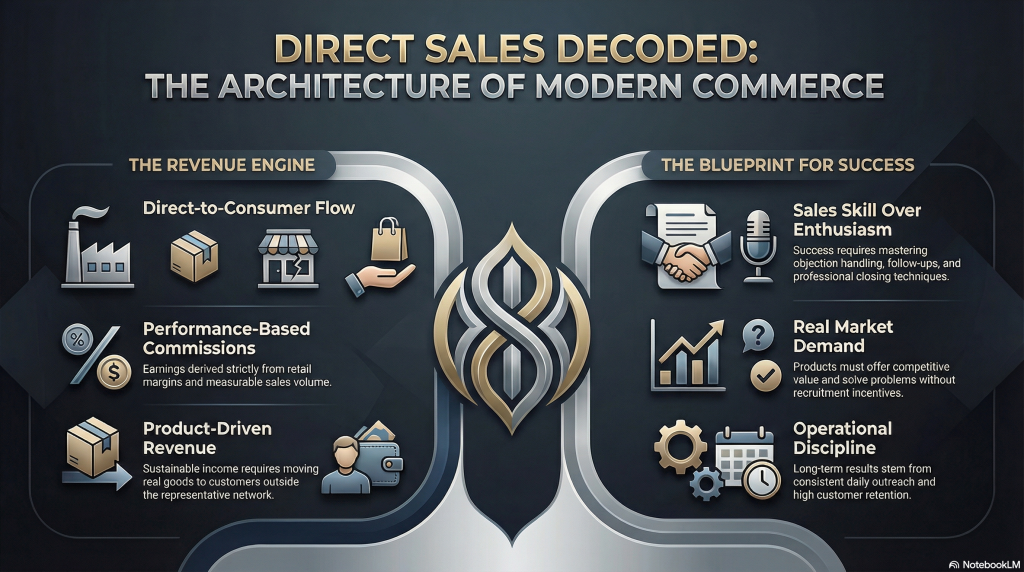
The company works with independent representatives who promote and sell products directly to end customers. These representatives are not employees. They operate as independent contractors and earn commissions based on sales performance.
The defining features of direct sales are:
- No physical retail storefront required
- Sales driven by individuals, not store traffic
- Compensation based on measurable product sales
- Relationship-based marketing instead of mass advertising
It is important to separate the structure from the reputation.
Direct sales is simply a distribution method. It becomes good or bad depending on product quality, compensation design, and how representatives operate within the system.
Before evaluating whether you should join, you first need to understand that the model itself is neutral. The outcomes depend on incentives and execution.
How Direct Sales Works (Step-by-Step)
Now let’s move from definition to mechanics.
If you are considering joining a direct sales company, you need to understand the flow of money and responsibility. The structure is usually straightforward.
Step 1: The Company Develops or Sources a Product
Every legitimate direct sales model begins with a product or service.
The company handles:
- Product development or sourcing
- Manufacturing
- Branding
- Compliance
- Logistics and fulfillment
This is important. Representatives are not building the product. They are distributing it.
Step 2: You Join as an Independent Representative
When you join, you typically sign an independent contractor agreement.
This means:
- You are not an employee
- You are paid based on performance
- You manage your own time and selling activity
There may be a startup fee. That fee usually covers a starter kit, samples, or training materials.
Step 3: You Market and Sell the Product
This is where the real work happens.
Sales can occur through:
- Personal conversations
- Social media
- Events or product demonstrations
- Digital presentations
You generate interest, explain the value, answer questions, and close sales.
No sales = no income.
Step 4: You Earn Commission on Sales
When a customer purchases through your referral link, order form, or account, you earn a percentage of the sale.
This percentage varies by company. It may include:
- Retail margin (the difference between wholesale and retail price)
- Commission percentage
- Performance bonuses
Your income depends directly on volume.
Step 5: In Some Models, You Can Build a Team
In certain direct sales structures (often called multi-level models), you can recruit other representatives.
If you do:
- You may earn a small override commission on their sales
- You may qualify for bonuses based on team performance
However, team commissions are usually tied to product sales not simply recruitment.
The Core Reality
The system only works when products move to real customers.
The company earns revenue from product sales. You earn income from product sales. Team bonuses (if available) are layered on top of that.
Understanding this flow removes much of the confusion.

Why Companies Use Direct Sales Instead of Retail
If direct sales carries controversy, a reasonable question follows:
Why would companies choose this model at all?
The answer is economic and strategic not emotional.
1. Lower Retail Overhead
Traditional retail requires:
- Physical store space
- Staff salaries
- Inventory storage
- Shelf placement fees
- Large-scale advertising
Each layer adds cost.
Direct sales removes much of that infrastructure. Instead of paying for store space, the company compensates representatives based on performance. Fixed overhead becomes variable cost.
This shifts financial risk away from the company and toward performance-based distribution.
2. Relationship-Based Selling
Some products sell better through explanation.
Health supplements, skincare, financial services, or specialty goods often require trust and conversation. A representative can answer objections in real time. That increases conversion rates for certain product types.
Retail shelves cannot educate. People can.
3. Faster Expansion
Opening retail locations is slow and capital-intensive.
Recruiting representatives is faster.
A company can expand into new regions without leasing property or building distribution centers in every city. Representatives become localized brand ambassadors.
4. Community-Driven Growth
Direct sales often builds community around a brand.
Events, team structures, mentorship, and recognition systems create engagement beyond a simple transaction. For some consumers, this adds emotional value.
For companies, it increases retention.
The Strategic Logic
Direct sales exists because it can be:
- Capital-efficient
- Scalable
- Relationship-driven
- Incentive-aligned with sales performance
However, these same strengths can become weaknesses if incentives shift away from product demand and toward aggressive recruitment.
The model survives because, when structured properly, it can move products profitably without retail stores.

Where the Money Actually Comes From
If you are thinking about joining a direct sales company, this is the section that matters most.
Income in direct sales is not mysterious. It flows from specific, measurable sources. If you understand these sources clearly, you can evaluate the opportunity realistically.
1. Retail Margin
In many models, you purchase products at a discounted rate and sell them at retail price.
Your income is the difference.
For example:
- Wholesale cost: $60
- Retail price: $100
- Your gross margin: $40
This is straightforward commerce. You are acting as a distributor.
However, you must account for expenses such as samples, marketing materials, and time.
2. Commission Percentage
Some companies handle fulfillment directly and pay you a commission for each sale made through your referral link or customer account.
Instead of holding inventory, you earn a percentage of total sales volume.
For example:
- Customer purchase: $200
- Commission rate: 25%
- Your earnings: $50
In this structure, the company manages inventory and shipping.
3. Performance Bonuses
Many direct sales companies offer bonuses tied to sales volume.
These may include:
- Monthly sales targets
- Rank advancement incentives
- Leadership bonuses
These bonuses reward consistency and volume, not isolated sales.
4. Team Overrides (In Multi-Level Structures)
If the company allows team building, you may earn a small percentage of sales generated by people you recruit.
This income is typically calculated as a percentage of team sales volume not recruitment fees.
The key detail is this:
If the compensation plan emphasizes product sales at every level, the structure is grounded in commerce.
If the compensation plan emphasizes recruitment purchases over customer demand, risk increases.
The Core Principle
All sustainable direct sales income must originate from product movement to real customers.
Not sign-up fees.
Not promises.
Not motivational events.
Products must be purchased, consumed, and repurchased.
When evaluating any opportunity, follow the revenue source. That will tell you more than testimonials ever will.
Why Some People Succeed and Many Don’t
One of the most confusing aspects of direct sales is the income gap.
In the same company, one person may build steady income, while another earns very little. The structure is the same. The difference lies elsewhere.
Here are the factors that most often separate outcomes.
1. Sales Skill vs. Enthusiasm
Excitement helps you start.
Skill helps you last.
Direct sales is still sales. That means:
- Handling objections
- Following up consistently
- Asking for the sale
- Managing rejection
Many people join with motivation but never develop sales ability. Over time, enthusiasm fades if results do not follow.
2. Product-Market Fit
Even strong sales skills cannot overcome weak demand.
If the product:
- Is overpriced for the market
- Has no repeat purchase behavior
- Is already saturated locally
Growth becomes difficult.
Successful representatives often operate in markets where real customer need exists outside their immediate social circle.
3. Consistency Over Time
Direct sales rewards sustained effort.
Income usually reflects:
- Daily outreach
- Ongoing customer conversations
- Regular follow-ups
- Retention of repeat buyers
Many people treat the business as temporary or inconsistent work. Income reflects that pattern.
4. Realistic Expectations
One of the biggest predictors of failure is unrealistic income expectation.
If someone expects rapid, passive income, disappointment comes quickly.
Direct sales income often builds gradually:
- First from personal sales
- Then from customer retention
- Possibly later from team volume
When expectations match effort and timeline, frustration decreases.
5. Emotional Resilience
Rejection is part of the model.
Friends may say no. Prospects may ignore messages. Some customers may stop ordering.
Those who separate rejection from identity last longer.
6. Financial Discipline (Avoiding the Inventory Trap)
Some representatives fail because they purchase their own products to hit monthly sales targets. This practice is often called “garage qualifying.”
The representative may earn a new rank or a short-term bonus. However, the cost of excess inventory often exceeds the reward. Profit disappears.
Sustainable success requires selling to real customers not buying volume to maintain status.
The Pattern
Direct sales does not randomly reward people. It rewards sales competence, process discipline, and strict financial logic. Understanding these traits helps you evaluate your own readiness before joining.
But self-awareness is only half the battle. You also need to separate industry facts from fiction. Unrealistic expectations usually come from bad information, which leads directly to the myths that trap new representatives.
Common Misconceptions About Direct Sales
Before you decide whether to join, it helps to clear away the myths. Direct sales carries strong opinions, and those opinions often blur the facts.
Here are the most common misunderstandings.
“It’s Passive Income”
Direct sales is not passive.
You may eventually build recurring customer orders, but those customers were acquired through active effort. Even team-based income requires leadership, training, and support.
If activity stops completely, income usually declines over time.
Passive income implies little ongoing work. Direct sales rarely fits that definition.
“Everyone Makes Money If They Just Try”
Effort matters. But effort alone is not enough.
Income depends on:
- Market demand
- Sales ability
- Pricing competitiveness
- Time invested
- Customer retention
Like most performance-based work, results vary widely. That variability is normal in commission-driven models.
“Recruiting Is the Main Way to Earn”
In legitimate structures, product sales drive compensation.
Recruitment may expand volume, but sustainable income requires customers purchasing real products.
If the emphasis is primarily on signing up new representatives rather than selling to end consumers, that is a warning sign.
“It’s Automatically a Pyramid Scheme”
A pyramid scheme is illegal because it pays primarily for recruitment rather than product value.
Direct sales, by contrast, is legal when revenue comes from actual customer sales.
The distinction is not emotional. It is structural. Follow the source of the money.
“You Have to Sell to Friends and Family”
Many people begin by reaching out to their immediate network. But long-term sustainability requires expanding beyond that circle.
Successful representatives eventually develop:
- Defined target audiences
- Content strategies
- Repeat customer systems
Relying only on personal relationships limits growth and can create unnecessary tension.
The Bigger Point
Misconceptions usually come from extreme examples either exaggerated success stories or high-profile failures.
Direct sales is neither guaranteed success nor automatic failure.
It is a structured sales model with clear incentives. When you understand the structure, you can evaluate it rationally instead of emotionally.

How to Evaluate a Direct Sales Opportunity Before Joining
If you are seriously considering joining, this is where you slow down.
Excitement is normal. So is optimism. But a clear evaluation protects you from avoidable mistakes.
Here are the criteria that matter most.
1. Is There Real Customer Demand?
Ask a simple question:
Would people buy this product if there were no compensation plan attached?
Look for:
- Competitive pricing
- Clear product differentiation
- Repeat purchase behavior
- Customers outside the representative network
If most purchases come from representatives themselves rather than end consumers, sustainability becomes questionable.
2. How Transparent Is the Compensation Plan?
A legitimate opportunity should provide:
- A clear breakdown of commission percentages
- Defined qualification requirements
- Income disclosure statements
- Realistic earnings data
If compensation explanations rely more on testimonials than documented structure, proceed cautiously.
Clarity reduces risk.
3. What Are the Startup and Ongoing Costs?
Initial costs may include:
- Enrollment fees
- Starter kits
- Inventory purchases
Ongoing costs may include:
- Monthly minimum purchase requirements
- Marketing tools
- Event attendance
- Subscription software
Calculate total monthly expense before projecting income.
Profit is revenue minus expenses not commission volume alone.
4. What Percentage of Representatives Are Profitable?
Many companies publish income disclosure statements.
Review them carefully.
Look for:
- Median earnings (not just top earners)
- Percentage of representatives earning more than expenses
- Average annual income across ranks
This data provides context for expectations.
5. Is Recruitment Emphasized More Than Product Value?
Pay attention to messaging.
If most training focuses on:
- Signing up new representatives
- “Building a downline”
- Advancing rank quickly
And less on customer acquisition and retention, that signals imbalance.
Healthy structures prioritize product sales first.
6. Does the Model Fit Your Personality and Risk Tolerance?
Direct sales requires:
- Comfort with rejection
- Self-motivation
- Sales conversation skills
- Income variability tolerance
If you prefer predictable salary income or dislike proactive selling, the model may feel stressful.
The Final Test
Ask yourself:
If I removed the hype, removed the events, removed the motivational language does the basic math still make sense?
If the answer is yes, you are evaluating clearly.
If the math depends on “everyone joining under me,” step back.
Understanding these factors does not guarantee success. But it dramatically reduces blind spots.

Who Direct Sales Is Actually For
Direct sales is not designed for everyone. That is not a criticism, it is a reality of any performance-based model.
Before joining, it helps to evaluate whether the structure aligns with how you prefer to work.
1. People Comfortable With Performance-Based Income
Direct sales does not guarantee a fixed paycheck.
Income fluctuates based on:
- Sales volume
- Customer retention
- Activity level
If you are comfortable with variability and motivated by commission-based rewards, the structure may feel energizing. If you prefer predictable income, the uncertainty may feel stressful.
2. People Willing to Sell Consistently
At its core, direct sales is selling.
That means:
- Starting conversations
- Presenting value clearly
- Handling objections
- Following up
If you dislike initiating outreach or asking for the sale, this model may feel uncomfortable.
Those who view selling as helping people solve problems tend to adapt better.
3. Self-Directed Individuals
There is usually no manager monitoring daily activity.
You must:
- Set your own schedule
- Track your own numbers
- Maintain your own motivation
Some people thrive in autonomy. Others perform better with structure and oversight.
4. People With Long-Term Patience
Income often builds gradually.
The first stage is learning. The second stage is consistent personal sales. The third stage, if applicable, is leadership and team development.
Those who expect rapid results often exit early. Those who commit to steady effort typically see clearer outcomes positive or negative based on performance.
5. Individuals Who Can Separate Identity From Rejection
Rejection is normal in sales.
It does not mean:
- The product is worthless
- You are incapable
- The opportunity is broken
It means the offer did not match the buyer at that moment.
Emotional resilience makes a measurable difference.
The Honest Fit Test
Direct sales fits people who are comfortable operating like independent business owners even on a small scale.
If you prefer stability, fixed compensation, and limited exposure to rejection, a traditional employment model may be a better fit.
Understanding yourself is just as important as understanding the compensation plan.
Conclusion
Direct sales is not mysterious once you understand its structure.
It is a distribution model built on independent representatives selling products directly to customers. Companies use it to reduce retail overhead and scale through people instead of storefronts. Representatives earn income based on measurable sales performance.
The model itself is neutral.
What determines the outcome is:
- Product demand
- Compensation design
- Market conditions
- Your ability to sell consistently
For some, direct sales becomes a flexible income stream or even a long-term business. For others, it proves more difficult than expected.
If you are considering joining, the smartest move is not to focus on hype or criticism. Focus on mechanics. Follow the money. Review the math. Evaluate your fit.
Clarity replaces emotion.
And with clarity, you can decide whether direct sales is an opportunity worth pursuing or one better observed from the outside.

Frequently Asked Questions
Is direct sales the same as MLM?
No. Direct sales is a distribution model. It describes how products move from a company to customers without traditional retail stores. Multi-level marketing (MLM) is a type of compensation structure within some direct sales companies. In MLM models, representatives can earn from both personal sales and team sales. Not all direct sales companies use this structure.
Is direct sales legal?
Yes, legitimate direct sales companies are legal.
However, illegal pyramid schemes sometimes disguise themselves as direct sales. The difference is structural: legal models generate revenue from real product sales to customers. Pyramid schemes rely primarily on recruitment fees rather than product demand.
Can you earn full-time income in direct sales?
It is possible, but not typical for most participants.
Income varies widely depending on:
- Sales volume
- Customer retention
- Market conditions
- Time invested
- Skill level
Before joining, review the company’s income disclosure statement to understand realistic earning ranges.
How much does it cost to start?
Startup costs vary by company.
They may include:
- Enrollment or registration fees
- Starter kits
- Initial product purchases
There may also be ongoing monthly requirements. Always calculate total expenses before projecting income.
What is the biggest risk in direct sales?
The biggest risk is misunderstanding the effort required.
If expectations are unrealistic, disappointment follows. If expenses exceed revenue, profitability becomes difficult.
The financial risk is usually lower than opening a traditional business but income is also less predictable.
How long does it take to see results?
That depends on activity level, market demand, and experience.
Some people generate early sales within weeks. Sustainable income, however, typically requires consistent effort over months, not days.

0 Comments