Introduction: Why Some AI Prompts Work Better Than Others
Not all AI prompts produce the same quality of results. Sometimes a short instruction works perfectly, while other times the response feels vague, incomplete, or slightly off target.
The difference usually isn’t the AI tool itself. It’s the structure of the prompt.
When important information is missing such as background context, clear instructions, or constraints the model has to guess what you want. Those guesses often lead to generic answers that require editing or repeated prompting.
This is where the CRISPE Prompt Framework becomes useful.
CRISPE is a structured method for writing prompts that provide the AI with enough context, direction, and guidance to generate more accurate and consistent outputs. The framework breaks a prompt into six components: Context, Role, Instructions, Steps, Parameters, and Examples.
In this article, you’ll learn how each part of the CRISPE framework works and how to use it to create clearer prompts that produce better results with less trial and error.
Key Takeaways
- The CRISPE Prompt Framework helps structure AI prompts so models generate clearer and more accurate responses.
- CRISPE stands for Context, Role, Instructions, Steps, Parameters, and Examples, each adding guidance for the AI.
- Context and role establish the situation and expertise the AI should apply to the task.
- Instructions, steps, and parameters define the task, reasoning process, and constraints of the response.
- CRISPE works best for complex tasks like research, planning, and structured writing where clarity and precision matter.
Disclaimer: I am an independent Affiliate. The opinions expressed here are my own and are not official statements. If you follow a link and make a purchase, I may earn a commission.
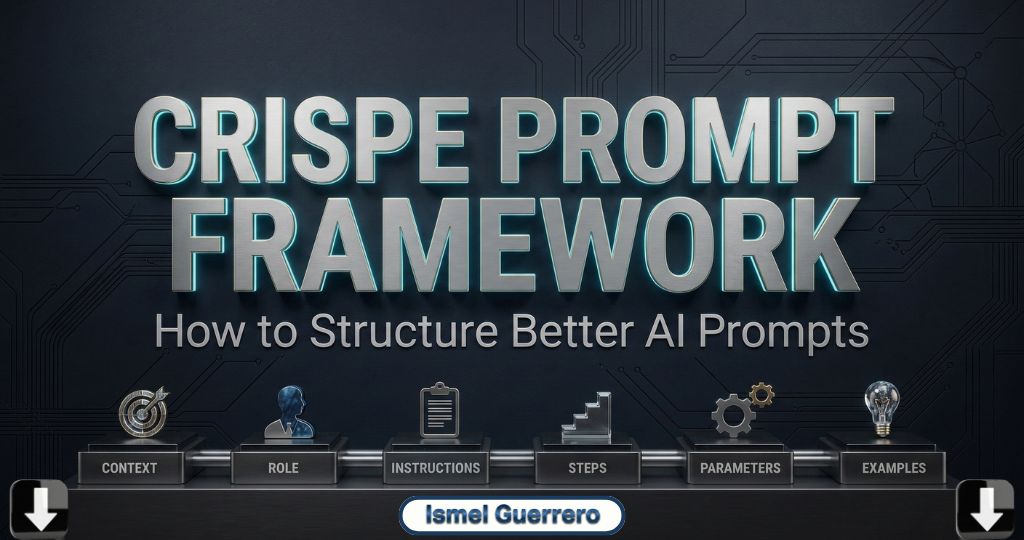
What Is the CRISPE Prompt Framework
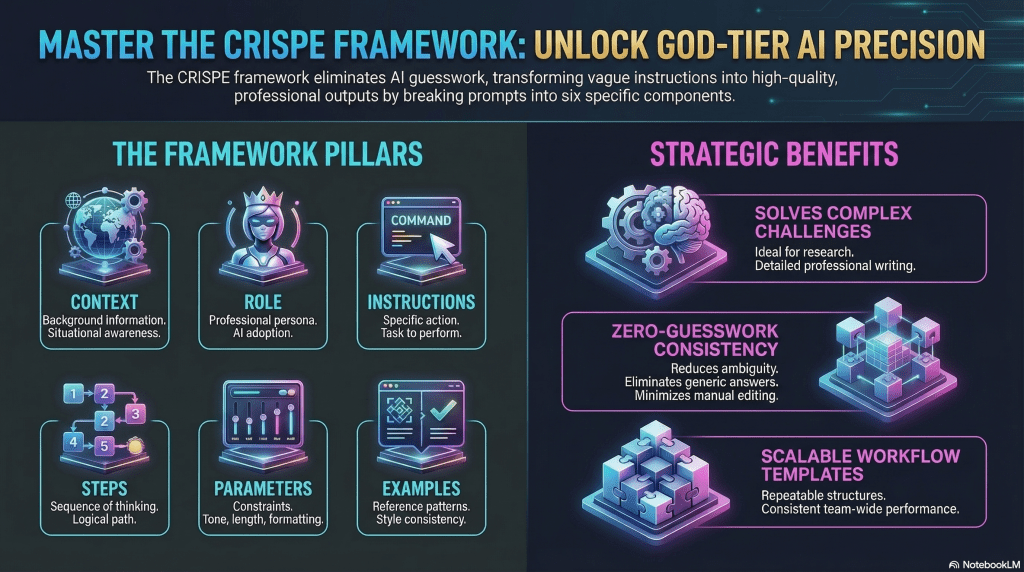
The CRISPE Prompt Framework is a structured method for designing AI prompts that produce clearer and more reliable results. Instead of relying on a single vague instruction, CRISPE organizes a prompt into six specific components that guide the AI step by step.
CRISPE stands for Context, Role, Instructions, Steps, Parameters, and Examples. Each element provides a different type of information that helps the model understand the task and generate a more accurate response.
- Context provides the background information needed to understand the situation.
- Role defines the expertise or perspective the AI should adopt.
- Instructions clearly state the task the AI needs to perform.
- Steps outline the logical process the AI should follow.
- Parameters set constraints such as tone, length, or format.
- Examples show the pattern or style expected in the final output.
Together, these components form a complete prompt structure that reduces ambiguity and improves consistency. Instead of leaving the model to guess what you want, the CRISPE framework gives it the information it needs to respond with precision.
In practice, you don’t always need to use every element in every prompt. However, the more complex the task, the more valuable this structured approach becomes.
Context: Give the AI the Background It Needs
Context is the foundation of the CRISPE framework. It provides the background information the AI needs to understand the situation before it begins generating a response.
Without context, the model must rely on general patterns from its training data. This often leads to answers that are technically correct but misaligned with the specific problem you are trying to solve.
Adding context reduces that uncertainty. It explains what the task is about, who the output is for, and why the response matters. Even a few sentences of relevant background can dramatically improve the quality of the result.
For example, compare these two prompts:
Without context: “Write a product description.”
With context: “Write a product description for a productivity app designed for freelance designers who struggle with managing multiple client deadlines.”
The second prompt gives the AI a clearer picture of the audience, the product, and the purpose of the description. This additional information allows the model to generate a more relevant and targeted response.
When using the CRISPE framework, the context section sets the stage for everything that follows. It ensures the AI understands the situation before moving on to the task itself.
Role: Assign the Expertise the AI Should Use
The Role component defines the perspective or expertise the AI should adopt when responding. By assigning a role, you guide the model toward a specific style of thinking, vocabulary, and reasoning.
Large language models are trained on vast amounts of text from many different domains. When you specify a role, you help the model narrow its focus and respond as if it were approaching the task from that professional viewpoint.
For example, compare these prompts:
Without a role: “Explain how to improve a website landing page.”
With a role: “Act as a conversion-focused digital marketing strategist and explain how to improve a website landing page.”
The second prompt signals that the response should emphasize conversion strategies, user behavior, and marketing principles rather than general web design advice.
Roles can reflect many types of expertise, such as:
- a marketing strategist
- a software engineer
- a financial analyst
- a product manager
- a technical writer
Choosing an appropriate role helps the AI frame the problem more effectively and produce answers that feel more informed and purposeful.
In the CRISPE framework, defining the role early ensures that the rest of the prompt its instructions, steps, and parameters are interpreted through the right professional lens.

Instructions: Clearly Define the Task
The Instructions section tells the AI exactly what you want it to do. This is the core action of the prompt, and it should be written as clearly and directly as possible.
When instructions are vague, the model has to interpret your request on its own. That often leads to answers that are too broad, incomplete, or not aligned with your goal. Clear instructions remove that uncertainty by specifying the task in precise terms.
For example:
Unclear instruction: “Help me improve this article.”
Clear instruction: “Rewrite the introduction of this article to make it more engaging and concise while keeping the main idea intact.”
The second version gives the AI a specific objective. It defines what should be changed, what should remain the same, and the outcome you expect.
Effective instructions usually rely on strong action verbs such as:
- summarize
- analyze
- rewrite
- compare
- generate
- explain
- evaluate
Using clear verbs helps the AI understand the exact operation it needs to perform.
In the CRISPE framework, instructions act as the central command of the prompt. Once the context and role establish the setting, the instructions direct the model toward the task that needs to be completed.

Steps: Guide the AI Through the Thinking Process
The Steps component outlines the logical process the AI should follow when completing the task. Instead of leaving the model to decide how to approach the problem, you provide a clear sequence of actions.
This is particularly useful for tasks that involve analysis, planning, or reasoning. When an AI is asked to produce a final answer immediately, it may skip important intermediate thinking. Defining steps helps ensure that the response follows a structured path.
For example:
Without steps: “Analyze this marketing campaign and suggest improvements.”
With steps: “Analyze this marketing campaign by following these steps:
- Identify the main objective of the campaign.
- Evaluate the strengths and weaknesses of the strategy.
- Suggest three specific improvements.”
The second prompt encourages the AI to break the task into manageable parts, which often results in a more thoughtful and organized response.
Steps can also help control the order of reasoning. Instead of jumping directly to conclusions, the AI works through the process you define. This reduces errors and improves the clarity of the output.
Within the CRISPE framework, the Steps section acts as a roadmap for the model. It guides the AI through the thinking process so the final answer reflects a logical progression rather than a single guess.

Parameters: Set Clear Constraints and Boundaries
The Parameters component defines the rules the AI should follow when generating its response. These constraints shape how the output should look, sound, and be structured.
Without parameters, the AI may produce answers that are too long, too short, too informal, or formatted in a way that isn’t useful for your needs. Clear parameters help prevent this by establishing boundaries before the model begins writing.
Common types of parameters include:
- Length limits (for example, under 200 words)
- Tone or style (professional, conversational, technical)
- Output format (bullet points, numbered list, table)
- Restrictions (avoid certain phrases or focus on specific topics)
For example:
Without parameters: “Write a summary of this report.”
With parameters: “Write a summary of this report in five bullet points using clear, non-technical language.”
The second version tells the AI exactly how the information should be delivered. This makes the output easier to use without requiring additional editing.
In the CRISPE framework, parameters act as guardrails. They ensure the AI’s response stays within the limits you set while still completing the task defined in the instructions.

Examples: Show the Output Pattern You Want
The Examples component helps the AI understand the style, structure, or pattern you expect in the final output. While instructions explain what to do, examples demonstrate how the result should look.
Large language models learn by recognizing patterns in text. Providing a short example gives the model a reference point it can follow, which often leads to more consistent and accurate responses.
For example:
Without an example: “Write a product description for a task management app.”
With an example: “Write a product description for a task management app.
Example style: ‘A simple tool designed to help freelancers organize their daily tasks and stay focused on what matters most.’”
The example doesn’t need to be long or detailed. Even a single sentence can guide tone, vocabulary, and structure.
Examples are especially useful when:
- you want the output to match a specific style
- the format needs to be consistent
- the task involves nuanced writing or messaging
In the CRISPE framework, examples provide the final layer of guidance. They reinforce the instructions and parameters by showing the AI exactly what a successful output should resemble.

A Complete CRISPE Prompt Example
Seeing the CRISPE framework applied in a single prompt makes it easier to understand how the six components work together. Each element adds a layer of clarity that helps the AI generate a more focused and useful response.
Below is an example of a prompt structured using the CRISPE framework.
Context: You are helping a startup founder improve the messaging for a new productivity app aimed at freelancers who struggle with managing multiple client deadlines.
Role: Act as an experienced product marketing strategist who specializes in SaaS products.
Instructions: Write a short product description that clearly explains the main benefit of the app and why freelancers would want to use it.
Steps:
- Identify the primary problem freelancers face when managing deadlines.
- Explain how the app helps solve that problem.
- Highlight the main benefit in a clear and compelling way.
Parameters: Keep the description under 120 words. Use simple, conversational language and avoid technical jargon.
Examples: Example tone: “A simple tool designed to help freelancers stay organized and meet every deadline without feeling overwhelmed.”
When all six CRISPE components are included, the prompt provides clear guidance about the situation, the perspective to use, the task to perform, the reasoning process, the constraints, and the desired style. This level of structure significantly improves the chances of receiving a response that requires little to no editing.
How the CRISPE Framework Improves Prompt Quality
The CRISPE framework improves prompt quality by reducing ambiguity and giving the AI clear instructions from the start. Instead of relying on a single vague request, the framework organizes a prompt into multiple components that guide the model through the task.
One of the main benefits is clarity. By providing context, defining a role, and specifying the instructions, you remove much of the guesswork the AI would otherwise rely on. The model understands the situation, the perspective it should adopt, and the exact outcome you expect.
Another advantage is structure. The steps and parameters guide the AI through the reasoning process while also setting boundaries for the response. This helps prevent overly broad answers and keeps the output focused on the task.
The framework also improves consistency. When prompts follow a repeatable structure, the results become easier to predict and refine. This is especially useful for tasks that need to be performed regularly, such as writing reports, generating content, or analyzing information.
Finally, CRISPE can reduce the amount of editing required after the response is generated. Because the prompt already includes the necessary context, constraints, and examples, the AI is more likely to produce an output that aligns with your expectations.

CRISPE vs CARE vs Multi-Chain Prompting
The CRISPE framework is one of several methods used to improve the quality of AI prompts. While each framework helps guide interactions with AI models, they focus on different aspects of the prompting process.
The CARE framework emphasizes clarity and simplicity. It focuses on four elements: Context, Ask, Rules, and Examples. CARE is particularly useful for everyday prompts where the goal is to quickly provide enough information for the AI to generate a useful response.
Multi-Chain Prompting takes a different approach. Instead of focusing on the structure of a single prompt, it breaks a task into multiple sequential prompts. Each response feeds into the next step, allowing complex tasks to be handled in stages.
The CRISPE framework focuses on building a highly structured prompt. By combining context, role, instructions, steps, parameters, and examples, CRISPE creates a detailed instruction set that guides the AI through both the task and the reasoning process.
These frameworks are not mutually exclusive. In practice, they can complement one another.
For example:
- CARE can help you create clear prompts for everyday tasks.
- Multi-Chain Prompting can organize complex workflows into multiple steps.
- CRISPE can structure a detailed prompt when precision and context are especially important.
Choosing the right approach depends on the complexity of the task and the level of control you want over the AI’s response.

When to Use the CRISPE Prompt Framework
The CRISPE framework is most useful when a task requires detailed instructions and a high level of accuracy. Because it provides context, structure, and constraints, it works well for prompts where the quality of the response matters more than speed.
You may find the CRISPE framework especially helpful when working on tasks such as research, structured writing, planning, or analysis. In these situations, the AI benefits from understanding the background of the task, the role it should assume, and the reasoning process it should follow.
CRISPE is also useful when prompts need to be reused. A structured prompt can serve as a template that produces consistent results across multiple tasks. This makes it easier to repeat workflows without rewriting instructions each time.
However, CRISPE is not necessary for every interaction with AI. For quick questions, brainstorming ideas, or short summaries, a simpler prompt is often sufficient. In those cases, using a shorter framework like CARE may be more efficient.
A good rule of thumb is to use CRISPE when the task involves multiple layers of thinking or when you want a clear and well-structured response from the start.
Conclusion: Structured Prompts Lead to Better Results
The CRISPE framework provides a simple way to structure AI prompts so that the model clearly understands the task, the context, and the expected output.
Instead of relying on vague instructions, CRISPE organizes a prompt into six elements: Context, Role, Instructions, Steps, Parameters, and Examples. Each component adds a layer of clarity that helps reduce ambiguity and guide the AI toward a more accurate response.
This structured approach is especially useful for complex tasks that require analysis, planning, or detailed writing. By defining the background, assigning a role, outlining the process, and setting clear constraints, you create prompts that are easier for the AI to interpret and execute.
Like other prompt frameworks, CRISPE is not meant to complicate the process. Its purpose is to make instructions clearer so that you spend less time correcting results and more time using them.
When prompts are well structured, the AI becomes far more reliable and the CRISPE framework offers a practical way to achieve that.

Frequently Asked Questions
What does CRISPE stand for in prompt engineering?
CRISPE stands for Context, Role, Instructions, Steps, Parameters, and Examples. It is a framework designed to structure AI prompts so the model receives clear background information, specific tasks, and defined constraints.
Do I need to include all six CRISPE components in every prompt?
Not necessarily. The full framework is most helpful for complex tasks that require detailed instructions. For simpler prompts, you may only need context, instructions, and parameters.
Is the CRISPE framework better than other prompt frameworks?
CRISPE is not necessarily better than other frameworks, but it is more structured. It works well for tasks that require detailed guidance, while simpler frameworks like CARE may be faster for everyday prompts.
Can CRISPE be used with any AI model?
Yes. The CRISPE framework works with most large language models, including ChatGPT, Claude, Gemini, and other AI systems. The framework focuses on how prompts are written rather than on the specific AI tool being used.
How is CRISPE different from Multi-Chain Prompting?
CRISPE focuses on improving the structure of a single prompt. Multi-Chain Prompting, on the other hand, breaks a task into multiple prompts that build on each other step by step.
Is the CRISPE framework suitable for beginners?
Yes. Although CRISPE includes several components, the framework is straightforward once you understand how each part works. Many users find that it makes prompt writing more organized and predictable.

0 Comments