Introduction
A/B testing is a simple way to compare two versions of a page, email, or ad to see which one performs better. It replaces guesswork with data, which makes every change more intentional and more reliable.
Many people struggle with testing because they are unsure where to start or what to test first. Others try to test everything at once and end up with results they cannot trust.
A clear A/B test shows you what works, what does not, and why. It helps you improve conversions, refine your message, and understand how people respond to your choices.
This guide explains what A/B testing is, how it works, and how to use it effectively without overcomplicating the process.
For a full glossary of marketing terms, visit our Marketing Glossary Page.
Key Takeaways
- A/B testing compares two versions to determine which performs better against a specific goal.
- Reliable tests focus on one variable at a time and use clear success metrics.
- Letting tests run long enough is critical for trustworthy results.
- High-impact elements like headlines and calls to action deliver the most value.
- Consistent testing leads to better decisions and long-term performance gains.
Disclaimer: I am an independent Affiliate. The opinions expressed here are my own and are not official statements. If you follow a link and make a purchase, I may earn a commission.
What A/B Testing Is
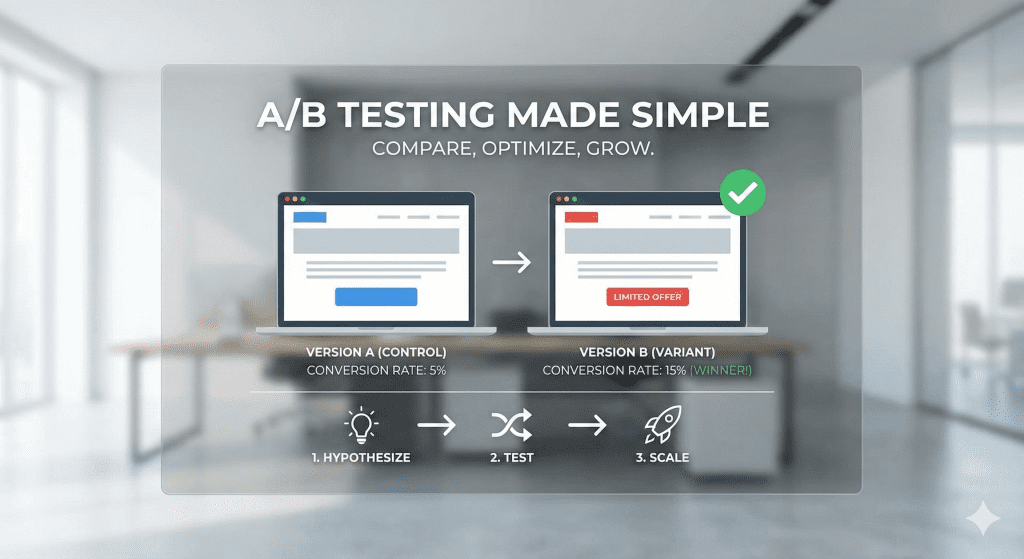
A/B testing is a method used to compare two versions of the same asset to see which one performs better against a defined goal. One version is the original, often called the control. The other version includes a single, intentional change and is known as the variation.
Both versions are shown to different segments of the audience at the same time. Because the audience is split, the results reflect how real users respond, not how the creator expects them to respond. This makes A/B testing a practical way to evaluate decisions using evidence rather than instinct.
At its core, A/B testing is about isolating cause and effect. If only one element changes between the two versions, any meaningful difference in performance can be attributed to that change. This is what separates A/B testing from casual experimentation or guesswork.
It is also important to understand what A/B testing is not. It is not testing multiple changes at once. It is not redesigning an entire page and hoping for the best. And it is not a one-time activity meant to deliver a permanent answer. A/B testing is a controlled comparison designed to answer one clear question at a time.
When used this way, A/B testing becomes a reliable decision-making tool. It helps teams learn how people actually behave, not how they think they will behave. That understanding is what makes testing valuable across websites, emails, ads, and product experiences.

Why A/B Testing Matters
Most decisions in marketing and product design start as assumptions. A headline feels strong. A layout looks clear. A call to action seems obvious. Until those ideas are tested, they remain guesses.
A/B testing matters because it replaces opinion with evidence. Instead of debating what should work, you can measure what actually does. This leads to decisions that are easier to justify and easier to repeat.
Testing also reduces risk. Making changes without data can hurt performance without warning. A/B testing lets you validate ideas on a smaller scale before applying them broadly. If a change improves results, you keep it. If it does not, you learn without causing long-term damage.
Another reason A/B testing matters is consistency. One successful test may improve a single page, but repeated testing builds patterns. Over time, you learn how your audience responds to language, structure, and offers. Those insights can be applied across pages, campaigns, and channels.
Most importantly, A/B testing supports steady improvement. You do not need one dramatic win to see value. Small, proven changes compound. Each test adds clarity, and that clarity leads to better performance decisions over time.
How A/B Testing Works
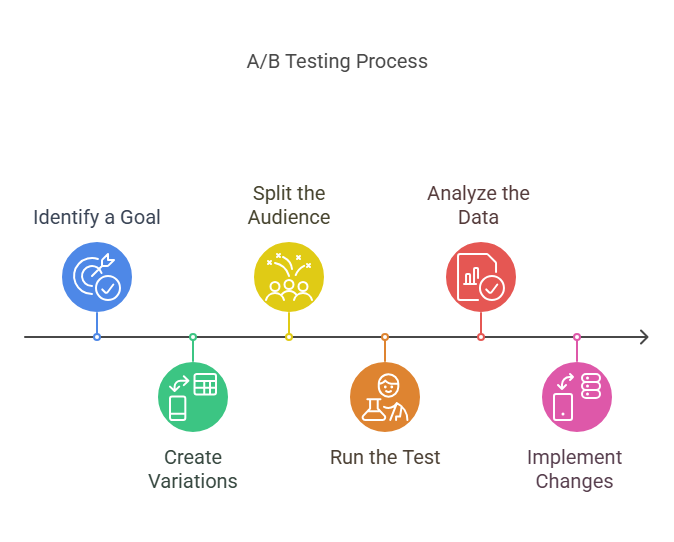
A/B testing works by showing two versions of the same asset to different segments of your audience and measuring how each version performs against a specific goal.
The goal might be clicks, signups, purchases, form completions, or another action that matters to the campaign.
Control And Variation
Version A is the control. It represents the current or original version.
Version B is the variation. It includes one deliberate change, such as a different headline, button label, image, or layout adjustment.
The key is control. Everything should stay the same except the element being tested. When only one variable changes, it becomes easier to understand what influenced the result.
Traffic Split And Testing Conditions
Users are sent to both versions during the same testing period. In most basic A/B tests, traffic is split evenly so each version gets a fair comparison.
Some platforms allow different traffic allocations, but an even split is the simplest setup for beginners.
The test should run long enough for both versions to collect meaningful data. Ending too early can create misleading results because early performance often changes as more people interact with each version.
Measuring The Result
Once the test has enough data, performance is compared against the metric chosen at the start.
The stronger version is not simply the one that looks better. It is the one that performs better against the goal of the test.
This structure is what makes A/B testing useful. It turns a marketing or design opinion into a controlled comparison, so decisions are based on how real users respond.
Nielsen Norman Group defines A/B testing as a quantitative research method that tests two or more design variations with a live audience to determine which version performs best.
The Step-by-Step A/B Testing Process
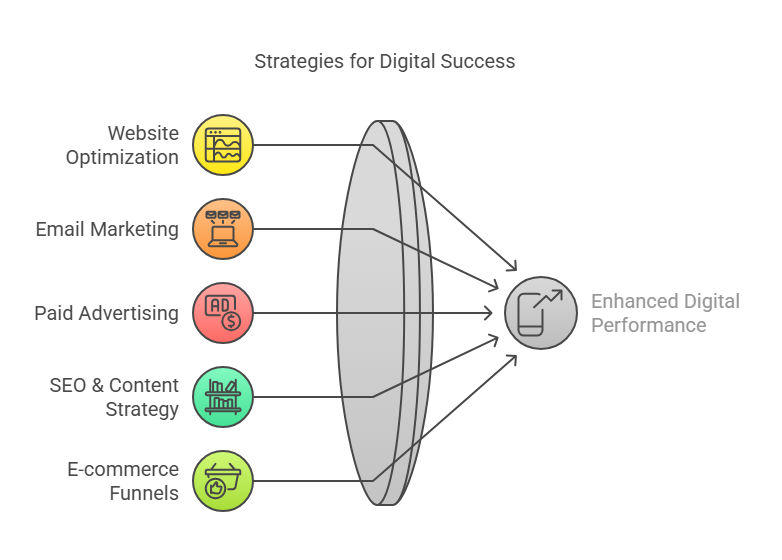
A clean A/B test follows a clear sequence. Each step protects the quality of the result. If you skip steps, change too many things, or judge the test too early, the outcome becomes harder to trust.
- Define The Goal
Start with one clear objective. This could be increasing signups, improving click-through rate, driving purchases, or getting more form completions.
The goal should be specific before the test begins. If the goal is unclear, the result will be easy to misread.
- Choose One Variable To Test
Select one element to change. This might be a headline, call to action, image, form length, offer angle, or layout adjustment.
Testing one variable keeps the test clean. If performance changes, you have a better chance of knowing what caused the difference.
- Create The Variation
Build the alternate version with only the selected change applied. Everything else should stay the same as the control.
This consistency is what makes the comparison fair. The variation should test one idea, not a full redesign.
- Split Traffic Between Both Versions
Send users to both versions during the same testing period. In most basic A/B tests, traffic is split evenly so each version gets a fair comparison.
Some platforms allow different traffic allocations, but an even split is the simplest setup for beginners.
- Run The Test Long Enough
Let the test collect enough data before judging the result. Early performance can shift quickly, especially when the sample size is small.
A test should run until enough people have seen and interacted with both versions to make the comparison meaningful.
- Compare Results Against The Goal
Evaluate the test using the metric chosen at the start. The winning version is the one that performs better against that goal, not the one that looks better or feels more persuasive.
After the test, apply the winner, document what you learned, and use that insight to guide future tests.
Google Ads recommends testing one variable at a time because changing multiple elements can make it difficult to know what drove the result. It also recommends choosing success metrics before the test begins.

What To Test And What To Avoid Testing
Not every element is worth testing. A/B testing works best when you focus on changes that can influence how people understand the offer, evaluate value, or decide to act.
The best tests usually affect one of three things: attention, clarity, or action. If a change does not influence one of those areas, it may not produce a useful result.
High-Impact Elements To Test First
Start with elements that directly affect the user’s decision.
These usually include:
- Headlines that define the main message
- Primary calls to action that guide the next step
- Offer framing that changes how value is understood
- Page layout that affects how quickly key information is found
- Form length when completion is the main goal
These tests are valuable because they sit close to the conversion decision. A stronger headline can make the offer easier to understand. A clearer CTA can reduce hesitation. A better offer frame can change how the reader judges value.
Mid-Impact Elements To Test After
Once the main message and structure are clear, test supporting elements.
These may include:
- Images that reinforce the message
- Button text that clarifies intent
- Color contrast that improves visibility
- Supporting copy that handles objections
- Trust signals such as testimonials, badges, or review snippets
These changes can improve performance, but they usually work best after the core message is already strong. Testing them too early may produce small gains without solving the real problem.
What To Avoid Testing
Some tests create noise without adding useful insight.
Avoid testing:
- Tiny visual changes most users will not notice
- Elements unrelated to the primary goal
- Multiple changes bundled into one test
- Changes made while the page, offer, or audience is still unstable
- Tweaks that improve one metric but hurt the full user journey
The goal is not to test everything. The goal is to test the changes most likely to teach you something useful. A focused test gives you a clearer result and a better decision.
When A/B Testing Makes Sense
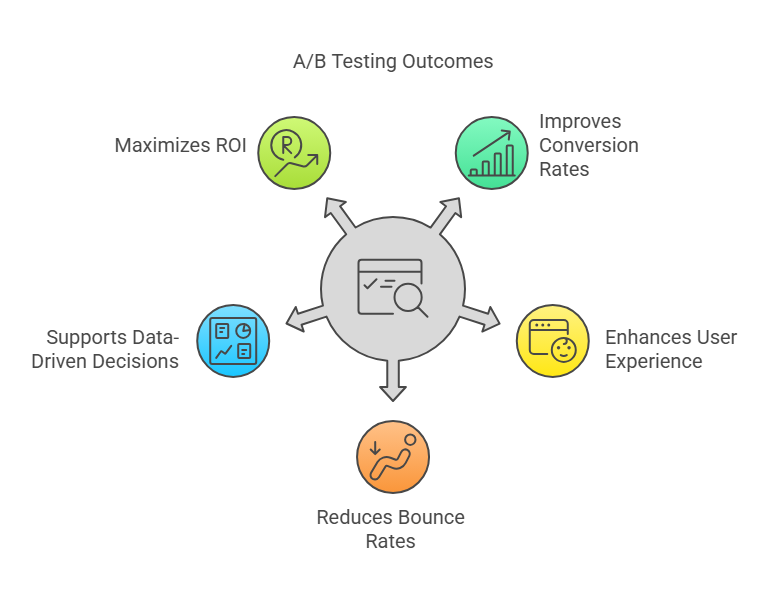
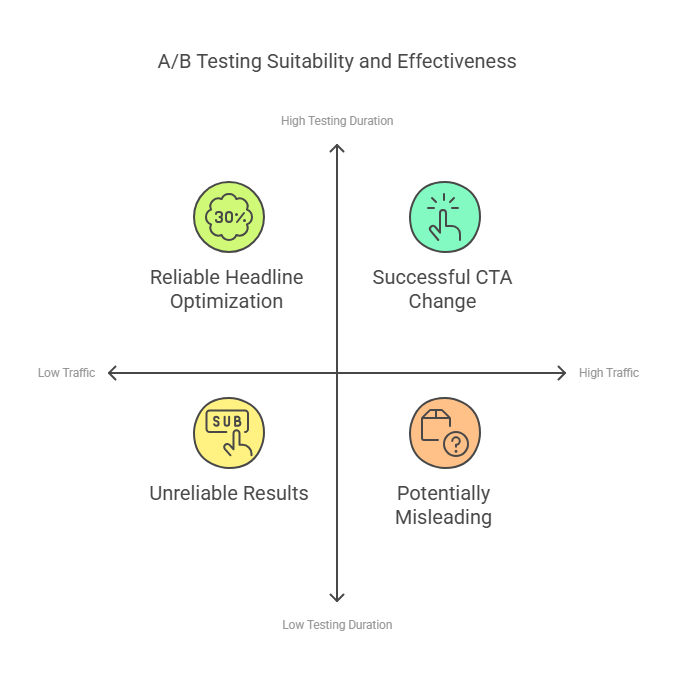
A/B testing is most effective when there is enough activity to support meaningful comparison. Without sufficient data, results can be misleading or inconclusive. Understanding when testing adds value helps you avoid wasted effort.
A/B testing makes sense when you have steady traffic or engagement. Pages, emails, or ads that receive regular visits provide enough interactions to compare versions reliably. The more consistent the activity, the easier it is to detect real performance differences.
It is also useful when you have a clear goal. Testing works best when success is defined upfront, such as increasing signups, clicks, or purchases. A clear objective keeps the test focused and makes the outcome easier to evaluate.
A/B testing is less effective when traffic is very low or when changes are frequent and uncontrolled. If a page is still being redesigned or a campaign is constantly shifting, testing can add noise rather than insight. In these cases, it is better to stabilize the experience first.
Testing also may not be necessary for obvious fixes. If a form is broken or a message is unclear, correcting the issue does not require a test. A/B testing is best reserved for decisions where multiple reasonable options exist and data can guide the choice.
Used in the right situations, A/B testing provides clarity and confidence. Used at the wrong time, it can slow progress and create false signals.
When A/B Testing Makes Sense
A/B testing is most useful when there is enough activity to support a meaningful comparison. Without enough traffic, clicks, signups, or conversions, results can look more certain than they really are.
A/B testing makes sense when the asset already receives steady engagement. Pages, emails, or ads with regular activity give each version enough exposure to reveal useful performance patterns. The more consistent the activity, the easier it is to separate real behavior from random fluctuation.
It also works best when the goal is clear before the test begins. Success should be tied to one primary metric, such as signups, clicks, purchases, or form completions. A clear goal keeps the test focused and prevents the results from being interpreted in multiple ways.
A/B testing is less useful when traffic is very low, when the page is still changing, or when the campaign environment is unstable. If the offer, audience, layout, or settings keep shifting during the test, the result becomes harder to trust.
Testing is also unnecessary for obvious fixes. If a form is broken, a button is hidden, or a message is confusing, fix the issue directly. A/B testing is best reserved for decisions where two reasonable options exist and data can help choose between them.
Used in the right situation, A/B testing provides clarity. Used too early or under unstable conditions, it can create false confidence.
A Simple A/B Testing Example
Imagine a landing page that offers a free downloadable guide. The page receives steady traffic, but the signup rate is lower than expected. The goal is to increase form completions.
The team decides to test the headline because it is the first message visitors see.
Version A uses the original headline:
“Download Our Complete Guide To Better Marketing Performance”
Version B uses a shorter, benefit-focused headline:
“Get More Leads From The Traffic You Already Have”
Everything else on the page stays the same. The form, design, offer, button text, and audience do not change.
After the test runs long enough to collect meaningful data, the results look like this:
| Version | Visitors | Signups | Conversion Rate |
| Version A | 1,000 | 42 | 4.2% |
| Version B | 1,000 | 61 | 6.1% |
Version B performs better against the goal. The shorter headline makes the value easier to understand and connects the guide to a specific outcome.
The insight is not just that one headline won. The useful lesson is that this audience responds better to outcome-focused language than broad descriptive language.
That insight can now guide future landing pages, email subject lines, and ad copy.

Common A/B Testing Mistakes
A/B testing can produce misleading results when the process is rushed or poorly controlled. Many bad tests are not caused by weak ideas.
They are caused by unclear setup, unstable conditions, or poor interpretation.
Testing Multiple Variables At Once
Changing more than one element in a single test makes the result harder to understand.
If you change the headline, image, and call to action at the same time, you may see a performance lift, but you will not know which change caused it. A clean A/B test isolates one variable so the lesson is clear.
Ending Tests Too Early
Early results can be unstable. One version may look like the winner after the first few hours or days, then lose that advantage as more users interact with both versions.
Stopping too early can create false confidence. Let the test collect enough data before deciding which version performed better.
Using Sample Sizes That Are Too Small
Small samples can produce dramatic swings that do not reflect real audience behavior.
If only a small number of people see each version, a few extra clicks or signups can make one variation look stronger than it really is. Larger samples usually make the result more stable and easier to trust.
Focusing On The Wrong Metric
Not every metric reflects success.
A test may increase page views, time on page, or clicks without improving the action that actually matters. Each test should be judged against one primary metric tied to the goal, such as signups, purchases, or form completions.
Ignoring The Full User Journey
A change can improve one step while hurting another.
For example, a more aggressive call to action may increase clicks but lower lead quality or reduce completed purchases. A result is only useful if it supports the broader goal, not just one isolated metric.
Changing Conditions During The Test
A/B tests need a stable environment.
If the audience, offer, page layout, campaign budget, or traffic source changes during the test, the result becomes harder to interpret. The cleaner the conditions, the easier it is to trust the outcome.
Avoiding these mistakes keeps testing disciplined. Optimizely explains statistical significance as the likelihood that a difference in conversion rates is not caused by random chance, which is why sample size, timing, and controlled conditions matter in A/B testing.

A/B Testing Tools You Can Use
A/B testing does not require complex software to be useful. The right tool depends on where the test happens, what you want to measure, and how much control the experiment needs.
A simple email subject line test can usually be handled inside an email platform. A landing page test may need a website builder, page builder, or testing tool. A larger experiment across a product or high-traffic site may require a dedicated testing platform.
The tool should support the test. It should not make the process more complicated than the decision you are trying to improve.
Website And Landing Page Tools
Website and landing page tools help you test changes on pages that receive regular traffic.
They are useful for testing headlines, calls to action, layouts, forms, pricing sections, and page structure. Many website builders and landing page platforms include basic testing features, which makes them a practical starting point for simple experiments.
Use this type of tool when the goal is to improve page conversions, such as signups, demo requests, downloads, or purchases.
Email Marketing Platforms
Email platforms are useful for testing messages sent to a subscriber list.
You can test subject lines, preview text, email content, calls to action, sending times, and offer framing. Email testing is often easier to start because the audience is already defined and results such as opens, clicks, and conversions are easier to track.
Use this type of tool when the goal is to improve email engagement or drive more action from an existing list.
Advertising Platforms
Ad platforms allow you to test headlines, descriptions, images, videos, audiences, placements, and offers inside paid campaigns.
These tests are useful because they show how people respond before they reach your landing page. A stronger ad variation can improve click-through rate, reduce wasted spend, or send more qualified traffic to the next step.
Use this type of tool when the goal is to improve campaign performance before optimizing the destination page.
Dedicated Testing Platforms
Dedicated testing platforms offer more control, deeper reporting, and more advanced experiment options.
They are useful for larger sites, product teams, or businesses with enough traffic to run frequent tests. These platforms can support more complex experiments, but they also require more planning and cleaner implementation.
Use this type of tool when testing is a regular part of your marketing, product, or conversion optimization process.
The best tool is the one that fits the test you are ready to run. Starting simple is usually better than adopting advanced software before you have enough traffic, clear goals, or a consistent testing process.
Conclusion
A/B testing gives you a reliable way to improve performance without relying on assumptions. By comparing two versions under the same conditions, you can see how real users respond and make decisions based on evidence rather than opinion.
The value of A/B testing does not come from complex tools or dramatic changes. It comes from focus. One clear goal. One intentional change. Enough data to trust the outcome. When those elements are in place, testing becomes a dependable part of decision making.
Over time, small improvements compound. Each test adds insight into how your audience thinks, reacts, and chooses to act. When A/B testing is treated as an ongoing practice rather than a one-time experiment, it creates clarity, confidence, and more predictable results across your pages, emails, and campaigns.

Frequently Asked Questions
How long should an A/B test run?
An A/B test should run long enough to collect a meaningful amount of data. This usually means several days or weeks, depending on traffic volume. Ending a test too early can lead to unreliable conclusions.
What is a good sample size for A/B testing?
There is no single number that fits every test. Each version should receive enough traffic to show a clear performance pattern. Larger samples reduce the chance of misleading results.
Can beginners run A/B tests without advanced tools?
Yes. Many website builders, email platforms, and ad tools include basic A/B testing features. You can run effective tests without technical expertise or complex software.
Is A/B testing only useful for websites?
No. A/B testing can be applied to emails, ads, landing pages, sign-up forms, checkout flows, and other parts of the user experience. The process stays the same across channels.
Should I test large changes or small changes first?
Start with elements that directly influence the goal, such as headlines, calls to action, or page structure. These often create the most meaningful impact before smaller refinements.
How do I know if my test results are reliable?
Reliable tests have one variable, a clear goal, enough data, and a consistent testing environment. When these conditions are met, the results are easier to trust and apply.

3 Comments
ClickFunnels vs Leadpages: The Brutally Honest 2025 Showdown - Ismel Guerrero. · March 23, 2025 at 9:59 pm
[…] A/B Testing Strategies for Beginners Test one element at a time—like a headline, CTA button, or offer format—for clearer data. […]
High-Converting Landing Pages to Maximize Results - Ismel Guerrero. · July 5, 2025 at 8:54 am
[…] Check out our A/B Testing Guide. […]
Conversion Rate Optimization: Step-by-Step Guide - Ismel Guerrero. · March 3, 2026 at 6:49 pm
[…] A/B testing, multivariate testing, and user behavior […]