Introduction
Content marketing is a strategic publishing discipline built around creating consistent, useful content that attracts and retains a defined audience.
For affiliate businesses, this discipline is not optional. It is the foundation that makes monetization possible without relying on aggressive promotion. When content is planned around real questions, clear explanations, and long-term relevance, affiliate links become a natural extension of the value provided.
This article explains how content marketing works in an affiliate model, how to build a strategy around it, and how to apply it responsibly without undermining trust.
Key Takeaways
- Content marketing is the core system that supports affiliate monetization.
- Strategy and consistency matter more than individual high-converting pages.
- Affiliate content works best when planned around search intent and audience needs.
- Trust, transparency, and balance are part of the content process, not add-ons.
- SEO strengthens content distribution when it supports clarity and structure.
Disclaimer: I am an independent Affiliate. The opinions expressed here are my own and are not official statements. If you follow a link and make a purchase, I may earn a commission.

What content marketing means in an affiliate business model
In an affiliate business, content marketing is the system that connects audience attention to monetization. Instead of treating content as a way to place links, it treats content as the primary asset that attracts, educates, and retains readers over time.
This model changes how success is measured. Individual pages matter, but the larger value comes from a body of work that consistently answers related questions. Each article builds context for the next, making recommendations feel expected and earned rather than inserted.
Affiliate monetization fits into this system as a layer, not the foundation. Products are introduced only when they are relevant to the topic being explained. This keeps the content useful even for readers who never click a link, which strengthens long-term credibility and repeat visits.
The practical takeaway is that affiliate content should be planned and evaluated like any other content marketing program. Topics are chosen for relevance and usefulness first, and monetization follows naturally from that alignment.
How affiliates build a content marketing strategy
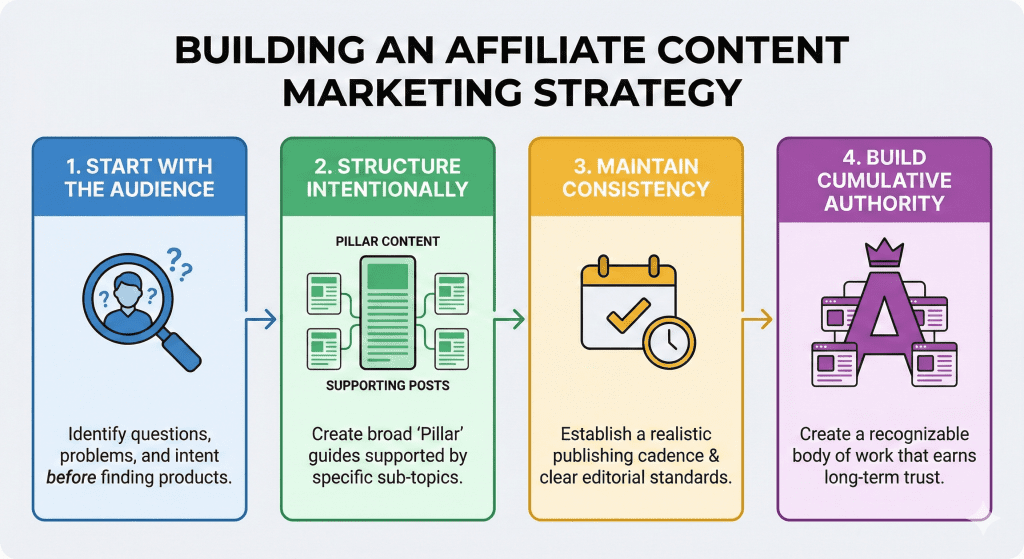
A content marketing strategy gives affiliate businesses direction and restraint. Instead of publishing isolated articles, it defines what the site or channel is about, who it serves, and which problems it consistently helps solve. This clarity prevents content from drifting toward opportunistic topics that may convert short term but weaken authority over time.
The process starts with the audience, not products. Affiliates identify the questions, situations, and decisions their readers face before researching tools or offers. This ensures content is organized around needs and intent, rather than around affiliate programs.
From there, topics are structured intentionally. Core subjects become pillar pieces that explain broad concepts, supported by more specific articles that explore subtopics, comparisons, or use cases. This creates a coherent content ecosystem where each piece reinforces the others.
Consistency completes the strategy. A realistic publishing cadence, clear editorial standards, and a repeatable format help content compound in value. Over time, the strategy turns individual articles into a recognizable body of work that readers trust and search engines understand.
Content types affiliates use across the marketing funnel
Content marketing works across different stages of awareness and decision-making. For affiliates, this means using distinct content types intentionally, not interchangeably. Each format supports a specific reader mindset and plays a different role in the overall strategy.
Informational content for awareness and trust
Informational content introduces topics, explains concepts, and helps readers understand problems before solutions are discussed. Guides, tutorials, and explanatory articles work well at this stage because they reduce confusion and establish credibility without pushing decisions.
In an affiliate context, this content builds familiarity and authority. Monetization is secondary and often minimal, but its long-term value is high because it brings in new readers and sets expectations for how recommendations will be handled later.
Comparative content for evaluation
Comparative content serves readers who are actively weighing options. They understand the problem and want help choosing between approaches, tools, or products. Comparison posts, alternatives articles, and “best for” guides fit here.
The focus should be on criteria and context rather than winners. Explaining why options differ and who each is suited for helps readers make confident decisions. This type of content often performs well commercially because it aligns closely with evaluation intent.
Transactional content for decision support
Transactional content supports readers who are close to acting. Reviews and buyer’s guides provide reassurance, clarify expectations, and address final concerns. At this stage, readers value honesty and specificity more than enthusiasm.
Strong transactional content remains useful even after the decision is made. Clear structure, balanced assessment, and transparent disclosure protect trust at the most sensitive point in the funnel.
📊 The 70/20/10 Content Mix
Many beginners make the mistake of writing only product reviews. This kills your authority because it makes you look like a salesperson, not an expert.
To build long-term trust and traffic, aim for this publishing ratio:
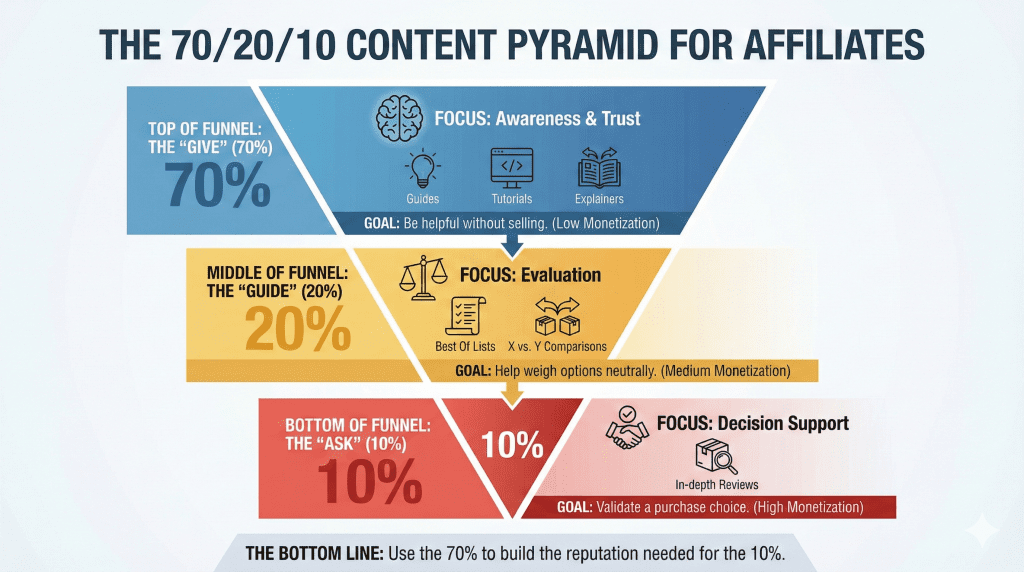
- 70% Informational (The “Give”): How-to guides, tutorials, and explainers. These build trust and attract backlinks. (Monetization: Low).
- 20% Comparative (The “Guide”): “Best X vs Y” or “Top 10 Tools.” These help people who are evaluating options. (Monetization: Medium).
- 10% Transactional (The “Ask”): Deep-dive product reviews and specific recommendations. These convert the trust you built in the other 90%. (Monetization: High).
The Rule: You have to earn the right to sell. The 70% earns it.
Practical Application: The 70/20/10 Rule in Action
The easiest way to understand the content mix is to see it applied to a real-world niche. In this example, we will use a Home Coffee Brewing website to show how the three content types work together to build trust and sales.
1. The 70% | Informational Content (The “Give”)
Goal: Answer questions and solve problems. No selling.
- Article Title: “Why Is My Coffee Bitter? Understanding Grind Size and Water Temperature.”
- The Content: This article explains the science of brewing. It teaches the reader that bitter coffee usually comes from over-extraction. It offers free value.
- The Link: It does not link to a product. Instead, it links to your Comparative article: “If you are struggling to get a consistent grind, check out our guide on Burr vs. Blade Grinders.”
2. The 20% | Comparative Content (The “Guide”)
Goal: Help the reader evaluate their options.
- Article Title: “Burr Grinders vs. Blade Grinders: Which One Do You Actually Need?”
- The Content: This article breaks down the pros and cons of each type. It helps the reader decide based on their budget and taste. It builds authority by being neutral.
- The Link: It links to specific product reviews for readers who are ready to choose: “If you decide a Burr grinder is right for you, read our full review of the Baratza Encore.”
3. The 10% | Transactional Content (The “Ask”)
Goal: Validate the purchase decision.
- Article Title: “Baratza Encore Review: Is It Still the King of Entry-Level Grinders?”
- The Content: This is a deep-dive review. It covers durability, noise levels, and grind consistency. It answers specific buyer questions like “Is it hard to clean?”
The Link: This contains the direct affiliate link to the retailer. Because the reader arrived here through the educational content (the 70% and 20%), they trust this recommendation completely.
Creating content that earns trust before monetization
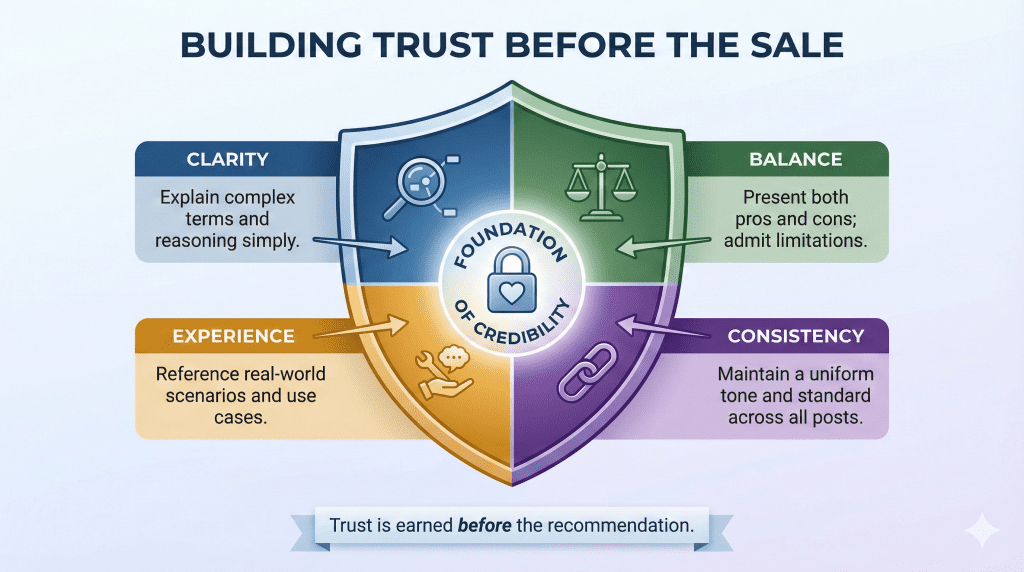
In content marketing, trust is not created at the moment of recommendation. It is built gradually through how consistently content helps readers think more clearly about a topic. For affiliates, this means separating the act of teaching from the act of monetizing.
Clear explanations are the foundation. When content defines terms, explains reasoning, and walks through decisions step by step, it signals competence without self-promotion. Readers are more receptive to recommendations when they understand how conclusions are reached.
Balance strengthens that signal. Acknowledging trade-offs, limits, or situations where a product is not a good fit reduces skepticism. Content that presents only positives feels incomplete, especially to readers who are already cautious about affiliate motives.
Experience adds credibility without requiring claims. Referencing common scenarios, practical constraints, or typical use cases shows familiarity with the subject. This helps content feel grounded rather than theoretical.
Transparency ties everything together. Consistent disclosures, neutral language, and predictable recommendation standards teach readers how to interpret the content. Over time, that predictability becomes a trust multiplier.
SEO as a distribution layer for content marketing
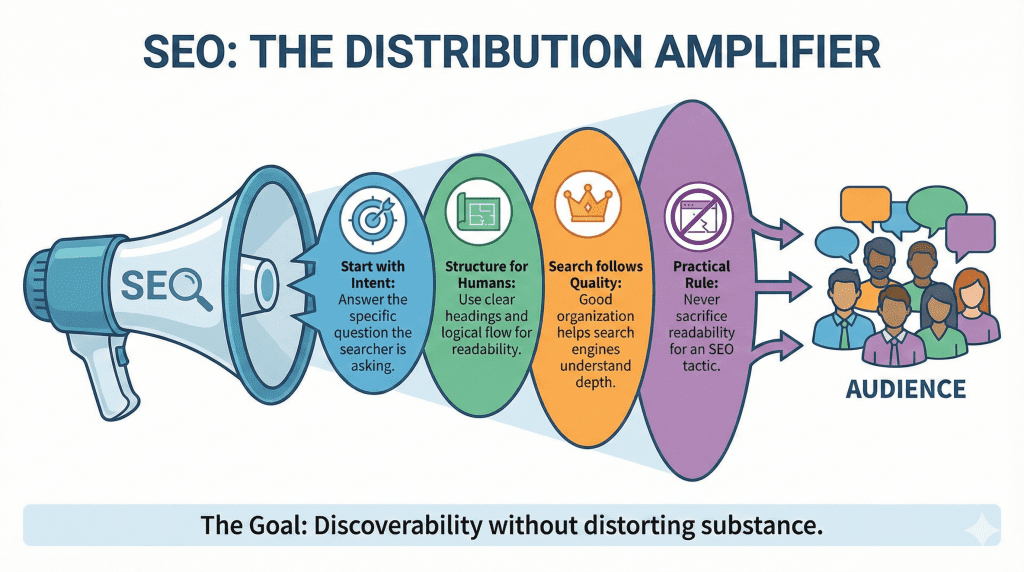
SEO supports content marketing by helping the right content reach the right audience at the right time. For affiliates, this means treating search as a distribution channel, not a writing style. The goal is discoverability without distorting the substance of the content.
The starting point is search intent. Topics are chosen based on the questions readers are actually asking, then developed fully so the content resolves uncertainty rather than skimming the surface. When intent is clear, keyword use becomes a byproduct of good structure instead of a separate optimization task.
Organization matters as much as wording. Clear headings, logical section flow, and internal links between related articles help readers navigate and help search engines understand topical depth. This reinforces the idea that content marketing is cumulative, not page by page.
Restraint is the practical rule. If an SEO tactic makes content harder to read or more promotional, it usually works against long-term performance. Content that is complete, well-structured, and genuinely useful tends to earn both engagement and visibility over time.
Disclosure, compliance, and ethical content standards
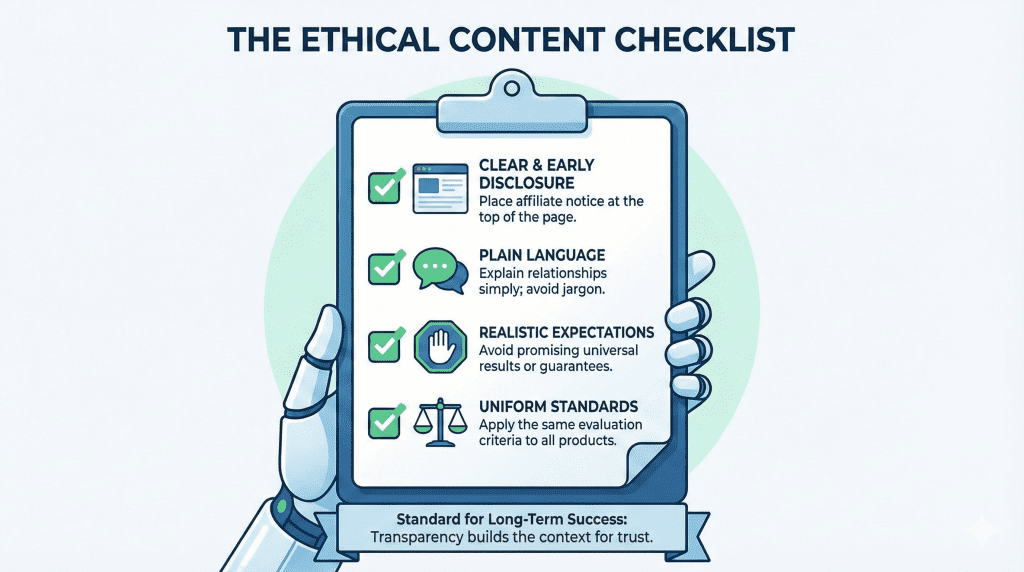
Disclosure is a core part of ethical content marketing, not an afterthought. For affiliate businesses, transparency sets the context for every recommendation and allows readers to evaluate information with clear expectations.
Disclosures should appear early and be written in plain language. Readers should immediately understand that the content may include affiliate relationships and what that means. Clear placement and consistent wording prevent confusion and reduce skepticism.
Ethical standards extend beyond disclosure. Content marketing should avoid promises, guarantees, or claims that imply universal outcomes. Products and services work differently depending on circumstances, and responsible content reflects that variability instead of minimizing it.
Consistency reinforces trust at scale. When disclosures, tone, and evaluation criteria remain uniform across content, readers learn how to interpret recommendations. This predictability strengthens credibility and protects the long-term integrity of the content marketing program.
Conclusion
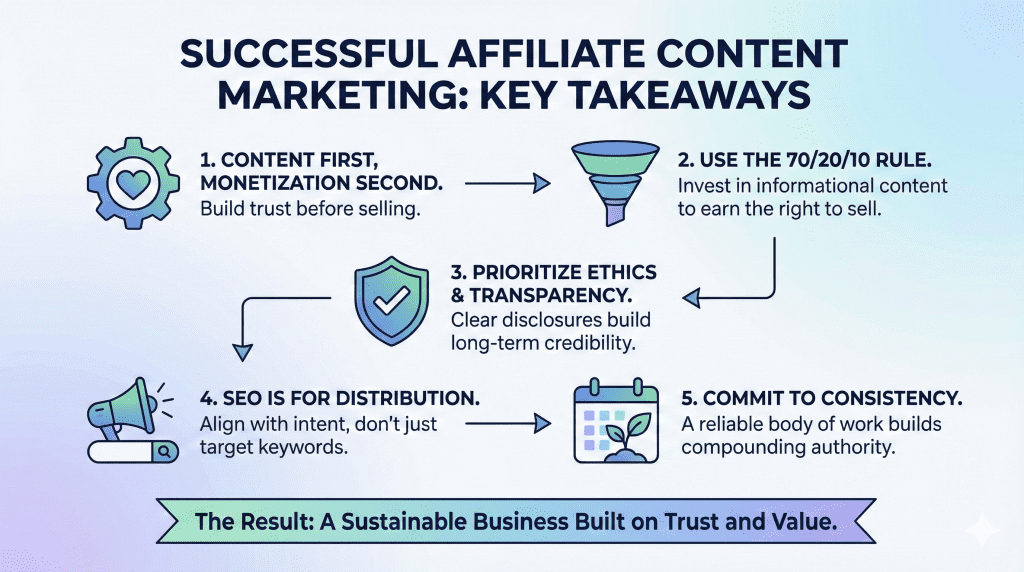
Content marketing is the engine that makes affiliate businesses sustainable. When content is treated as a long-term publishing practice rather than a conversion tactic, it creates space for clarity, consistency, and trust to develop naturally.
Affiliates who lead with content strategy, align topics with real intent, and use SEO as a distribution layer build authority that compounds over time. In this model, monetization is not forced into every page. It appears where it makes sense and feels credible because it is supported by context.
The result is a content ecosystem that serves readers first and performs commercially as a consequence. That balance is what allows content marketing for affiliates to remain effective, compliant, and durable over the long term.
Frequently Asked Questions
What is content marketing for affiliates?
Content marketing for affiliates is the practice of building a consistent body of useful content that attracts an audience and supports affiliate monetization naturally. The content comes first, and affiliate links are added only where they are relevant and helpful.
How is affiliate content marketing different from traditional content marketing?
The principles are the same, but the business model differs. In affiliate marketing, content must balance education with transparent recommendations, while maintaining trust and compliance throughout.
Which content types work best for affiliate businesses?
Informational content builds awareness, comparative content supports evaluation, and transactional content helps with final decisions. A strong strategy uses all three across the funnel.
How does SEO support content marketing for affiliates?
SEO helps distribute content to the right audience by aligning topics with search intent and structuring content clearly. It works best when it enhances clarity rather than driving promotional language.
Where should affiliate disclosures be placed?
Disclosures should appear near the top of the content, before or close to the first affiliate mention. They should be written in clear, plain language that is easy for readers to understand.

0 Comments