Introduction
Content marketing is the practice of creating and distributing useful, relevant content to attract and retain a clearly defined audience. It is not a campaign or a channel, but a long-term strategy built around trust, consistency, and relevance. When done well, content marketing helps people understand problems, evaluate options, and make better decisions over time.
This discipline matters because audiences increasingly ignore direct promotion. They look instead for clarity, guidance, and credibility. Content marketing meets that expectation by prioritizing usefulness before outcomes and relationships before transactions.
This guide explains how content marketing works as a strategy, how to plan and create effective content, how distribution and measurement fit into the system, and how content marketing adapts across different business models.
Key Takeaways
- Content marketing is a long-term strategy, not a one-time campaign.
- Effective content marketing starts with audience needs, not products.
- Strategy and consistency matter more than volume.
- Distribution and measurement support content, they do not replace it.
- Trust and clarity are the foundation of sustainable results.
Disclaimer: I am an independent Affiliate. The opinions expressed here are my own and are not official statements. If you follow a link and make a purchase, I may earn a commission.
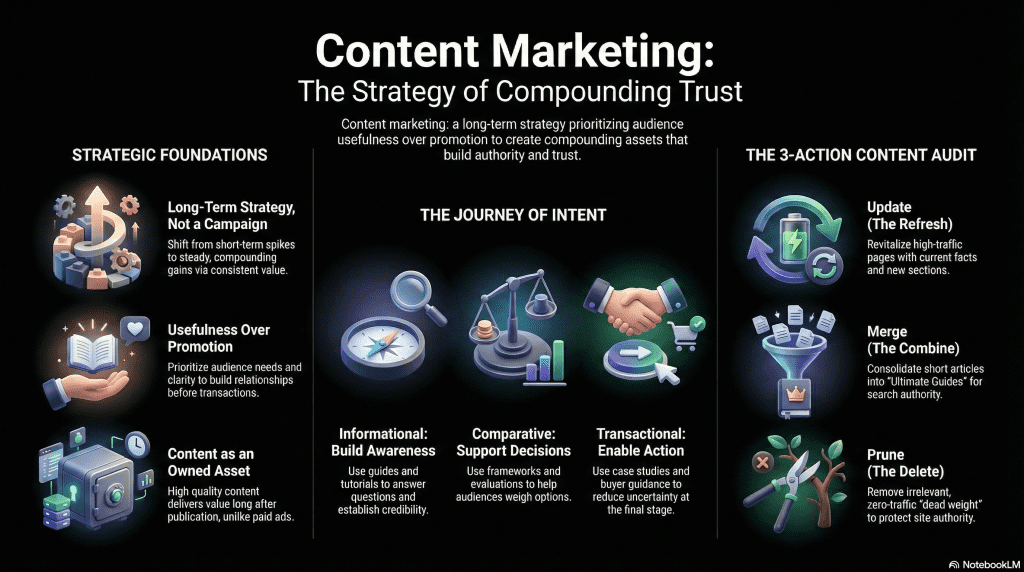
What content marketing is and what it is not
Content marketing is a strategic approach to publishing that focuses on helping an audience understand, decide, or act more confidently over time. Its purpose is to create value through information and insight, not to interrupt or persuade aggressively. When done correctly, it builds a relationship with the audience before asking for attention, trust, or action.
What content marketing is centered on usefulness. It addresses real questions, explains concepts clearly, and provides context that helps people think more clearly about a topic. Each piece of content is designed to stand on its own while also contributing to a broader body of work.
What content marketing is not is promotion disguised as education. Publishing content solely to insert keywords, push products, or capture short-term traffic undermines credibility quickly. Content that exists only to convert tends to perform poorly over time because it fails to earn trust.
The distinction matters because content marketing compounds. When content is created with strategy and intent, it becomes an asset that continues to attract, educate, and support audiences long after publication.

How content marketing works as a business strategy
As a business strategy, content marketing aligns audience needs with long-term organizational goals. Instead of competing for attention through interruption, it earns attention by being consistently useful. This shifts growth from short-term spikes to steady, compounding gains.
The strategy begins with understanding the audience’s problems, questions, and decision paths. Content is then planned to support those needs across time, not just at the moment of conversion. This makes content marketing effective even when readers are not ready to act immediately.
Content also functions as an owned asset. Unlike paid channels, high-quality content continues to deliver value after it is published, provided it is maintained and updated. Over time, this creates leverage: each new piece strengthens the overall system rather than standing alone.
The practical outcome is strategic patience. Content marketing works best when businesses commit to clarity, consistency, and relevance, allowing trust and authority to build naturally as the content library grows.
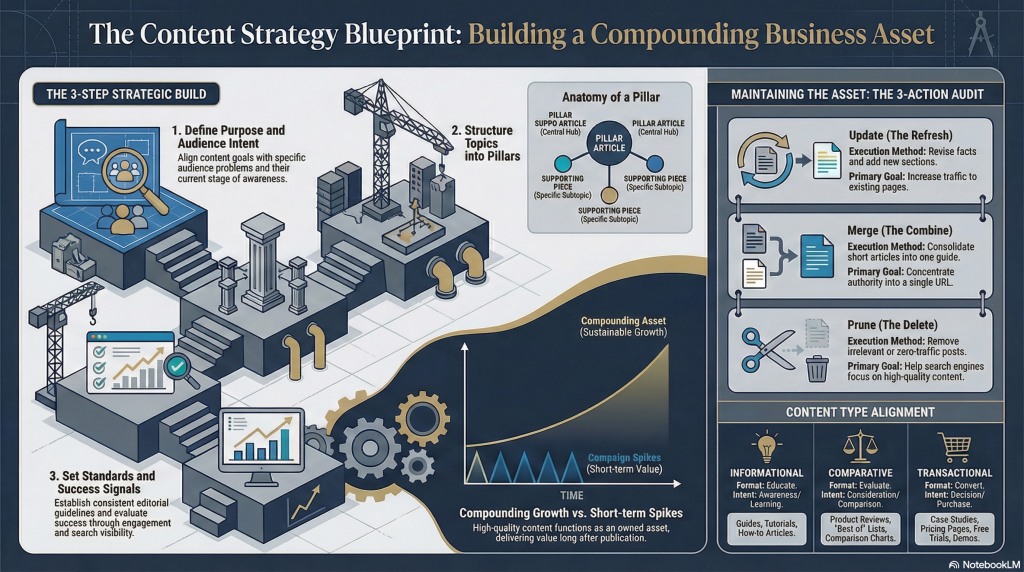
How to build a content marketing strategy
Building a content marketing strategy is about making deliberate choices before content is created. The goal is to ensure every piece of content serves a clear purpose and contributes to a larger system rather than existing in isolation.
Step 1: Define the purpose of your content marketing
Start by clarifying why content exists for the business. This might include educating an audience, supporting sales conversations, building authority, or improving retention. A clear purpose acts as a filter for what should and should not be published.
Step 2: Understand your audience and their intent
Effective strategies are grounded in real audience needs. Identify the questions, problems, and decisions your audience faces, then group them by intent or stage of awareness. This prevents content from being driven by assumptions or trends alone.
Step 3: Choose core topics and prioritize them
Select a small number of core subjects that your business can consistently support with high-quality content. These topics should align with audience needs and long-term relevance. From there, prioritize based on importance, demand, and your ability to add meaningful insight.
Step 4: Structure content into pillars and supporting pieces
Organize content so that broad, foundational topics are covered in pillar articles, supported by more specific pieces that explore subtopics, examples, or applications. This structure improves clarity for readers and reinforces topical depth over time.
Step 5: Set editorial standards and a realistic cadence
Define guidelines for tone, depth, sourcing, and formatting so content remains consistent regardless of who creates it. Pair this with a publishing cadence that can be maintained long term. Consistency matters more than frequency.
Step 6: Decide how success will be evaluated
Determine which signals matter most, such as engagement, search visibility, or contribution to downstream actions. Measurement should support learning and improvement, not just reporting. This keeps the strategy adaptive without becoming reactive.
Bottom line: a strong content marketing strategy turns content from a series of outputs into a coherent, long-term asset.
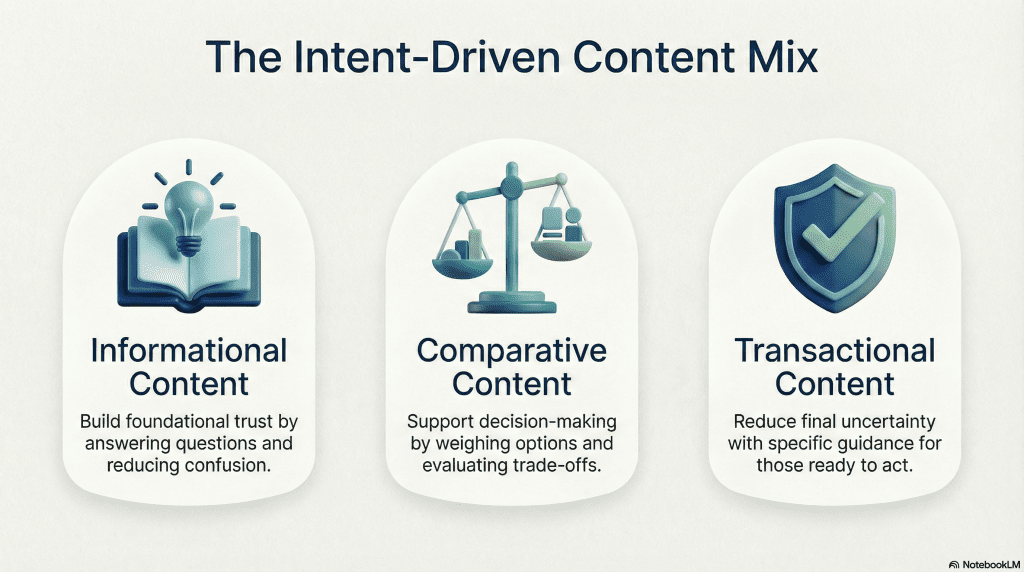
Content types used in content marketing
Content marketing relies on a mix of formats, each designed to serve a specific purpose in the audience’s journey. Choosing the right content type is less about creativity and more about intent, clarity, and usefulness.
Informational content
Informational content helps people understand a topic or problem more clearly. Guides, tutorials, explainers, and foundational articles fall into this category. Their role is to build awareness and trust by reducing confusion and answering common questions.
This type of content is often the entry point for new audiences. While it may not drive immediate action, it establishes credibility and creates the context needed for deeper engagement later.
Comparative and evaluative content
Comparative content supports decision-making. It helps audiences weigh options, understand differences, and evaluate trade-offs. Examples include comparisons, alternatives articles, frameworks, and side-by-side evaluations.
The value here comes from clarity and criteria, not conclusions. Explaining how to think about a choice is often more helpful than telling readers what to choose.
Transactional and decision-support content
Transactional content assists audiences who are close to acting. Case studies, buyer guidance, and recommendation-oriented content fit this category. The goal is to reduce uncertainty by addressing final questions and setting realistic expectations.
Strong transactional content remains balanced and specific. It acknowledges limitations and context, which protects trust at the most sensitive stage of the journey.
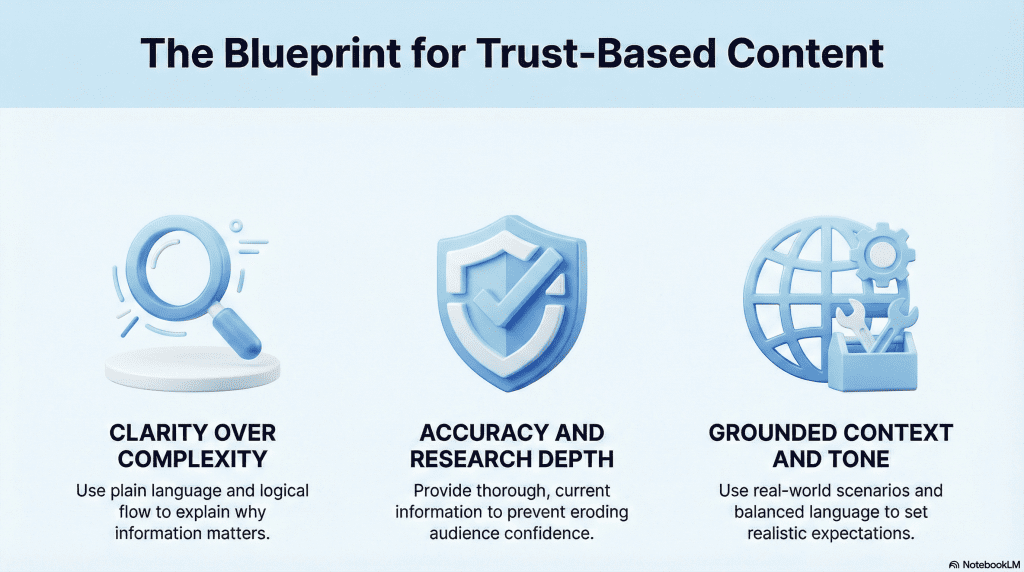
Creating high-quality content that builds trust
High-quality content marketing is defined less by style and more by substance. Trust is built when content consistently helps readers think more clearly, not when it tries to impress or persuade.
Clarity comes first. Strong content explains ideas in plain language, defines terms when needed, and follows a logical progression. Readers should be able to understand not just what is being said, but why it matters and how conclusions are reached.
Accuracy and depth reinforce that clarity. Content should be well-researched, current, and appropriately thorough for the topic. Shallow coverage or vague generalities erode confidence, especially when readers are making decisions based on the information.
Experience adds context without requiring claims of authority. Referencing common scenarios, constraints, or real-world considerations helps content feel grounded and practical. This signals familiarity and care rather than expertise by assertion.
Tone completes the picture. Balanced language, acknowledgment of trade-offs, and transparent sourcing set realistic expectations. When readers know what content can and cannot do for them, trust grows naturally.
Distribution channels for content marketing
Distribution determines whether content is discovered, used, and remembered. Even high-quality content has limited impact if it is not placed where the right audience can find it at the right time. Content marketing treats distribution as an extension of strategy, not an afterthought.
Search is often the primary channel. SEO helps content reach audiences who are actively looking for information, making it especially effective for evergreen topics. Clear structure, intent alignment, and internal linking improve discoverability without changing how the content is written.
Email and newsletters support ongoing relationships. They allow content to reach people who have already shown interest, reinforcing consistency and encouraging return engagement. In this context, distribution is about continuity rather than reach.
Social and community platforms amplify visibility and feedback. These channels work best when content is adapted to the norms of the platform and shared as a resource, not as a promotion. Repurposing key ideas across formats can extend the lifespan of strong content.
Bottom line: effective distribution ensures content marketing connects usefulness with visibility, allowing value to compound over time.
Measuring content marketing performance
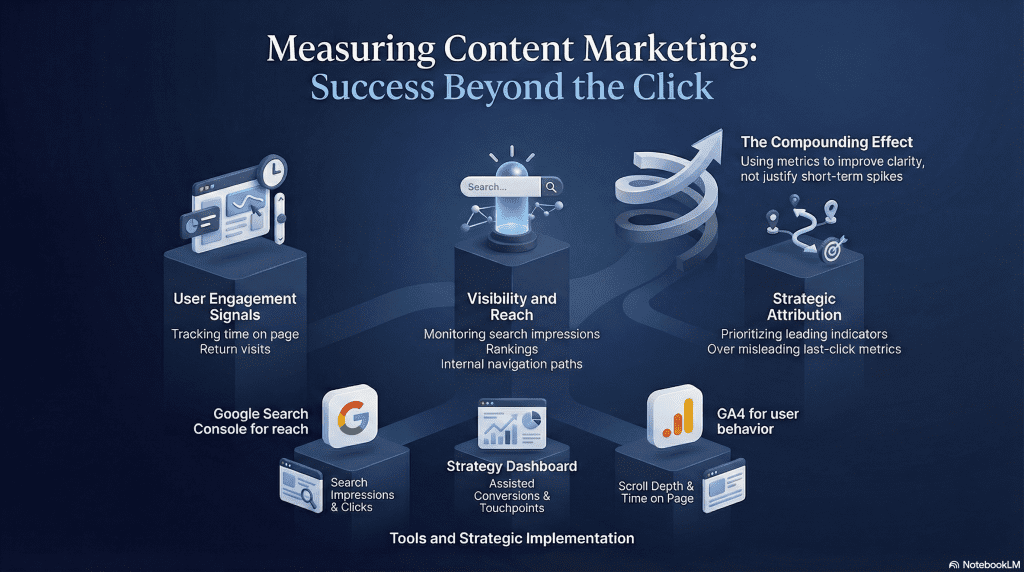
Measuring content marketing performance is about understanding what is working and why, not proving immediate returns. Because content marketing compounds over time, metrics should reflect both short-term engagement and long-term contribution.
Engagement signals are a starting point. Time on page, scroll depth, return visits, and interaction patterns help indicate whether content is actually being used. These signals show clarity and relevance, even when no immediate action follows.
Visibility and reach provide additional context. Search impressions, rankings, and internal navigation paths reveal how content is discovered and how well it fits within the broader content system. These metrics help identify gaps in coverage or opportunities for expansion.
Attribution should be handled carefully. Content often supports decisions indirectly, influencing awareness or understanding before any measurable conversion occurs. Leading indicators, such as assisted conversions or content touchpoints, are usually more meaningful than last-click metrics alone.
Bottom line: effective measurement balances patience with insight, using metrics to improve clarity and strategy rather than to justify short-term outcomes.
Where to find these numbers: Use Google Search Console for impressions/clicks and GA4 (Google Analytics) for time on page/scroll depth.”
Maintaining and scaling content marketing
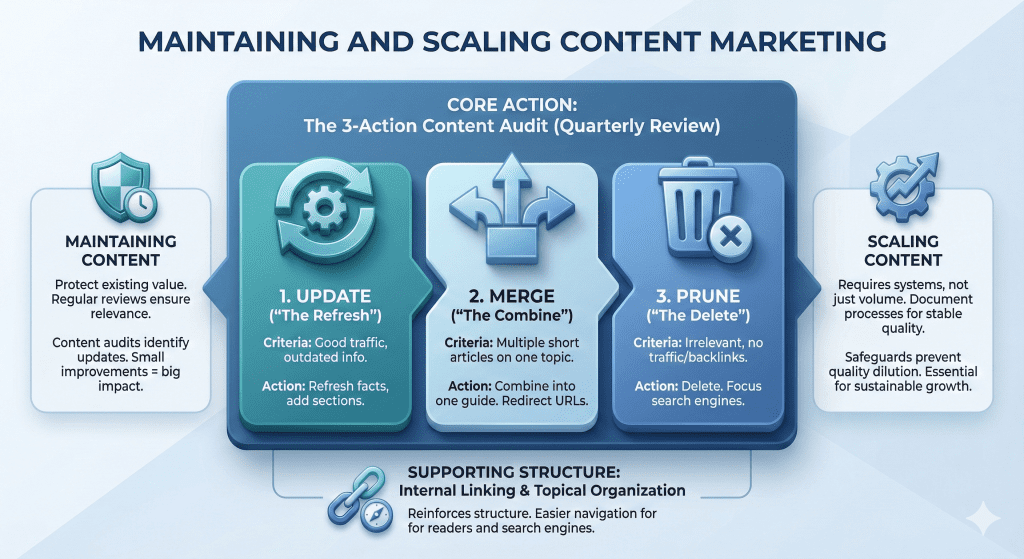
Maintaining content marketing is about protecting the value of what has already been created. Over time, content can become outdated, misaligned with audience needs, or disconnected from newer pieces. Regular reviews help ensure that core topics remain accurate, clear, and relevant.
Content audits are a practical starting point. Reviewing performance, freshness, and topical coverage helps identify what should be updated, consolidated, or expanded. Small improvements to existing content often produce more impact than creating new content from scratch.
Scaling content marketing requires systems, not just volume. Clear editorial standards, documented processes, and consistent formats allow content quality to remain stable as output increases. Without these safeguards, scaling often leads to dilution rather than growth.
Internal linking and topical organization support both maintenance and scale. As content libraries grow, intentional connections between related pieces reinforce structure and make the overall system easier to navigate for both readers and search engines.
The 3-Action Content Audit
You don’t need to keep every page you have ever published. In fact, low-quality pages can drag down your site’s overall authority.
Once a quarter, review your content library and assign one of three actions to every URL:
- Update (The “Refresh”): Does the page have good traffic but outdated info? Update the facts, add a new section, and change the “Last Updated” date.
- Merge (The “Combine”): Do you have three short articles on the same topic? Combine them into one “Ultimate Guide” and redirect the old URLs to the new one. This concentrates authority.
- Prune (The “Delete”): Is the post irrelevant, receiving zero traffic, and earning no backlinks? Delete it. Removing “dead weight” helps search engines focus on your best content.
How content marketing adapts to different business models
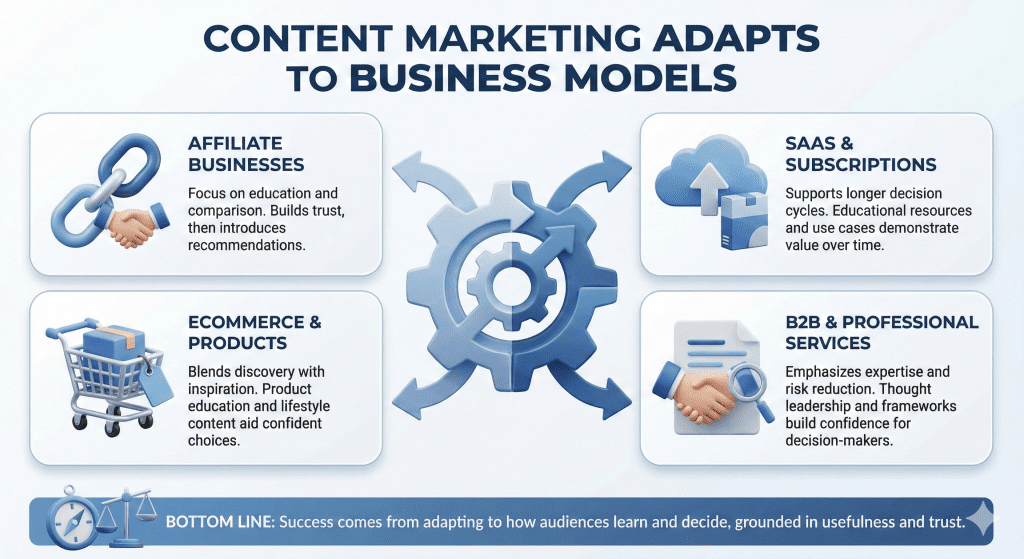
The principles of content marketing remain consistent, but how they are applied varies by business model. Audience needs, buying cycles, and success metrics shape how content is planned and evaluated.
In affiliate businesses, content marketing focuses on education and comparison. Content builds trust first, then introduces recommendations where they are contextually relevant. Revenue is a byproduct of clarity and credibility rather than direct promotion.
In SaaS and subscription businesses, content often supports longer decision cycles. Educational resources, use cases, and onboarding-style content help prospects understand value over time and reduce friction after conversion.
For ecommerce and product brands, content marketing blends discovery with inspiration. Product education, buying guides, and lifestyle content help audiences make confident choices while strengthening brand perception.
In B2B and professional services, content marketing emphasizes expertise and risk reduction. Thought leadership, frameworks, and in-depth explanations help decision-makers evaluate fit and build confidence before engaging directly.
Bottom line: content marketing succeeds across models when it adapts to how audiences learn and decide, while staying grounded in usefulness and trust.
Conclusion
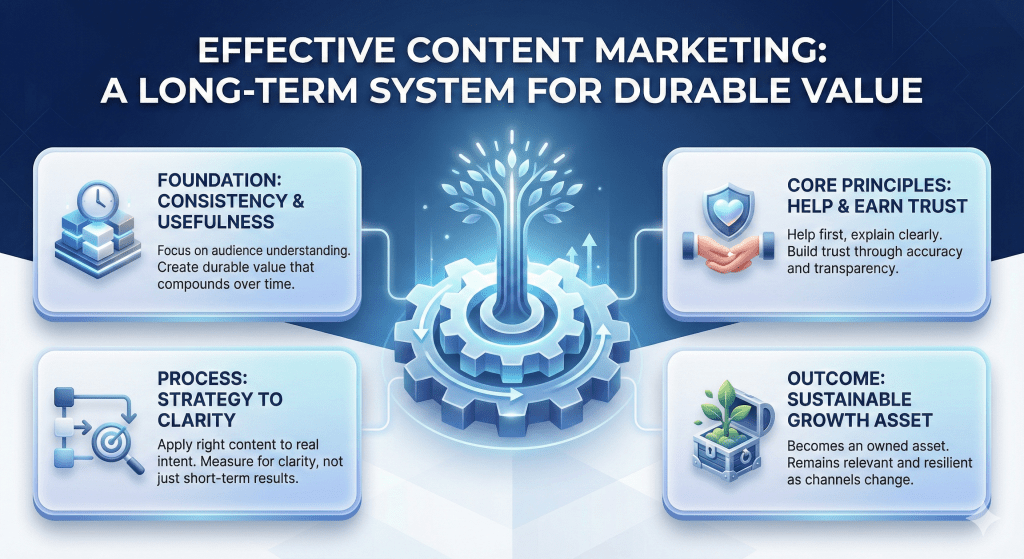
Content marketing is most effective when it is treated as a long-term system rather than a series of isolated tactics. By focusing on usefulness, consistency, and audience understanding, it creates durable value that compounds over time.
A strong content marketing program starts with strategy, applies the right content types to real intent, and uses distribution and measurement to improve clarity rather than chase short-term results. Across business models, the core principles remain the same: help first, explain clearly, and earn trust through accuracy and transparency.
When content is planned and maintained with this mindset, it becomes an owned asset that supports growth in a sustainable way. That is what allows content marketing to remain relevant, effective, and resilient as channels and algorithms change.
Frequently Asked Questions
What is content marketing?
Content marketing is the practice of creating and distributing useful, relevant content to attract and retain a defined audience. Its goal is to build trust and understanding over time, not to promote products directly.
How long does content marketing take to work?
Content marketing is a long-term strategy. Early engagement signals can appear within months, but meaningful results typically compound over time as content accumulates and authority grows.
How is content marketing different from SEO?
SEO focuses on discoverability through search engines, while content marketing focuses on usefulness and audience value. SEO supports content marketing by helping strong content reach the right audience.
What types of content are most effective?
Effective content types depend on intent. Informational content builds understanding, comparative content supports evaluation, and decision-support content helps audiences act with confidence.
How do you measure content marketing success?
Success is measured through a combination of engagement, visibility, and contribution to broader goals. Metrics should help improve strategy and clarity, not just track immediate outcomes.

0 Comments