Introduction
High-ticket affiliate marketing isn’t about chasing clicks or making dozens of tiny sales. It’s about aligning with premium products and programs where one conversion carries real weight. Instead of needing hundreds of buyers, you can focus on fewer, more qualified prospects, the kind of audience that values transformation and is ready to invest in it.
What makes this model powerful is the shift in focus: quality over quantity, authority over volume, and solving meaningful problems over pushing quick wins. With the right strategy, even a small but engaged audience can generate serious commissions by connecting buyers to high-value solutions.
In this guide, you’ll learn what high-ticket affiliate marketing really is, why it works, the niches and offers worth promoting, and how to build a system that consistently attracts premium buyers.
Key Takeaways
- Focus on Authority: Stop chasing clicks. Build trust and credibility instead.
- Leverage Small Audiences: You do not need thousands of leads. A smaller, engaged audience generates substantial commissions.
- Solve High-Stakes Problems: The best programs address urgent needs in finance, business, health, and SaaS.
- Prioritize Strategy: Success comes from choosing the right offers and creating value-driven content.
- Think Long-Term: This model is not about fast wins. It is about sustainable growth and positioning yourself as a trusted guide.
Disclaimer: I am an independent Affiliate. The opinions expressed here are my own and are not official statements. If you follow a link and make a purchase, I may earn a commission.
What Is High-Ticket Affiliate Marketing?
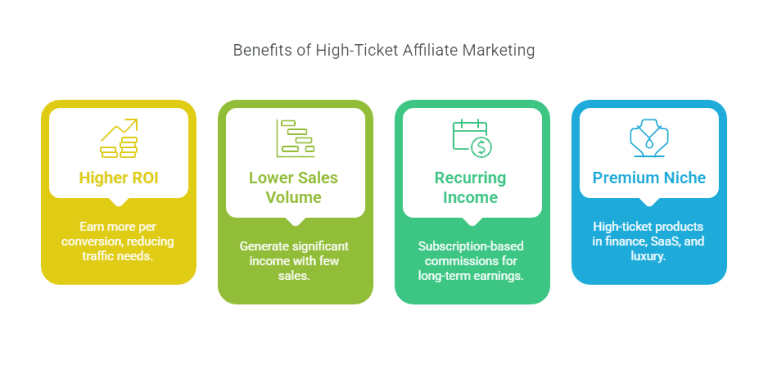
High-ticket affiliate marketing is a business model built around premium products. These products offer significant value to the buyer. You focus on high-quality sales that generate large commissions instead of small, frequent conversions.
The goal is to guide motivated buyers toward solutions that genuinely help them. Do not focus on pushing traffic. Focus on authority. High-ticket buyers are not impulse shoppers. They look for clarity. They want proof. They need a trustworthy advisor.
Your role is to understand their deeper problem. Communicate the value of the solution. Position yourself as someone who can help them make an informed choice.
This approach differs from general affiliate marketing because the content is strategic. Quick product roundups do not convert at premium price points. Surface-level reviews fail to build enough trust. Deeper guidance works best. Create walkthroughs, comparisons, and buyer journeys. Content must reduce risk for someone about to make a meaningful investment.
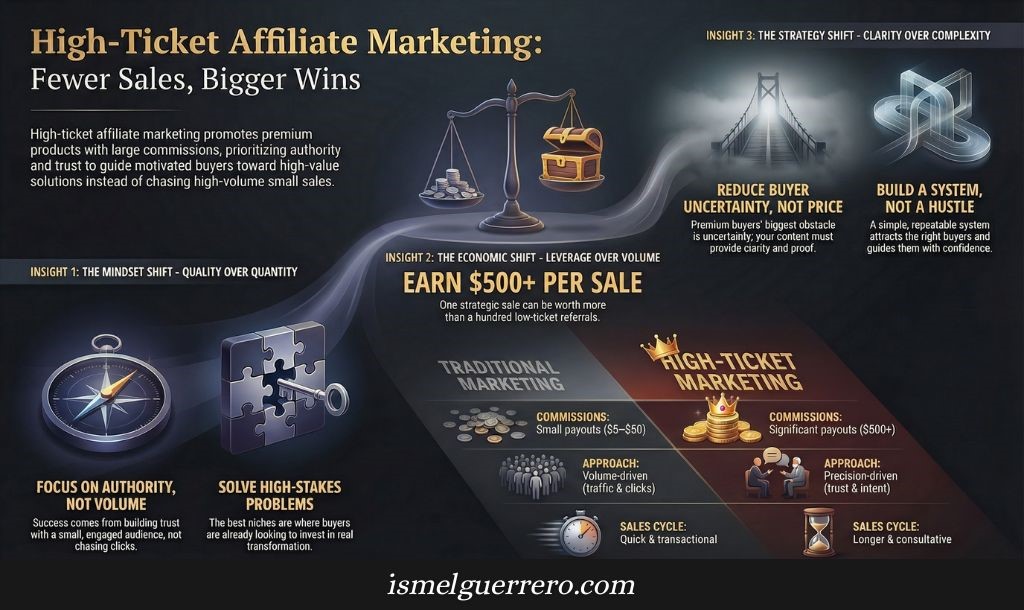
Traditional vs. High-Ticket Affiliate Marketing
| Aspect | Traditional Affiliate Marketing | High-Ticket Affiliate Marketing |
|---|---|---|
| Products | Low-cost, entry-level items (eBooks, trial offers, small tools) | Premium solutions (software, coaching, high-end services) |
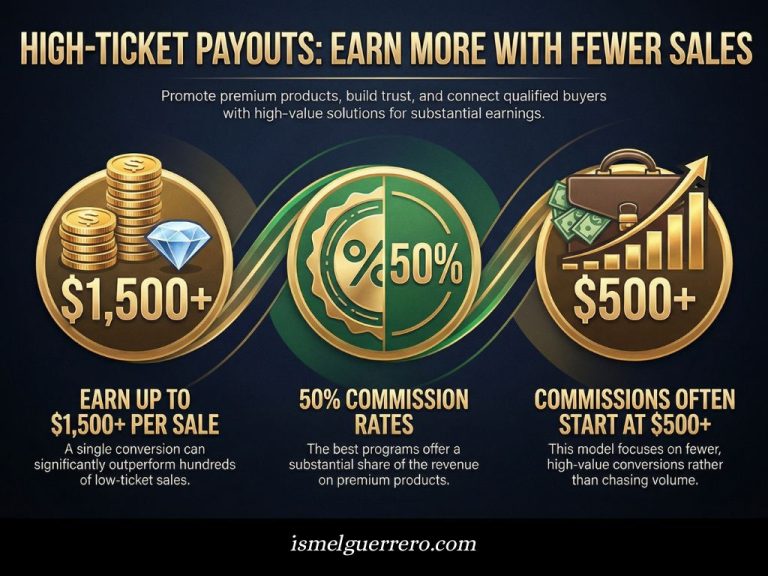
| Commissions | Small payouts ($5–$50 per sale) | Significant payouts ($500+ per sale, often recurring) |
| Approach | Volume-driven: traffic, clicks, and constant posting | Precision-driven: fewer leads, deeper trust, higher intent |
| Sales Cycle | Quick, transactional, low-commitment | Longer, consultative, focused on value and authority |
| Competition | High — easy for anyone to enter, low differentiation | Lower — trust, authority, and positioning create barriers |
In the high-ticket world, one smart offer, delivered to the right prospect, can out-earn a hundred random referrals. You’re not hustling harder. You’re moving like a strategist: targeting, nurturing, and closing deals that pay like a real business.
The result? More income, more freedom and more authority. That’s high-ticket affiliate marketing.
How High-Ticket Affiliate Marketing Works
High-ticket affiliate marketing works by connecting a motivated buyer with a premium solution and guiding them through a decision process that feels informed and safe. Instead of relying on impulse clicks or casual browsing, the model centers on understanding how high-value purchases are made and building content that supports that journey.
The process starts with intent. High-ticket buyers are already searching for meaningful answers, often comparing tools, evaluating approaches, or assessing whether a solution is worth the investment. Your content meets them at that moment of evaluation and gives them the clarity they need to move forward.
From there, trust becomes the engine of conversion. Premium buyers want proof that the product works and that the affiliate understands their situation. When you provide detailed explanations, comparisons, case style insights, or transparent walkthroughs, you help reduce uncertainty. That reduction in uncertainty is what creates conversion leverage.
The economics of the model also work differently. You are not depending on a high volume of visitors or a large social following. A small stream of qualified prospects can outperform massive traffic if the message, content, and audience fit are aligned. One sale can reflect hours of strategic work instead of weeks of chasing clicks.
When the system is working, the entire pipeline feels focused and efficient. A clear niche, a defined problem, helpful content, and a trusted voice bring the buyer to the point where choosing the right solution makes sense. That clarity is the heart of high-ticket affiliate marketing.
Why High-Ticket Affiliate Marketing Outperforms the Low-Ticket Model
High-ticket affiliate marketing stands out because it gives you leverage. Traditional models trap you in a cycle of volume. You need hundreds of sales to create meaningful revenue. This forces you to post constantly and chase viral traffic.
The high-ticket approach flips that structure.
- You Gain Leverage: Focus on fewer buyers. These people are actively searching for premium solutions. They do not need impulse triggers. They need clarity and confidence. A single conversion here can equal weeks of low-ticket commissions.
- The Economics Shift: Premium offers often come with recurring or long-term payouts. This is common in SaaS, coaching, and membership markets. Your work today continues generating income long after the sale is closed. This creates stability.
- Buyer Psychology Changes: Low-ticket purchases attract casual browsers. High-ticket buyers are different. They want transformation. They are prepared to invest in outcomes that matter. These buyers refund less often. They stay longer. They create deeper trust cycles.
Scale by improving your authority. Refine your content. Do not try to grind out more traffic. That distinction makes high-ticket affiliate marketing the smarter path for long-term growth.

What You Need to Succeed with High-Ticket Affiliate Marketing
High-ticket affiliate marketing rewards clarity, credibility, and consistency. You do not need a large audience or years of experience, but you do need a set of skills and behaviors that help premium buyers trust your guidance. These buyers invest more because the outcome matters, and they expect a level of depth that low-ticket marketing rarely demands.
- The first requirement is authority. You do not have to be the top expert in your niche, but you must demonstrate that you understand the problem your audience is trying to solve. Authority shows up through helpful explanations, transparent reviews, and content that reflects real research rather than surface level summaries.
- The second requirement is alignment. High-ticket affiliate marketing works best when the offers you promote match your values and your audience’s goals. If the product solves a meaningful problem and you believe in the solution, your content becomes much easier to create and far more persuasive.
- The third requirement is communication. Premium buyers rely on clear explanations, honest comparisons, and examples that help them envision the outcome. When your content answers questions before they are asked, you remove friction and guide the buyer through their own decision process.
- The final requirement is consistency. High-ticket affiliate marketing is built over time, not through quick bursts of activity. As you publish more content, gather small wins, and refine your approach, your authority grows. That gradual compounding effect is what turns a simple affiliate link into a reliable income stream.
When these elements come together, the model becomes predictable. You know who you help, you understand what they need, and you create content that moves them toward a high-value solution with confidence.
Best Niches for High-Ticket Affiliate Marketing
High-ticket affiliate marketing works best in niches where buyers expect to invest in meaningful solutions. These are markets built around improvement, efficiency, transformation, or long-term gains. When the stakes are high, the value of a strong solution rises, and buyers become more willing to commit to premium products or services.
What matters most is not the niche itself, but the problem the niche is built on. High-ticket success follows problems that are urgent, complex, or deeply important to the buyer. When the cost of inaction is high, the perceived value of the solution increases, which makes premium offers more attractive and easier to promote.
Below are five categories that consistently perform well for affiliates. Each one reflects a real need, steady demand, and a buyer mindset that aligns with high-ticket purchasing.
Business and Marketing
Businesses invest heavily in tools and guidance that help them grow, automate, or streamline operations. They care about clear outcomes such as more leads, better systems, or increased revenue. This creates a natural fit for content that explains processes, compares solutions, or demonstrates long-term value.
Why this niche works:
- Buyers invest for clear financial returns
- Solutions often integrate into daily operations
- High-ticket offers align with business goals and growth
Finance and Investing
Money related decisions carry weight, and buyers expect to pay for insight or tools that reduce risk. Whether they are managing debt, planning for retirement, or exploring new investment paths, they want clarity and support from trusted guides.
Why this niche works:
- Buyers view premium products as long-term investments
- High urgency and strong emotional drivers
- Audiences actively seek detailed explanations
Health and Wellness
People are willing to invest in their physical and mental wellbeing, especially when they want expert guidance or structured programs. The transformation mindset is strong here, which pairs naturally with high-ticket solutions.
Why this niche works:
- Personal stakes are high
- Motivation levels are strong and recurring
- Buyers value expertise and structured improvement
Tech and SaaS
Software solutions often come with recurring pricing and enterprise features. Businesses depend on reliable tools, and affiliates who can explain capabilities and workflows earn trust quickly.
Why this niche works:
- Recurring payments create long-term commissions
- Buyers want comparison content and transparent reviews
- Switching costs and adoption cycles support premium pricing
Personal Development
Growth minded audiences invest in skills, mindset, and guidance that help them improve their performance or confidence. Content that clarifies outcomes or simplifies frameworks resonates strongly here.
Why this niche works:
- Buyers seek transformation and long-term improvement
- High-ticket solutions feel practical rather than indulgent
- Audiences respond well to thoughtful, story driven content
Bottom Line
Each of these niches has depth, demand, and an audience willing to invest in meaningful outcomes. Your goal is not to choose the niche with the highest payouts, but the one where you can communicate clearly, provide value, and understand the buyer’s journey.
For specific offers within these niches, refer to your cluster page on programs. This pillar remains focused on the model and strategy behind high-ticket affiliate marketing.
How to Build Your High-Ticket Affiliate System (Step by Step)
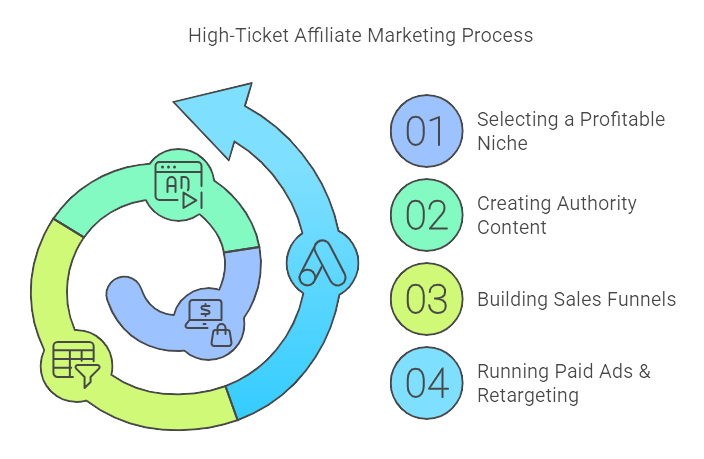
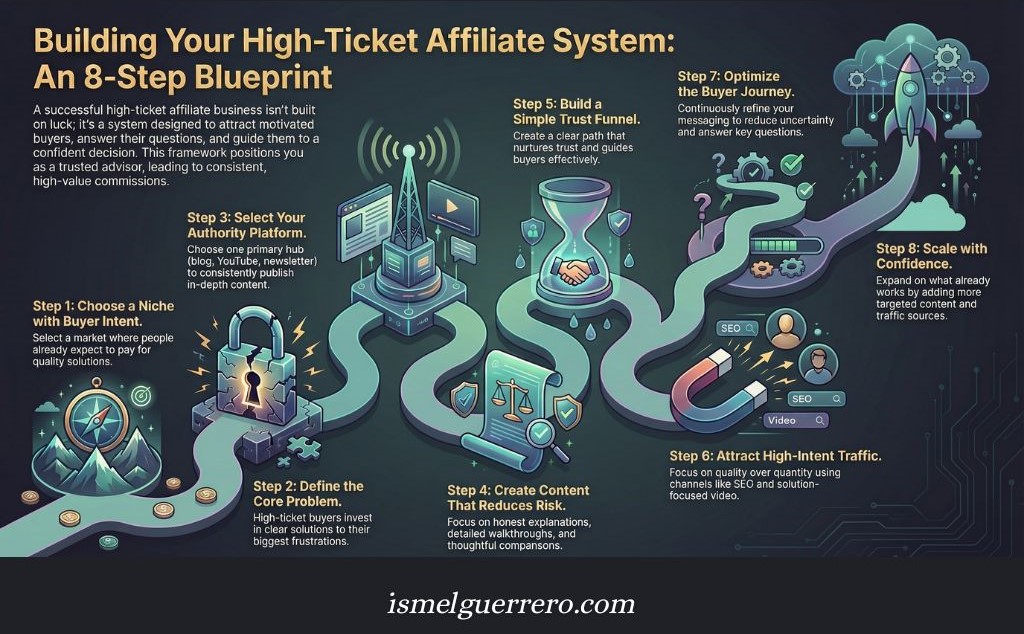
High-ticket affiliate marketing becomes predictable when you build a system that attracts the right buyer, answers their questions, and guides them toward a confident decision. The goal is not to post endlessly or hope for lucky conversions. The goal is to design a path that helps a motivated buyer move from curiosity to clarity.
Below is the step-by-step framework that supports a sustainable high-ticket affiliate business. Each step builds authority, reduces friction, and positions you as a trusted advisor in your niche.
Step 1: Choose a Niche With Real Buyer Intent
Start by selecting a niche where people already expect to pay for quality solutions. Your goal is alignment, not trend chasing. Choose a market where you understand the problems buyers are trying to solve and where you can speak confidently about their challenges.
Look for:
- Clear, high-stakes problems
- Audiences willing to invest in results
- Long-term demand, not temporary spikes
A niche grounded in real intent prevents wasted effort and makes your content more persuasive from the start.
Step 2: Define the Core Problem You Help Solve
High-ticket success depends on problem clarity. Buyers do not invest in vague improvements. They invest when they see a direct path from their current situation to a better outcome.
Identify:
- The top frustrations your buyer faces
- The risks of doing nothing
- The results they want most
Your content becomes more impactful when every article, video, or email ties back to a specific problem you help solve.
Step 3: Select the Platform Where You Will Build Authority
Your authority hub is where your most valuable content lives. It can be a blog, YouTube channel, newsletter, or a combination of platforms. What matters is consistency and depth, not being everywhere.
Choose a platform that aligns with your strengths:
- If you explain concepts well, a blog works
- If you excel at walkthroughs, YouTube works
- If you build relationships easily, email works
This hub becomes the anchor that all your high-ticket activity builds around.
Step 4: Create Authority Content That Reduces Buyer Risk
Premium buyers want clarity and proof. They are trying to understand whether a solution can help them achieve a meaningful outcome. Your content bridges that gap.
Focus on:
- Honest explanations
- Thoughtful comparisons
- Detailed walkthroughs
- Case style insights
- Strategy and reasoning
The more your content helps someone understand their options, the easier the decision becomes.
Step 5: Build a Simple Funnel That Nurtures Trust
You do not need a complex funnel to succeed. What you need is a clear path that helps a buyer move from first contact to informed decision.
Your funnel may include:
- A lead magnet or helpful resource
- A short email sequence that clarifies the problem and solution
- A content path that answers deeper questions
This is where trust compounds. When buyers feel guided rather than pushed, they stay engaged.
Step 6: Bring in Traffic With Intent, Not Volume
High-ticket affiliate marketing does not rely on massive traffic. It relies on the right traffic. Focus on channels that bring motivated buyers, not casual scrollers.
High intent channels include:
- SEO for comparison and problem based keywords
- YouTube for solution focused videos
- Email for nurturing and long-term trust
When your traffic is intentional, every conversion becomes easier.
Step 7: Optimize Your Messaging and Improve the Buyer Journey
Refinement is where your system becomes scalable. Examine your content, your funnel, and your messaging through the lens of buyer clarity.
Ask:
- Where does the buyer still feel uncertainty
- Which questions remain unanswered
- Where can you add proof or examples
Small improvements to clarity often create significant increases in conversions.
Step 8: Scale With Confidence, Not Pressure
Scaling a high-ticket system is strategic, not frantic. Once your foundation works, you can expand through:
- More targeted content
- Additional traffic sources
- Collaborations or interviews
- Paid ads that amplify proven pieces
You build on what works, instead of chasing volume.
Bottom Line
A well built system does not depend on luck. It attracts the right buyers, communicates the right information, and gives the buyer enough confidence to move forward. That is the architecture behind consistent high-ticket results.
Premium Buyer Psychology (How High-Ticket Buyers Make Decisions)
High-ticket affiliate marketing works because it aligns with how people make big decisions. These buyers think differently than casual shoppers. They do not browse for deals or react to impulse triggers. They evaluate outcomes. You must understand this mindset to make your content persuasive.
1. Premium Buyers Have High Intention
These people actively search for answers. They usually have a clear goal in mind. They want to streamline a business, protect their finances, or transform their health. The stakes feel meaningful. Buyers move slowly and look for depth before they commit.
2. Uncertainty Is the Real Obstacle
Price is rarely the biggest barrier. Uncertainty stops the sale. A high-ticket purchase brings questions. Will this work for me? Is the advisor trustworthy? Your content plays a central role in resolving these doubts. Provide transparent explanations. Offer honest comparisons. Reduce the uncertainty that keeps buyers from moving forward.
3. Proof Matters More Than Persuasion
Hype does not work here. Buyers respond to thoughtful walkthroughs and real use cases. They need to picture the result. Show the logic behind the solution. Demonstrate how it applies to their situation. The value becomes clearer than the cost when the outcome is visible.
4. Alignment Builds Trust
A buyer wants to feel understood. Your messaging must reflect their goals and frustrations. They need to see you as a guide rather than a promoter. That sense of alignment builds trust quickly. It creates a smoother decision process.
Bottom Line You are speaking to buyers who want clarity. Guide them toward a solution that fits their needs. Do not push a product link. This psychology supports consistent high-ticket results.
Common Challenges and How to Overcome Them
High-ticket affiliate marketing offers strong rewards, but it also presents challenges that many beginners do not anticipate. Premium buyers expect clarity, proof, and a level of confidence that takes time to build.
These hurdles are not signs that the model is too difficult, they are part of the process that filters out low-quality approaches. When you understand these challenges, you can move through them with purpose instead of frustration.
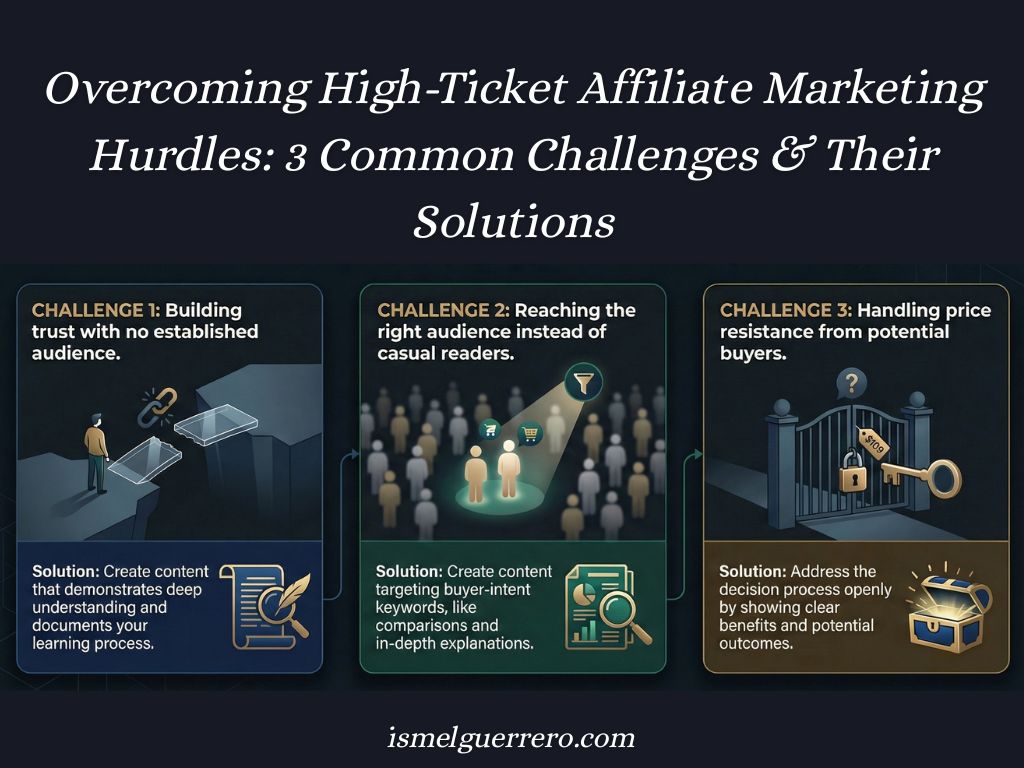
1: Building Trust Without an Established Audience
Premium buyers hesitate when the creator feels new or unproven. They want to see thoughtful explanations, consistent content, and a clear point of view before committing to a high-value purchase.
How to overcome it: Start by creating content that demonstrates understanding, not expertise. Share honest breakdowns of concepts, explain how solutions work, and document your learning process. Trust grows faster when the buyer sees genuine intention and steady improvement.
2: Reaching the Right Audience
Traffic alone does not create high-ticket sales. Many affiliates attract casual readers or freebie seekers who are not ready for premium solutions. This leads to low conversions and frustration.
How to overcome it: Focus on content that captures buyer intent. These are people searching for comparisons, deeper explanations, or next steps. When your content speaks directly to someone looking for clarity before a purchase, every visitor becomes more valuable.
3: Handling Price Resistance
A high-ticket offer naturally creates questions. Buyers want to understand whether the investment is justified and how the solution supports their goals. If these questions go unanswered, hesitation grows.
How to overcome it: Address the decision-making process openly. Show the benefits, the potential outcomes, and the reasoning behind the solution. Use examples when possible. When the value becomes clearer than the cost, resistance softens.
4: Getting Accepted Into Selective Programs
Some premium brands review an affiliate’s platform before approving them. Beginners often feel discouraged when they face rejection early on.
How to overcome it: Start with programs that welcome new affiliates, build quality content around the problems you solve, and reapply once your authority has grown. A few well-structured articles or videos can strengthen your credibility quickly.
5: Staying Consistent Long Enough to See Results
High-ticket affiliate marketing compounds over time. Many affiliates stop too early because they expect quick wins instead of gradual momentum.
How to overcome it: Set a simple content rhythm, improve each piece slightly more than the last, and focus on clarity. When you treat each article or video as a long-term asset, your authority grows in a predictable way.
Bottom Line: Every challenge in high-ticket affiliate marketing is navigable with patience and clarity. These obstacles do not block progress, they shape it. When you approach them as part of the process rather than as setbacks, the model becomes much easier to sustain.
Pros vs. Cons at a Glance
| Pros (Why It Works) | Cons (What to Watch Out For) |
|---|---|
| Big commissions: one sale can equal hundreds of low-ticket ones. | Longer sales cycles: buyers take more time to decide. |
| Small but qualified audiences can drive strong income. | Lower conversion rates than low-ticket products. |
| Builds authority and positions you as a trusted advisor. | Requires deeper content, branding, and patience. |
| Recurring revenue potential with SaaS, memberships, and coaching. | Some elite programs are harder to get accepted into. |
| Buyers are serious, invested, and less likely to refund. | Higher entry barrier compared to low-cost offers. |
Bottom line: high-ticket affiliate marketing isn’t harder than low-ticket; it’s different. You’ll spend less time chasing traffic, but more time nurturing trust. If you embrace the longer cycle and lean into authority-driven content, the rewards can be transformational.
Choosing the Right Affiliate Program (Without Guessing)
Not every high-ticket program is worth your time. A flashy payout means nothing if the product doesn’t convert or damages your credibility. The key is choosing programs that balance commission potential with audience fit and brand trust.
Here’s how to evaluate offers the smart way:
1. Start With the Problem, Not the Payout
Before looking at commission numbers, ask:
- Does this product solve an urgent, high-value problem?
- Are buyers satisfied (low refund rates, positive reviews)?
- Would I recommend it to a close friend without hesitation?
If the answer isn’t “yes” to all three, the commission doesn’t matter.
2. Understand the Commission Structure
High-ticket programs pay in different ways. Some are simple (flat-rate per sale), others layer recurring or tiered bonuses. Know how and when you’ll be paid.
Commission Models at a Glance
| Model | How It Works | Best For | Example Programs |
|---|---|---|---|
| Flat-Rate | Fixed payout per sale (e.g., $1,000 per course) | Beginners who want predictable income | Coaching programs, high-end courses |
| Percentage-Based | Earn a % of each sale (e.g., 30% of $5,000 = $1,500) | Affiliates promoting variable-priced offers | Consulting, masterminds |
| Recurring | Monthly commissions for active subscriptions | Affiliates building long-term income | SaaS tools, memberships |
| Hybrid | Upfront + recurring commissions | Affiliates who want quick wins + stability | SaaS bundles, software + coaching |
3. Look for Affiliate Support
The best programs equip you with tools like:
- Ready-to-use landing pages and funnels.
- Training, swipes, and creatives.
- Responsive affiliate managers.
If the brand isn’t investing in your success, chances are you’ll struggle to see consistent results.
4. Match the Offer to Your Audience
Even a great program will flop if your audience isn’t ready for it. Make sure the product:
- Solves a problem your audience actually cares about.
- Fits their budget and expectations.
- Enhances your authority instead of undermining it.
The Bottom Line: The right affiliate program is more than a big payout; it’s a partnership. When you align with offers that genuinely help your audience and back them with authority-driven content, you’ll build income and reputation at the same time.
Want a curated list of top-tier programs?
→ Explore our full guide to the best high-ticket affiliate programs.
Advanced Strategies for Scaling High-Ticket Affiliate Marketing
Once your high-ticket affiliate foundations are in place, scaling is not about doing everything at once. It is about strengthening what already works and adding new layers of leverage gradually. At this stage, you are not trying to reinvent your model. You are looking for ways to reach more of the right people and help them move through your system with less friction.
These strategies assume you already have a clear niche, a defined problem you help solve, and at least a basic funnel in place.
Layer additional traffic channels, not random tactics
Scaling starts with exposure, but not all traffic is equal. Instead of chasing every platform, add channels that align with your existing strengths and buyer intent.
For example:
- If your core is search content, add YouTube walkthroughs that support the same topics.
- If your strength is video, add a blog for written breakdowns and comparison pages.
Each new channel should reinforce the same core message and the same high-ticket journey, not compete with it.
Deepen your best content instead of publishing more at random
In high-ticket markets, a few strong pieces can outperform dozens of light ones. Scaling is often about improving depth, clarity, and usefulness within content that already attracts the right buyers.
You can:
- Expand existing articles with clearer examples and updated insights
- Add FAQs directly into content where questions naturally arise
- Create follow-up pieces that explore a key concept in more detail
Depth builds authority, and authority supports higher conversion rates.
Use email to segment and personalize follow-up
As your list grows, your subscribers will be at different stages of awareness. Some are just learning about the problem. Others are comparing solutions and close to a decision. Treating everyone the same leaves opportunity on the table.
Simple segmentation can include:
- Tagging people based on which lead magnet they downloaded
- Sending extra education to those who engaged with beginner content
- Sending more detailed comparisons and use cases to those who clicked on decision-focused content
This does not need to be complex. Even light segmentation can make your messages feel more relevant and timely.
Introduce stronger bridge content between education and offer
High-ticket buyers often need one more step between “I understand the topic” and “I am ready to buy.” Bridge content connects your educational work to the specific solution you recommend.
This can look like:
- A detailed use case that shows the product in context
- A “who this is for and who this is not for” breakdown
- A simple roadmap that shows how the product fits into the bigger picture
Bridge content respects the buyer’s thinking process and makes the next step feel logical rather than forced.
Collaborate with complementary creators in your niche
Partnerships can scale trust faster than solo content alone. When another creator with a related audience introduces you as a helpful resource, you borrow some of their credibility.
Examples include:
- Guest content that teaches one part of your framework
- Joint workshops or live sessions focused on a shared problem
- Interview style content where you explain your system and perspective
The goal is not aggressive promotion, it is to reach people who are already engaging with related topics.
Continuously refine your system based on real questions
Scaling is not only about more traffic or more content. It is also about listening. The questions your audience asks through comments, emails, or calls reveal where your system still feels unclear.
Over time, you can:
- Add clarifying sections to key pieces of content
- Turn recurring questions into standalone articles or videos
- Adjust your funnel to address hesitation earlier
Each refinement makes the journey smoother and supports a higher percentage of conversions without changing your core model.
Bottom Line: Scaling high-ticket affiliate marketing is an iterative process. You keep what works, deepen the parts that matter most, and expand your reach in ways that respect buyer intent. Done this way, growth feels controlled and sustainable rather than chaotic.

Conclusion: Built on Clarity, Not Complexity
High-ticket affiliate marketing works because it rewards depth, trust, and patience. It moves you away from the constant churn of low-value clicks and toward a model where a smaller, more intentional audience can support meaningful income. Instead of chasing trends, you focus on solving real problems for buyers who are ready to invest in the right solution.
The ideas in this guide form a complete system: understand your niche, choose offers that align with genuine needs, create content that reduces risk, and refine your process as you learn more about your audience. None of this requires a large following. It requires consistency and a willingness to think like a strategist rather than a promoter.
As your authority grows, the results compound. Each article, video, or email becomes part of a larger body of work that helps buyers feel confident in their decisions. That confidence is what drives high-ticket conversions. When buyers sense that you understand their concerns, they see you as a guide worth listening to.
High-ticket affiliate marketing isn’t about complexity. It is about clarity: clarity in what you teach, clarity in the problems you help solve, and clarity in how buyers can move forward. When you approach it this way, you build a business that lasts one shaped by trust, thoughtful content, and steady growth.
FAQs About High-Ticket Affiliate Marketing
What is high-ticket affiliate marketing?
High-ticket affiliate marketing is a model where you earn larger commissions by promoting premium products or services. Instead of relying on dozens of small sales, you focus on buyers who are looking for meaningful solutions and are prepared to invest in them. The approach is slower and more strategic, but it creates stronger long-term results.
Do I need a big audience to succeed?
No, you need a qualified audience. High-ticket buyers respond to clarity, trust, and problem-solving, not follower counts. Even a small group of engaged readers or viewers can convert well when your content matches their needs.
How long does it take to get results?
High-ticket sales often take longer because buyers need time to evaluate the solution and feel confident. Some creators make early sales if their niche is focused and their content is clear. For most, results grow steadily as authority and consistency increase.
What kind of content works best for high-ticket offers?
Content that reduces uncertainty works best. This includes comparisons, walkthroughs, use cases, and deeper guides that help buyers understand how the solution fits their goals. High-ticket audiences value thoughtful explanations over quick lists or surface reviews.
How do I choose a high-ticket offer without feeling overwhelmed?
Start with the problem your audience is trying to solve. A strong high-ticket offer should have a clear purpose, transparent value, and a brand you can stand behind. When the product and the audience align, the content becomes easier to create and conversions feel natural.
Are high-ticket programs harder to promote than low-ticket ones?
They require more clarity, not more effort. Low-ticket products rely on volume, while high-ticket decisions hinge on trust and understanding. When your content answers the questions buyers already have, selling higher-end solutions becomes straightforward.
What should I do if I’m rejected from a high-ticket affiliate program?
Many premium programs review applicants closely to protect their brand. If you are declined, begin with accessible programs, build a small body of helpful content, and reapply once your authority is clearer. A few strong pieces of content can change your acceptance rate significantly.
Is high-ticket affiliate marketing beginner-friendly?
Yes, if you focus on learning the audience, understanding the problem, and creating simple, useful explanations. You do not need expert status to start, only the willingness to build clarity and trust over time. Beginners who commit to this approach often see stronger results than those focused on quick wins.

6 Comments
High Ticket: A Complete Guide to Premium Products and Services. - Ismel Guerrero. · January 21, 2025 at 6:55 pm
[…] If you’re interested in learning more, check out this guide on high-ticket affiliate marketing and how to get started. […]
High Ticket Affiliate Marketing for Beginners: A Step-by-Step Guide - Ismel Guerrero. · February 2, 2025 at 1:45 pm
[…] Learn how to get started in high-ticket affiliate marketing with our step-by-step guide. […]
High-Ticket Digital Products: Guide to Finding and Selling Them - Ismel Guerrero. · February 4, 2025 at 11:48 pm
[…] a foundational understanding, check out our What Is High-Ticket Affiliate Marketing? […]
Best High-Ticket Affiliate Programs for 2025 (Earn Big Commissions) - Ismel Guerrero. · February 13, 2025 at 12:14 am
[…] For a complete overview of high-ticket strategies, check out our High-Ticket Affiliate Marketing Guide. […]
Affiliate Marketing vs MLM: Don’t Choose Until You Read This - Ismel Guerrero. · May 10, 2025 at 2:13 pm
[…] Next: read our High-Ticket Affiliate Marketing Guide. […]
Faceless Marketing: The Strategy Taking Over the Internet - Ismel Guerrero. · May 13, 2025 at 5:58 pm
[…] Next: Read our Affiliate Marketing Guide and our High-Ticket Affiliate Marketing Guide. […]