Introduction
A good prompt can change the quality of an entire project. Whether you’re writing, brainstorming, or generating content with AI, the clarity of your prompt often determines how useful the output will be. That’s why many people look for prompt generators, tools that help you shape better instructions with less effort.
If you’re exploring these tools, you’re likely looking for something that saves time, strengthens your ideas, and produces more reliable results. This guide explains what prompt generators do, the different types available, and how to choose one that fits your workflow. You’ll also find a ranked list of the best prompt generators and examples you can use right away.
By the end, you’ll understand how these tools work and how to use them to improve the quality and consistency of your AI-generated content.
Key Takeaways
Prompt Generators
- Prompt generators help you create clearer, more effective instructions for AI tools.
- Different generators serve different needs, from writing and SEO to images and general productivity.
- The best prompt generators improve reasoning, structure, and output quality, not just formatting.
- Choosing the right tool depends on your goals, workflow, and preferred level of customization.
- A good prompt generator supports consistency and reduces the time spent revising AI outputs.
Disclaimer: I am an independent Affiliate. The opinions expressed here are my own and are not official statements. If you follow a link and make a purchase, I may earn a commission.
What a Prompt Generator Actually Does
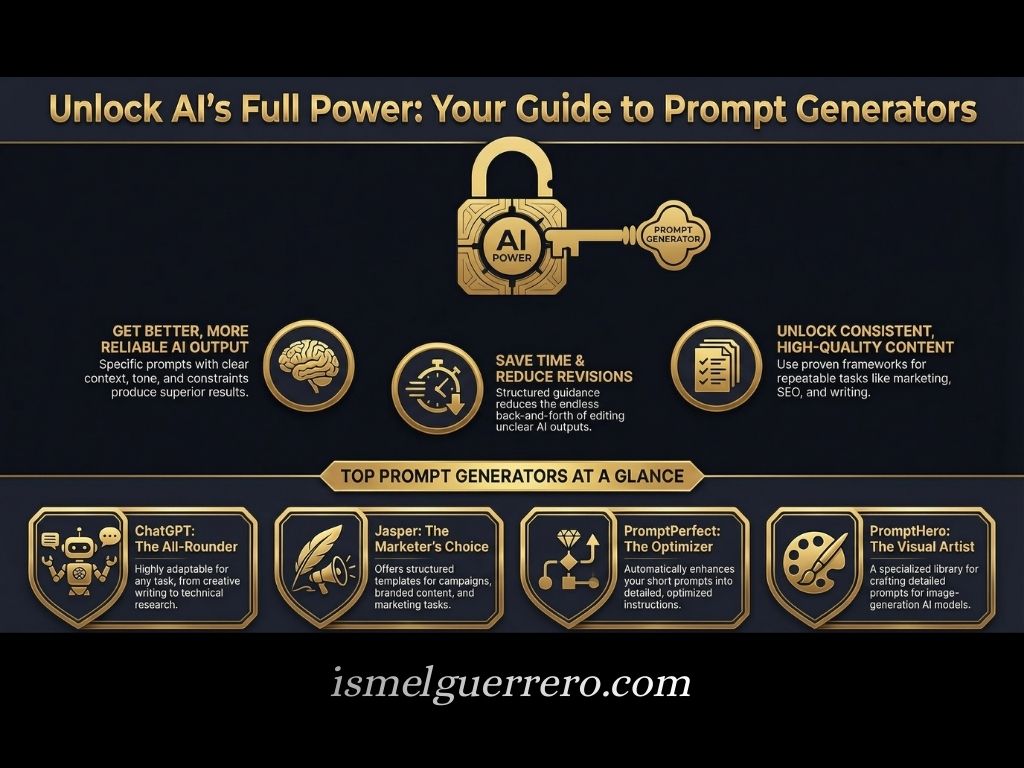
A prompt generator helps you create clearer, more effective instructions for AI tools. Instead of starting from a blank page, you begin with structured guidance that shapes the way the AI processes your request. This makes it easier to produce content that feels consistent, relevant, and aligned with your goals.
A good prompt generator does three things well. It helps you articulate the outcome you want, it adds the structure the AI needs to respond accurately, and it reduces the back-and-forth revisions that come from unclear direction. The result is more predictable output and a smoother workflow.
Prompt generators matter because AI responds best to specificity. When your prompt includes context, tone, constraints, and a clear objective, the AI has enough direction to create something useful. A generator simplifies this process by walking you through the details that improve the final result.
Bottom line: prompt generators turn vague ideas into actionable instructions, making AI tools easier to use and more reliable.
Types of Prompt Generators
Prompt generators come in several forms, each designed to support a different style of work. Some guide you through a structured set of questions, while others automatically refine your input into a stronger prompt. Understanding these categories helps you choose a tool that supports the outcomes you care about most.
AI-powered prompt generators
These generators use AI to rewrite or enhance your prompt based on your intent. You provide a short description of what you want, and the tool expands it into a detailed instruction set. They work well for anyone who wants powerful prompts without learning complex prompt-writing techniques.
Template-based prompt generators
These tools offer pre-built frameworks for common tasks. You fill in a few details, and the template shapes the structure for you. They are helpful for repeatable tasks like email writing, storytelling, SEO outlines, and research summaries.
Writing-focused prompt generators
These generators produce prompts specifically for creative writing, storytelling, or content development. They help you clarify themes, characters, tone, and structure, making it easier to start a draft or overcome writer’s block.
Marketing and SEO prompt generators
Designed for content creators and marketers, these tools help you produce prompts for blog posts, product descriptions, keyword-driven outlines, and ad copy. They reduce guesswork and ensure consistency across drafts.
Image prompt generators
These tools help you craft detailed prompts for image models. They guide you on style, lighting, composition, and subject details, making visual outputs more predictable.
Best Prompt Generators (Ranked and Compared)
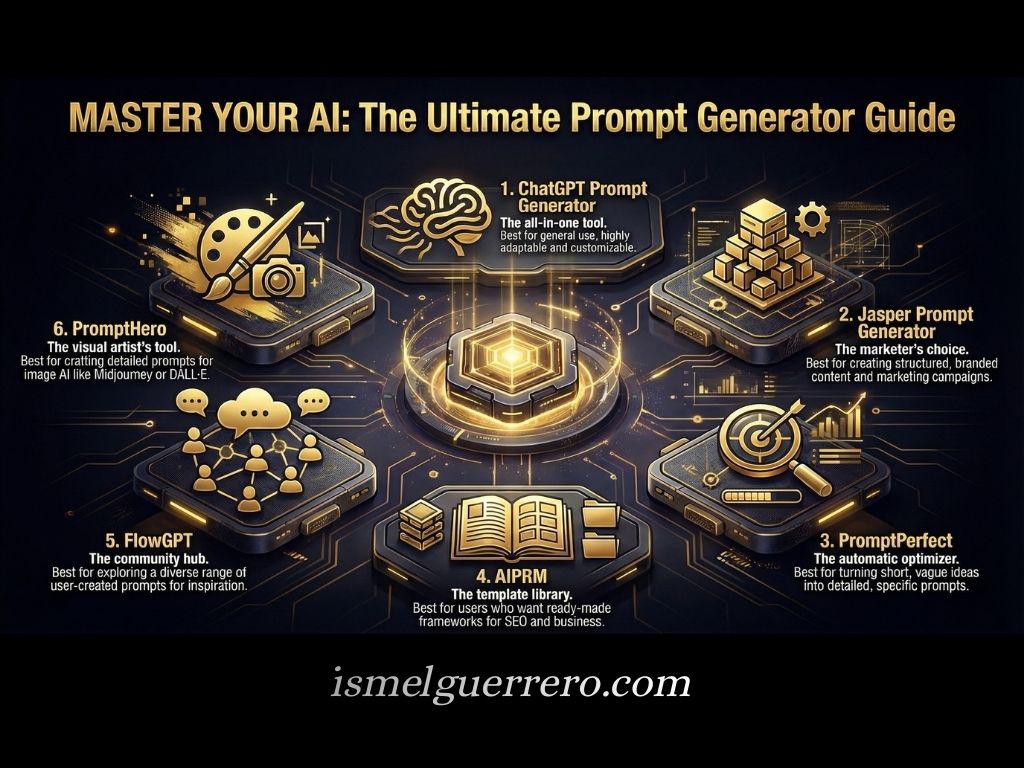
Prompt generators vary in purpose, design, and depth. Some are built for general use, others focus on writing, marketing, or image creation. This section highlights the tools that consistently provide strong results, along with who each one is best suited for. The goal is to help you choose based on workflow, not popularity.
1. ChatGPT Prompt Generator (Built-in Model Capabilities)
What it is: A flexible, AI-powered prompt generator available directly inside ChatGPT through meta-prompts and structured instructions.
Who it’s for: Users who want a versatile tool that adapts to writing, research, brainstorming, or structured tasks.
Strengths:
- Highly adaptable to any use case
- Allows detailed customization
- Supports iterative refinement
Limitations:
- Requires clear input to get the best results
- No visual interface for templates
Best fit: A strong choice for users who want one tool that can support multiple types of prompt creation.
2. Jasper Prompt Generator
What it is: An AI writing platform with built-in prompt templates designed for marketing and content teams.
Who it’s for: Writers, marketers, and business owners who want structured prompts for campaigns, content, and brand messaging.
Strengths:
- Organized templates for common marketing tasks
- Consistent tone controls
- Easy-to-use interface
Limitations:
- Focused mainly on marketing use cases
- Subscription required
Best fit: Teams and creators who want guided prompts for structured, branded content.
3. PromptPerfect
What it is: A refinement tool that takes a short user prompt and expands it into a more detailed, optimized version.
Who it’s for: Users who want to improve clarity, structure, and specificity without rewriting prompts manually.
Strengths:
- Enhances vague prompts automatically
- Supports multiple AI models
- Reduces trial-and-error
Limitations:
- Works best for text-based tasks
- Optimization can feel heavy for simple requests
Best fit: Anyone who wants a straightforward way to strengthen prompts before sending them to an AI.
4. AIPRM
What it is: A prompt library and template system that integrates with ChatGPT for writing, SEO, and business tasks.
Who it’s for: Users who prefer ready-made prompt frameworks rather than building prompts from scratch.
Strengths:
- Large library of templates
- Easy filtering by use case
- Helpful for consistent formatting
Limitations:
- Templates vary in depth and quality
- Best features require a paid subscription
Best fit: Writers and marketers who want reliable templates they can quickly adapt.
5. FlowGPT
What it is: A community-driven platform that shares user-created prompts for many different purposes.
Who it’s for: Beginners and power users who want inspiration, examples, and prebuilt prompt structures.
Strengths:
- Diverse library of prompts
- Community rankings help surface quality
- Good starting point for learning prompt patterns
Limitations:
- Mixed quality across the library
- Some prompts require adjustment
Best fit: Users who want to explore a wide range of prompt styles and adapt them to their own goals.
6. Writesonic Prompt Generator
What it is: An AI writing tool with built-in prompt assistance for marketing, SEO, ads, and short-form content.
Who it’s for: Content creators who want quick access to structured prompts for commercial writing.
Strengths:
- Fast, guided prompt creation
- Useful for repetitive content tasks
- Clear organization by category
Limitations:
- Primarily focused on marketing outputs
- Requires subscription
Best fit: Creators producing regular content for blogs, ads, or product pages.
7. PromptHero (Image Prompt Generator)
What it is: A tool focused on creating and studying image prompts for models like Midjourney, DALL·E, and Stable Diffusion.
Who it’s for: Users who work with visual AI tools and need clearer direction for style, lighting, and composition.
Strengths:
- Large library of visual prompt examples
- Supports multiple image models
- Helpful for understanding visual styles
Limitations:
- Focuses only on image prompts
- Requires practice to adapt examples
Best fit: Designers and creators who want more control over image generation.
Prompt Generator Comparison Table
Compare popular prompt tools by use case, strengths, learning curve, and pricing so you can pick the one that fits your workflow best.
| Tool | Best Use Case | Strength | Learning Curve | Price Range | Ideal User |
|---|---|---|---|---|---|
| ChatGPT Prompt Generator | General writing and reasoning tasks | Flexible and highly customizable | Low to moderate | Free to paid | Users who want one tool for many types of prompts |
| Jasper Prompt Generator | Marketing and branded content | Organized, predictable templates | Low | Paid | Businesses and content teams |
| PromptPerfect | Strengthening vague or short prompts | Clear structure and refinement | Very low | Paid | Users who want optimized prompts without rewriting |
| AIPRM | Template-driven workflows | Large prompt library | Very low | Free to paid | Writers who prefer ready-made frameworks |
| FlowGPT | Exploring community prompt ideas | Broad inspiration library | Low | Free | Users who want examples to adapt |
| Writesonic Prompt Generator | Quick marketing and SEO tasks | Fast, structured results | Low | Free to paid | Creators publishing frequent content |
| PromptHero | Image prompting | Visual examples for composition and style | Low to moderate | Free to paid | Designers and visual creators |
Bottom line: these tools differ in depth and purpose. The right choice depends on whether you need inspiration, structure, refinement, or multi-purpose support.

How to Choose the Right Prompt Generator
The best prompt generator depends on the type of work you do and the level of structure you prefer. Some tools are designed for exploration, others for precision, and others for repeatable tasks. Choosing the right one begins with understanding what you want the tool to help you accomplish.
Start by identifying your main goal. If you need support with writing or marketing content, a template-based generator may offer the structure you want. If your work relies on reasoning, research, or multi-step outputs, an AI-powered generator gives you more flexibility. For visual projects, an image-focused tool will provide the details required for strong results.
Next, consider your workflow. Some tools are ideal for quick tasks, while others excel in longer projects that require refinement or iteration. If you prefer guided steps, choose a generator with built-in templates. If you want full control, look for tools that allow you to customize prompts in depth.
It also helps to think about your comfort level. Beginners often appreciate frameworks that walk them through the essentials. Experienced users may want tools that support more detailed instructions and scenario-based prompts.
The right prompt generator is the one that helps you work with more clarity and less friction. When the tool fits the way you think and create, it becomes easier to produce consistent, high-quality outputs.

Example Prompt Generator Templates You Can Use Now
Prompt generator templates help you create consistent instructions without having to start from scratch. These examples are designed to work across different AI tools and can be adapted to fit writing, marketing, research, or creative work. You can use them as-is or customize them based on the outcome you want.
General Prompt Generator Template
Use this template when you want the AI to create a strong prompt for any task.
Prompt: Create a clear, detailed prompt that will help an AI tool complete the following task: [describe your goal]. Include context, the desired outcome, constraints, and the format of the final output. End the prompt with a short checklist so the AI can confirm it understood the instructions.
Writing Prompt Generator Template
Use this for content, storytelling, or long-form writing.
Prompt: Generate a writing prompt that supports the following goal: [describe your topic or intent]. Include tone guidance, structural suggestions, and one or two optional variations for different styles of writing.
Marketing Prompt Generator Template
Use this for ads, emails, landing pages, or content planning.
Prompt: Create a marketing-focused prompt that helps an AI produce content for [describe your project]. Include the target audience, the main message, the tone, and any brand constraints. Provide one alternative version that focuses on clarity and one that focuses on persuasion.
SEO Prompt Generator Template
Use this for outlines, keyword-based content, or search-focused writing.
Prompt: Create a prompt that guides an AI to write search-friendly content about [topic]. Include the user intent, structural elements, coverage depth, and any required keyword themes. Suggest one variation for beginners and one for advanced users.
Image Prompt Generator Template
Use this for visual models like Midjourney, DALL·E, or Stable Diffusion.
Prompt: Generate a detailed image prompt based on this idea: [describe your concept]. Include style, lighting, composition, perspective, and any important visual details.
Offer one simplified version and one more descriptive version.
These templates serve as flexible starting points. As you refine them, you’ll develop patterns that match your workflow, making it easier to create reliable prompts for different tasks.
What to Do After Choosing a Prompt Generator
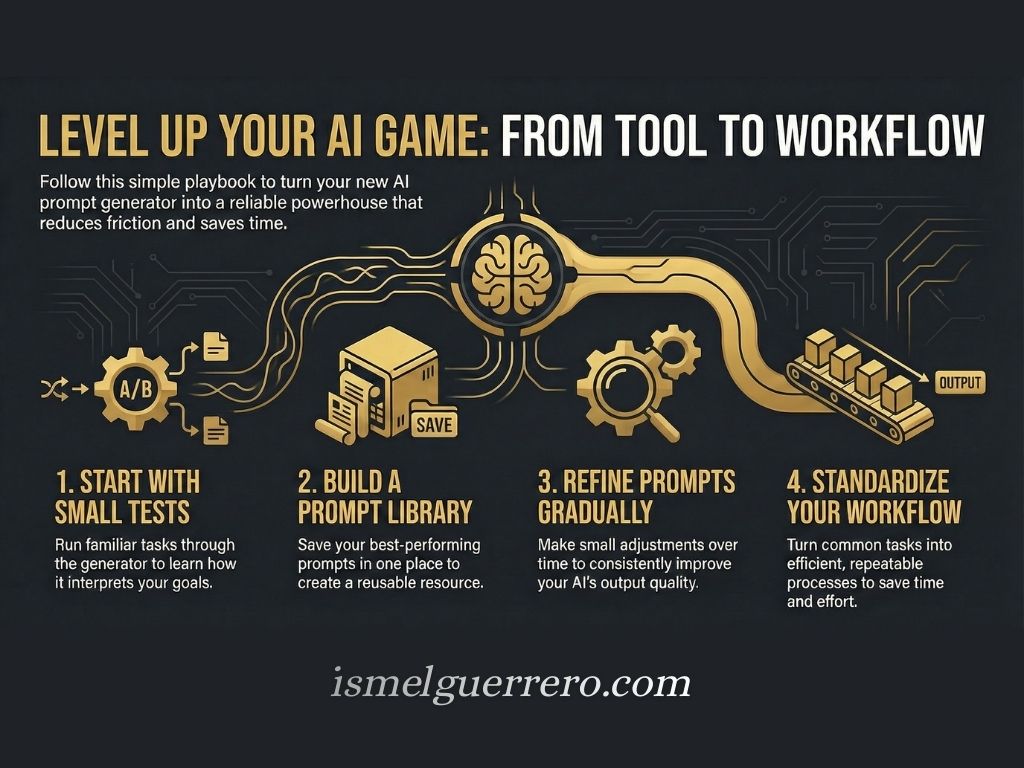
Once you’ve selected a prompt generator, the next step is learning how to incorporate it into your workflow in a consistent and meaningful way. The goal is not to use the tool for everything, but to use it where it strengthens clarity and reduces friction. A good generator becomes part of a simple system that helps you produce more reliable outputs with less revision.
Start with small tests. Choose one or two tasks you complete often and run them through the generator. This helps you understand how the tool interprets your goals and how much detail you need to provide. Early tests also show where the generator adds value and where you may still need to adjust the prompt manually.
Create a place to save your best prompts. Over time, you’ll notice patterns in prompts that consistently produce strong results. Keeping them in one location, such as a document or notes app, gives you a reusable library you can adapt anytime. This also helps you avoid rewriting prompts from scratch.
Refine your prompts gradually. As you work with the tool, you’ll develop a clearer sense of what information improves output quality. Add context where needed, simplify sections that feel repetitive, and test variations to see what produces the most consistent results. Small adjustments tend to make the biggest difference.
Finally, look for opportunities to standardize parts of your workflow. When you find a prompt generator that performs well for a specific task, use it to create a repeatable process. This turns everyday work into something more efficient and predictable, freeing up time for deeper thinking and creative problem-solving.
Conclusion: A Good Prompt Generator Makes AI Easier to Use
A strong prompt generator doesn’t replace your skills, it amplifies them. It takes the guesswork out of crafting instructions, helps you work more consistently, and gives AI the context it needs to produce accurate, reliable output. Whether you’re writing, designing, researching, or planning, a generator turns scattered ideas into a clear starting point.
As you experiment with different tools, you’ll notice which features support your workflow and which ones you can ignore. Over time, you’ll build your own rhythm: a set of templates, structures, and constraints that match how you think and what you want to create. That’s the real value of prompt generators. They help you shape AI into something predictable and usable rather than something you constantly have to correct.
The next step is simple. Choose one generator. Test it on a task you do often. Save the outputs that work, refine the ones that don’t, and build from there. With steady practice your prompts get sharper, your results improve, and AI becomes a tool you can rely on not just experiment with.
A prompt generator is more than convenience; it’s structure. And structure is what turns AI from a novelty into something that genuinely supports your work.

FAQs About Prompt Generators
What is a prompt generator?
A prompt generator is a tool that helps you create clear, structured instructions for AI systems. It reduces guesswork, improves output quality, and gives you repeatable frameworks for writing, research, design, or planning tasks.
Do prompt generators work for all types of AI tools?
Most do, as long as you can copy the generated text into your AI platform. Some generators are built specifically for chat models, while others focus on image models or structured workflows.
Are prompt generators only for beginners?
Not at all. Beginners use them for guidance, but experienced users rely on them to speed up tasks, test new frameworks, and maintain consistent output across projects.
What makes one prompt generator better than another?
The best tools offer clarity, customization, and templates suited to your goals. A good generator should reduce friction, not add steps, and produce prompts that consistently improve your results.
Can prompt generators help with creative work?
Yes. Many include templates for storytelling, brainstorming, style mimicry, and character development. They help you explore ideas without starting from a blank page.
Are prompt generators free to use?
Some are fully free, others use freemium models, and a few offer advanced capabilities behind paid plans. The right choice depends on how often you use AI and the level of control you need.
How do I know which prompt generator to choose?
Start with your primary use case. Writers and marketers benefit from template-driven tools, while researchers and analysts may prefer generators that support structured reasoning or long-form workflows. Pick the one that aligns with the type of output you want most.
Do I still need to edit AI output if I use a prompt generator?
Yes. Prompt generators improve quality, but human review ensures accuracy, tone alignment, and credibility. Think of them as a starting point that speeds up your process.

0 Comments