Introduction
Everyone loves the idea of affiliate marketing. But almost no one tells you what it really takes to succeed. You’ve seen the screenshots. The “$10K in 30 days” headlines. The influencers flaunting passive income while sipping espresso on some tropical beach. But here’s what most don’t say out loud: Affiliate marketing can work, but only if you treat it like a real business.
Random links? Won’t cut it. Copy-paste promos? Easy to ignore. Promoting things you barely understand? That kills trust fast. So what does work in 2026? Creating real value. Building genuine trust. Recommending products people actually want, in a way that feels helpful, not hypey.
This isn’t a get-rich-quick scheme. This is the blueprint for turning attention into income in a way that’s sustainable, ethical, and honest. If you’re tired of chasing trends and ready to build something real, keep reading. Because affiliate marketing still works, just not the way most people are doing it.
Key Takeaways
- Affiliate marketing works when it functions as guided recommendation, not mass promotion. Trust and relevance create conversions, not links alone.
- Sustainable affiliate income comes from alignment between audience intent, content purpose, and the product being recommended.
- Beginners succeed faster by narrowing focus: one niche, one platform, and a small set of well-understood offers outperform scattered efforts.
- High-performing affiliate content resolves uncertainty at decision points instead of pitching features or chasing urgency.
- Distribution matters as much as creation. Traffic converts only when content format, platform, and user intent are aligned.
- Funnels turn single clicks into long-term leverage by capturing attention, extending the decision window, and building trust over time.
- Tools support the system but never replace it. A minimal, intentional tool stack prevents distraction and accelerates execution.
- Most affiliate failures stem from avoidable trust erosion: poor relevance, weak context, hidden disclosures, or premature monetization.
- Affiliate marketing rewards consistency and judgment more than tactics. Progress compounds when value comes first and monetization follows.
Disclaimer: I am an independent Affiliate. The opinions expressed here are my own and are not official statements. If you follow a link and make a purchase, I may earn a commission.
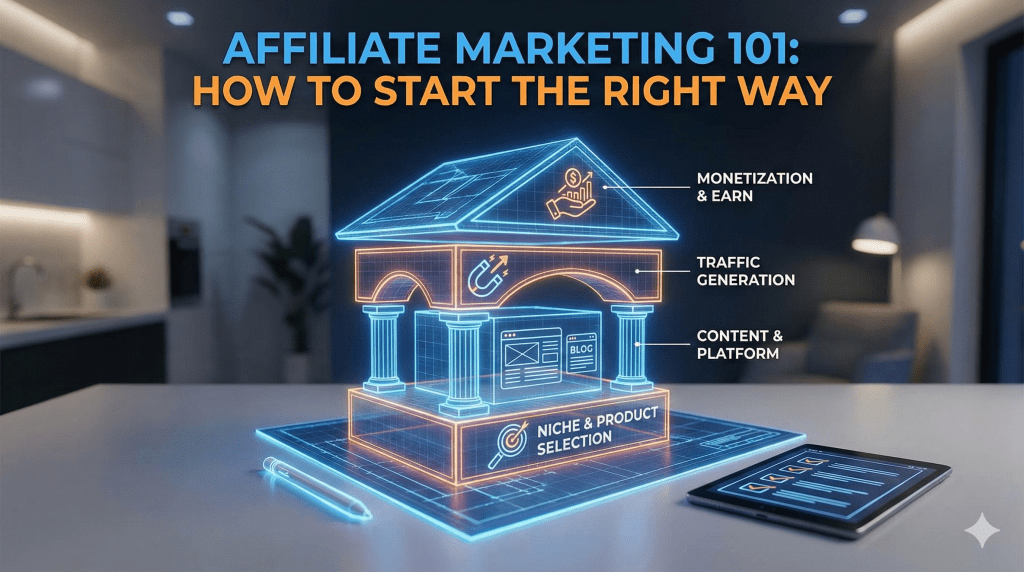
What Is Affiliate Marketing?
Affiliate marketing is a performance-based business model in which you earn a commission by recommending products or services created by another company.
The mechanics are simple. You partner with a brand, receive a unique tracking link, and include that link within your content. When a reader clicks it and completes a defined action such as a purchase or sign-up you earn a commission.
The link itself is not the business. Your role is.
As an affiliate, you are not responsible for product creation, inventory, payments, or customer support. Your responsibility is distribution and judgment deciding what to recommend, when to recommend it, and to whom.
Affiliate marketing works when recommendations align with real audience needs. Instead of persuading strangers, you guide people who already trust your perspective toward solutions that fit their situation. The commission is a consequence of relevance, not pressure.
This is what separates sustainable affiliate businesses from short-term tactics. When done poorly, affiliate marketing looks like indiscriminate promotion. When done well, it functions as informed recommendation at scale.
That distinction determines whether affiliate marketing remains a side experiment or becomes a durable business model.
How Affiliate Marketing Actually Works
Affiliate marketing follows a simple structure, but its effectiveness depends on execution, not mechanics.
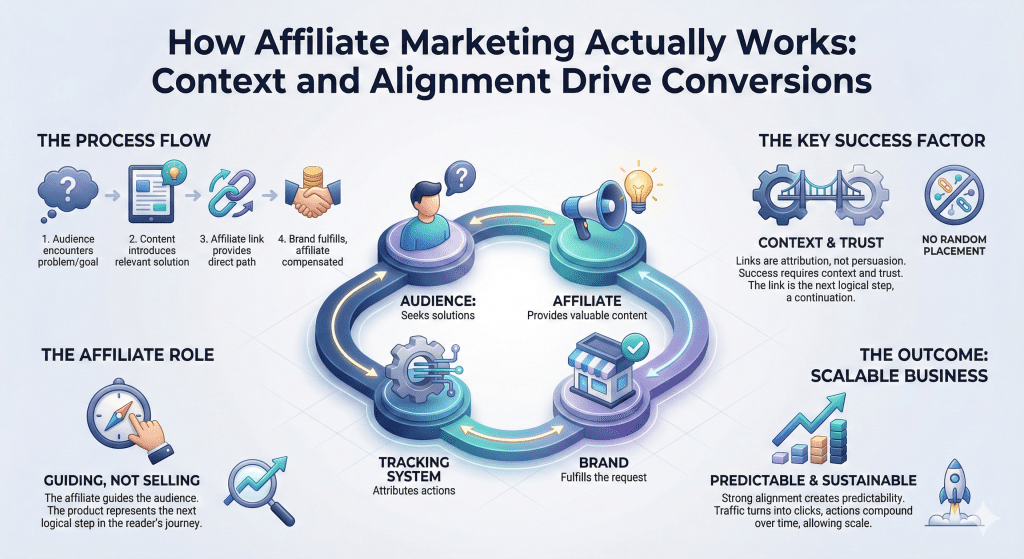
At a basic level, the process involves four parties: the audience, the affiliate, the brand, and the tracking system that connects them. When an affiliate shares a tracked link and a user completes a qualifying action, the system attributes that action to the affiliate and credits a commission.
What matters is how that link is introduced.
Affiliate links function as attribution tools, not persuasion tools. They identify the source of a conversion, but they do not create intent on their own. Intent is created earlier through content that answers questions, removes uncertainty, or helps someone make a decision they were already considering.
A typical flow looks like this:
- An audience member encounters content that addresses a specific problem or goal
- The content introduces a relevant solution as part of that explanation
- The affiliate link provides a direct path to act on that solution
- The brand fulfills the transaction and the affiliate is compensated
The link succeeds when it feels like a continuation of the content, not an interruption.
This is why random link placement rarely converts. Without context, the link has no meaning. Without trust, the recommendation carries no weight.
Affiliate marketing works best when the product represents the next logical step in the reader’s journey. In that role, the affiliate is not selling. They are guiding.
When alignment is strong between audience, content, and offer the system becomes predictable. Traffic turns into clicks. Clicks turn into actions. Actions compound over time.
That predictability is what allows affiliate marketing to scale beyond one-off commissions into a sustainable business model.
Why Affiliate Marketing Has a Low Barrier to Entry
Affiliate marketing stands out because it allows beginners to participate in a real business model without taking on the most expensive or complex responsibilities first.
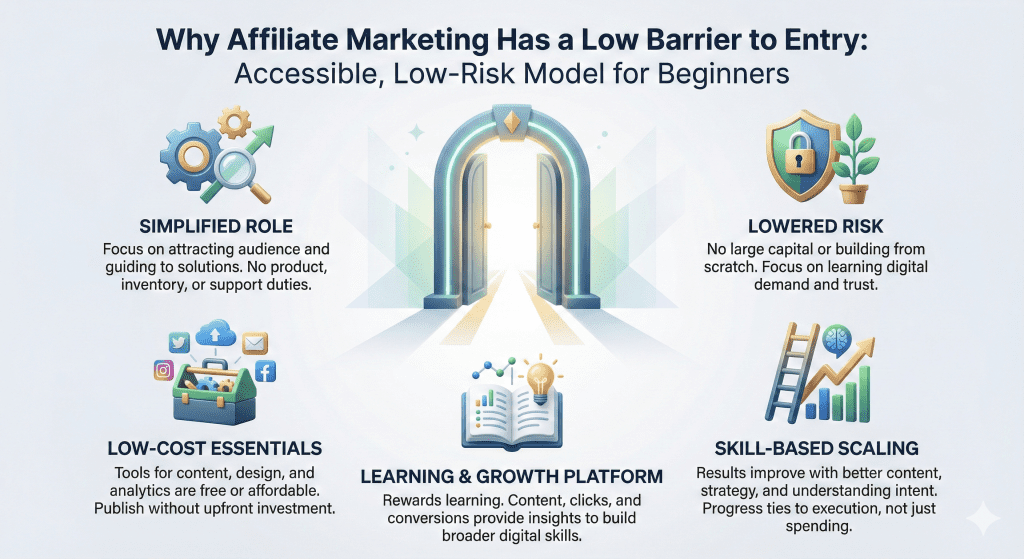
There is no product to manufacture, no inventory to manage, and no customer support to operate. Those obligations remain with the merchant. The affiliate’s role is narrower but still valuable: attracting the right audience and guiding them toward an appropriate solution.
This separation dramatically lowers risk at the start. Instead of investing time and capital into building something from scratch, beginners can focus on learning how digital demand works what people search for, what influences decisions, and what earns trust.
Cost is another major advantage. In 2026, most of the essential tools required to begin are either free or inexpensive. Content can be published on platforms like blogs, video channels, or social media without upfront investment. Email tools, design software, and analytics platforms all offer entry-level plans that support early growth.
More importantly, affiliate marketing scales with skill rather than resources. Results improve as you learn to write better content, choose stronger offers, and understand audience intent. Progress is tied to decision-making and execution, not to how much money you can spend.
That said, accessibility should not be confused with ease. While entry is simple, outcomes are not automatic. The same low barrier that allows beginners in also creates competition. Sustainable results depend on focus, consistency, and a willingness to improve over time.
Affiliate marketing works well for beginners because it rewards learning. Each piece of content teaches you something about your audience. Each click reveals what resonates. Each conversion validates alignment between problem, solution, and presentation.
Used correctly, it becomes both an income model and a training ground for broader digital skills.
How to Choose Affiliate Programs That Actually Pay
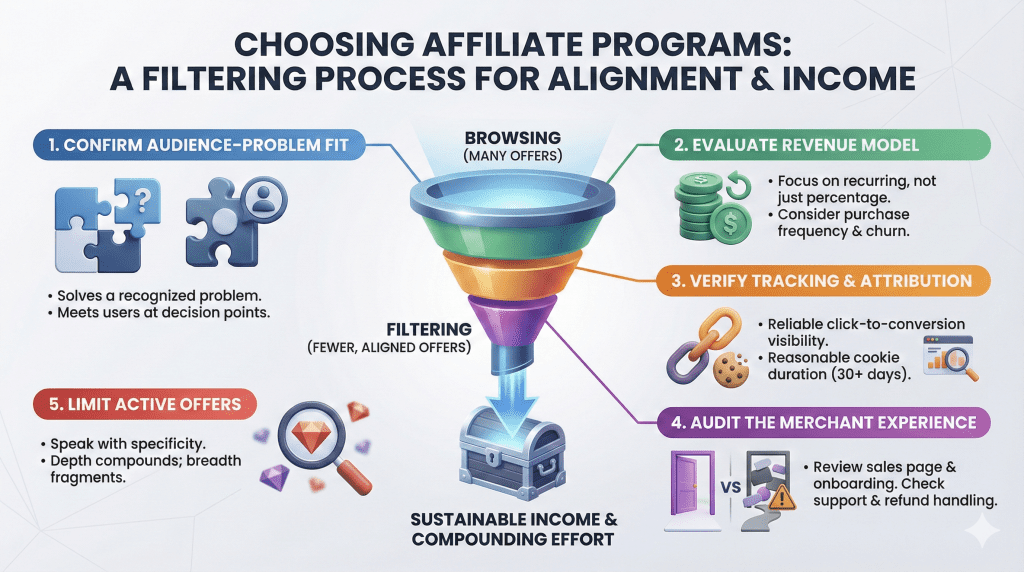
Choosing affiliate programs is a filtering process, not a browsing exercise. High-performing affiliates don’t promote more offers; they promote fewer, better-aligned ones. The goal is to eliminate weak programs early so your effort compounds instead of leaks.
Step 1: Confirm Audience–Problem Fit
Before looking at commissions or dashboards, start with intent. Ask one question: Does this product solve a problem my audience already recognizes?
Programs that require you to manufacture urgency or educate from zero rarely convert well. The strongest offers meet users at a decision point they are already approaching. When the product answers a question your content is already addressing, the recommendation feels natural instead of promotional.
If you can’t clearly articulate who this product is for and when they need it, it’s not the right offer.
Step 2: Evaluate the Revenue Model, Not Just the Percentage
Commission rate alone is a misleading metric. A lower percentage on a product that converts consistently will outperform a high percentage on an offer that stalls at checkout.
Focus on:
- Purchase frequency and price point
- Recurring vs. one-time commissions
- Refund rates and churn (when available)
Recurring programs are especially valuable because they reward long-term value, not just persuasion. One good referral can outperform dozens of one-off sales over time.
Step 3: Verify Tracking and Attribution
Affiliate income depends on reliable attribution. Programs with unclear tracking, short cookie windows, or opaque reporting introduce unnecessary risk.
Look for:
- Reasonable cookie duration (30 days or more is a baseline)
- Transparent dashboards with click-to-conversion visibility
- Clear terms around attribution and reversals
If you can’t confidently explain how and when you get credited, the program isn’t worth scaling.
Step 4: Audit the Merchant Experience
Every recommendation ties your reputation to the product experience. Weak onboarding, aggressive upsells, or poor support reflect on you, even if the product technically works.
Before promoting:
- Review the sales page as a customer
- Examine post-purchase emails and onboarding
- Check how refunds and support are handled
If the experience feels rushed, manipulative, or confusing, your audience will associate that friction with your recommendation.
Step 5: Limit the Number of Active Offers
More programs do not mean more income. In practice, they dilute focus and weaken messaging.
A small set of well-understood offers allows you to:
- Speak with specificity instead of generalities
- Create deeper, more useful content
- Build repeat exposure and familiarity
Depth compounds. Breadth fragments.
Bottom line: Affiliate programs don’t fail because of low commissions. They fail because of misalignment. When the product fits the audience, the economics make sense, and the experience holds up under scrutiny, the recommendation stops feeling like marketing and starts feeling like guidance.

Build Your Audience Before You Monetize
Affiliate marketing does not fail because of links or platforms. It fails because there is no audience to receive the recommendation.
An affiliate link has no persuasive power on its own. It only works when it is placed in front of people who already trust the source and understand why the recommendation exists. Without that relationship, clicks are sporadic and commissions are unreliable.
This is why audience-building is not a growth tactic. It is the structural requirement that makes everything else in affiliate marketing function.
Why Audience Comes First
Every successful affiliate business is built on repeated attention. Readers return. Viewers watch again. Subscribers open emails consistently. That repetition is what turns recommendations into decisions.
When an audience exists, affiliate marketing becomes guidance. When it does not, it looks like promotion.
Trust is accumulated long before a product is introduced. Content earns that trust by answering questions clearly, reducing uncertainty, and demonstrating judgment over time. The affiliate relationship works because the audience already believes the recommendation is made in their interest.
The Role of Focus
Audience-building requires clarity. Broad positioning attracts attention but rarely retains it. Narrow positioning creates relevance.
A defined niche allows content to:
- Speak to specific problems instead of general topics
- Attract people with similar intent and expectations
- Build familiarity through repetition rather than novelty
This focus is what makes later recommendations feel precise instead of generic.
Platform Choice and Attention Quality
Where content is published matters less than how consistently it appears in one place.
Early traction comes from concentrating effort on a single primary platform and publishing content that matches how the audience prefers to consume information. Whether written, video, or email-based, the goal is the same: earn attention repeatedly from the same group of people.
Audience-building is successful when people recognize the perspective, not just the topic.
Why This Matters for Monetization
Affiliate income is not created at the moment a link is clicked. It is created earlier, when the audience decides the source is worth listening to.
Without that decision, monetization remains unpredictable. With it, recommendations compound over time.
This is why building an audience is not optional or something to “optimize later.” It is the foundation that determines whether affiliate marketing remains a side experiment or becomes a durable system.
Content That Converts: How to Turn Attention Into Action
Affiliate content does not convert because it exists. It converts because it resolves uncertainty. Every high-performing affiliate asset follows the same underlying logic: it helps the reader move from question to decision without friction.
This section breaks that process into clear steps.
Start With Decision-Stage Intent
Conversion-focused content begins where the audience is already evaluating options. Informational content builds awareness, but affiliate revenue comes from moments of comparison, validation, or confirmation.
Strong affiliate content aligns with questions like:
- “Is this worth it?”
- “Which option is better for my situation?”
- “What happens if I choose this?”
If the content does not clearly map to a decision point, links will be ignored regardless of placement.
Structure the Content to Reduce Cognitive Load
Readers do not convert when they feel overwhelmed. They convert when the path forward feels obvious.
Effective structure follows a predictable progression:
- Context: Define the problem or situation clearly
- Evaluation: Explain what matters when choosing a solution
- Resolution: Show how the recommended product fits that criteria
- Direction: Clarify the next step
This structure mirrors how people make decisions. It removes the need for persuasion because the conclusion feels earned.
Introduce the Product as a Solution, Not a Feature Set
Affiliate links should appear at the moment the reader understands why they need a solution, not when they are still processing the problem.
Avoid leading with features, discounts, or claims. Instead:
- Anchor the product to a specific outcome
- Explain what changes after using it
- Clarify who benefits most and who should skip it
This framing positions the link as assistance, not promotion.
Place Links Where They Support Momentum
Link placement is a pacing decision, not a density one. Too early and it feels premature. Too late and the moment passes.
High-performing placements typically include:
- After a clear solution is introduced
- Within comparison tables or decision summaries
- At the conclusion, framed as a logical next step
Links should never interrupt explanation. They should reinforce it.
Reinforce Trust With Specificity
Generic claims do not convert. Specific context does.
Trust increases when content includes:
- Clear use cases
- Honest limitations
- Direct language about who the product is not for
Precision signals experience. Experience converts better than enthusiasm.
Bottom line: Affiliate content converts when it helps readers make decisions with confidence. The goal is not to convince, but to clarify. When structure reduces uncertainty and recommendations align with intent, clicks become a natural outcome rather than a forced one.
Check out our Full Affiliate Marketing Platforms Guide.
Affiliate Content Distribution: How to Get the Right Eyes on the Right Pages
Creating strong affiliate content is only half the equation. Distribution determines whether that content ever reaches the people who are ready to act. The goal is not maximum traffic, but qualified attention, visitors who already have intent.
This section outlines a practical distribution framework, step by step.
Choose One Primary Traffic Channel
Trying to distribute content everywhere dilutes results. Effective affiliates focus on mastering one channel before expanding.
Choose based on intent, not popularity:
- Search (SEO): Best for decision-stage content with long-term payoff
- YouTube: Strong for product explanations, comparisons, and trust-building
- Email: Best for nurturing and repeat exposure to offers
- Social (Short-Form): Effective for discovery, but requires a secondary conversion path
One channel done well outperforms five done poorly.
Match Content Type to the Channel
Distribution fails when content format and platform intent are misaligned.
Examples:
- Comparison articles → Search traffic
- Tutorials and reviews → YouTube
- Case studies and recommendations → Email
- Hooks and problem statements → Short-form social
The platform determines how the content should be packaged, not the other way around.
Optimize for Discovery, Not Virality
Affiliate content benefits from consistency and clarity, not spikes.
For search:
- Target queries with commercial or evaluative intent
- Optimize headlines for specificity, not cleverness
- Answer the query completely, not partially
For video:
- Titles should resolve uncertainty (“Is X Worth It?”)
- Thumbnails should clarify the decision, not tease it
Discovery compounds when content is predictable and useful.
Use Email to Extend the Decision Window
Most visitors will not convert on first exposure. Email extends the conversation.
Effective use includes:
- Following up on the original problem the content addressed
- Reinforcing why the solution matters
- Introducing affiliate links as reminders, not pushes
Email turns one piece of content into multiple conversion opportunities.
Reinforce Distribution With Internal Pathing
High-performing affiliate sites guide readers forward.
This includes:
- Linking related decision-stage content together
- Adding “next step” sections within articles
- Creating resource or recommendation hubs
Distribution does not end at the click. Navigation matters.
Bottom line: Affiliate distribution works when traffic source, content type, and user intent align. Visibility alone does not create income. Relevance does. When the right content reaches the right person at the right moment, conversion becomes the default outcome.
Affiliate Funnels: How to Turn One Click Into Ongoing Income
Sending traffic directly to an affiliate link is the fastest way to lose leverage. It relies on timing, impulse, and luck. Funnels replace that uncertainty with structure.
An affiliate funnel is not about complexity. It’s about owning the relationship before asking for the action. This section breaks the process into clear, beginner-friendly steps.
Capture the Click (Don’t Waste It)
Most visitors are not ready to buy on first contact. If you send them straight to an affiliate offer, you give up the chance to follow up.
Instead, capture the click with a simple opt-in:
- A checklist
- A short guide
- A template
- A quick win related to the problem your content addresses
The goal is not the lead. The goal is permission to continue the conversation.
Deliver Immediate Value
The moment someone opts in is when attention is highest. What you deliver next sets expectations for everything that follows.
Effective delivery means:
- The promised resource arrives immediately
- The content solves a real, specific problem
- The experience feels helpful, not promotional
If the first interaction disappoints, the funnel collapses before it begins.
Introduce the Affiliate Offer as the Next Logical Step
Affiliate links convert best when they feel inevitable, not forced.
Position the offer as:
- A tool that saves time
- A shortcut to the outcome they want
- A solution you would use yourself
This introduction can happen on:
- The thank-you page
- The first follow-up email
- A short tutorial that naturally leads to the product
The key is alignment. The offer must clearly extend the value you already delivered.
Follow Up With Context, Not Pressure
Most conversions happen after multiple exposures. Follow-up is where trust compounds.
Effective follow-up includes:
- Reinforcing the original problem
- Explaining why the solution matters
- Addressing common objections
- Sharing real use cases or examples
This is education, not persuasion. The more clarity you provide, the less selling is required.
Build One Funnel Before You Build Many
Beginners often overbuild. The strongest results come from one simple funnel executed well.
A starter funnel looks like this:
- One content asset (blog post or video)
- One lead magnet
- One core affiliate offer
- A short follow-up sequence
Once this works, duplication becomes easy. Scale comes from repetition, not complexity.
Bottom line: Affiliate funnels turn traffic into an asset. Instead of one chance to convert, you create a system that educates, builds trust, and earns over time. The funnel does not replace good content. It amplifies it.

Affiliate Marketing Tools That Actually Help
You don’t need a big stack to start. Pick one tool per category, get consistent, then upgrade only when something is clearly slowing you down.
Website and Publishing
- WordPress (best for SEO + affiliate articles)
- Ghost (clean publishing + memberships, lighter than WordPress)
- Webflow (design-forward sites, more control, more setup)
- YouTube (if your content is demos, reviews, comparisons)
Tip: Choose the platform you can publish on weekly. Consistency beats “best.”
Affiliate Link Management
- Pretty Links (WordPress link cloaking + click tracking)
- ThirstyAffiliates (WordPress link organization + categories)
- Geniuslink (smart routing for Amazon + international visitors)
- Bitly (basic link shortening when you don’t have WordPress)
What this solves: clean links, easier updates, basic click visibility.
Email Marketing
- ConvertKit (creator-first automations, tagging, simple funnels)
- MailerLite (strong value + easy automations)
- Beehiiv (newsletter-first affiliate monetization)
- ActiveCampaign (powerful automations, heavier setup)
Tip: Don’t over-automate early. A simple welcome sequence is enough.
Landing Pages and Simple Funnels
- Systeme.io (beginner-friendly all-in-one)
- Carrd (fast one-page opt-ins)
- Leadpages (polished opt-in pages, easy testing)
- ClickFunnels (full funnel system, higher cost/complexity)
What to avoid: paying for a “funnel tool” before you have traffic.
Tracking and Analytics
- Google Analytics (traffic sources + behavior)
- Google Search Console (SEO queries + pages getting impressions)
- UTM Builder (campaign tracking for links you share)
- Affiliate network dashboards (ShareASale/CJ/Impact/etc. clicks + conversions)
Tip: The only numbers that matter early: which pages get traffic, which links get clicks, which offers convert.
Content and Creative
- Canva (thumbnails, tables, lead magnets, graphics)
- Grammarly (clean writing, fewer credibility-killing errors)
- ChatGPT (outlines, rewrites, comparison structure support, not voice)
What to avoid: using tools to “sound smarter” instead of clearer.
The recommendation
A beginner stack should feel boring:
- One publishing platform
- One email tool
- One link tool
- Basic analytics
If you’re juggling more than that before you are consistent, you’re usually procrastinating with software.
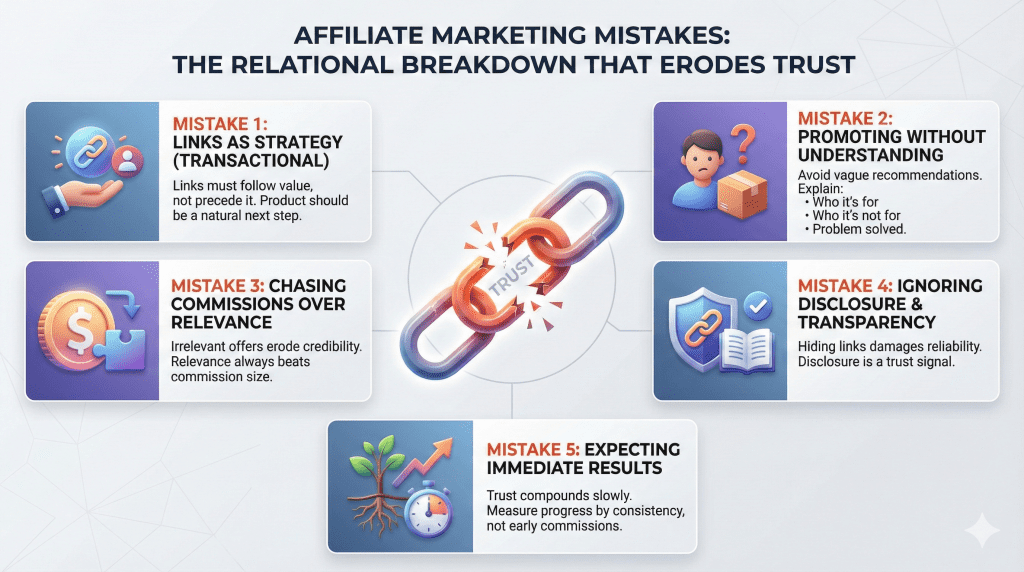
Affiliate Marketing Mistakes to Avoid (That Quietly BurnTrust)
Most affiliate marketers don’t fail because the model is broken. They fail because small, avoidable mistakes compound over time and erode trust before income ever has a chance to build.
This section isn’t about fear. It’s about removing friction from the path you’re already on.
Mistake 1: Treating Links as the Strategy
Affiliate marketing does not start with a link. It starts with intent.
When links appear without context, explanation, or relevance, they feel transactional. Readers skip them. Viewers ignore them. Trust erodes silently.
Correction: Links should appear after value, not instead of it. The product should feel like the natural next step, not the point of the content.
Mistake 2: Promoting Products You Don’t Understand
You don’t need to buy everything you recommend, but you do need to understand it deeply.
Vague recommendations signal distance. The audience can tell when you’re repeating marketing copy instead of sharing insight.
Correction: Only promote offers you can explain clearly:
- Who it’s for
- Who it’s not for
- What problem it actually solves
Clarity converts better than hype.
Mistake 3: Chasing High Commissions Over Relevance
High payouts are tempting. Irrelevant offers are expensive.
When promotions don’t match the audience’s intent, clicks drop and credibility takes the hit. One mismatched recommendation can undo weeks of trust-building.
Correction: Relevance always beats commission size. A smaller payout on a perfectly aligned offer outperforms a large commission that doesn’t fit.
Mistake 4: Ignoring Disclosure and Transparency
Trying to “hide” affiliate links doesn’t make them perform better. It makes you look unreliable when people eventually notice.
Disclosure is not a legal formality. It’s a trust signal.
Correction: Use clear, simple language: “This post contains affiliate links. If you purchase, I may earn a commission at no extra cost to you.”
Nothing more is needed. Transparency strengthens credibility.
Mistake 5: Expecting Early Results to Prove the Model
Affiliate marketing compounds slowly. Most people quit before momentum shows up.
Early content rarely converts well. That’s normal. Trust is still forming. Traffic is still inconsistent. Skills are still developing.
Correction: Measure progress by consistency and clarity, not commissions. The first payout is a milestone, not the finish line.
The Pattern Behind Every Failure
When affiliate marketing breaks down, it’s almost never technical. It’s relational.
- Too many links.
- Too little context.
- Too much urgency.
- Too little trust.
Avoid these mistakes, and the system becomes stable. From there, growth is a matter of repetition, not reinvention.
Conclusion: From Understanding to Your First Commission
Affiliate marketing doesn’t reward shortcuts. It rewards alignment.
When you step back and look at the full picture, the path is simple even if it isn’t easy. You build an audience around a clear niche. You create content that solves real problems. You recommend products that genuinely help, at the moment they’re most relevant. Over time, trust compounds, and commissions follow.
Nothing in this model works in isolation. Links don’t work without content. Content doesn’t work without traffic. Traffic doesn’t convert without trust.
That’s why affiliate marketing feels confusing to so many beginners. They see individual tactics, but they miss the system.
The system is this:
- Help first
- Relevance second
- Monetization last
When you respect that order, affiliate marketing stops feeling salesy and starts feeling natural. Recommendations become part of the value you provide, not interruptions to it.
Your first commission won’t come from perfection. It will come from consistency. From showing up when results are quiet. From improving one piece at a time instead of chasing every new strategy.
Affiliate marketing still works not because the internet is full of opportunities, but because people still look for guidance before they buy. If you can be that guide, ethically and consistently, the model works in your favor.
The only remaining question isn’t whether affiliate marketing works. It’s whether you’re willing to apply it long enough for the system to work for you.

Frequently Asked Questions (FAQs)
Do I need a website to start affiliate marketing?
No. You can start with platforms like YouTube, TikTok, Instagram, or an email list. A website gives you more control and long-term stability, but it’s not required on day one.
How long does it take to make the first commission?
For most beginners, it takes anywhere from 30 to 90 days. The timeline depends on consistency, content quality, traffic source, and how well the offer matches the audience. Results compound over time rather than appearing instantly.
Is affiliate marketing still profitable in 2026?
Yes, but the approach has changed. Profitable affiliate marketing today relies on trust, relevance, and useful content not mass links or aggressive promotion. Those who treat it like a business still see strong results.
Do I need to buy every product I promote?
You don’t need to buy everything, but you do need to understand what you’re recommending. The more firsthand experience you have, the easier it is to explain who the product is for and when it makes sense to use it.
How many affiliate programs should I join at the start?
Start with one or two strong, relevant offers. Promoting too many products early can dilute trust and confuse your audience. Depth converts better than variety when you’re starting out.
Is affiliate marketing legal?
Yes. Affiliate marketing is legal when done properly. You must disclose affiliate relationships clearly and follow FTC guidelines. Transparency protects both you and your audience.
Can I do affiliate marketing with no money?
Yes. Many affiliates start using free platforms, free tools, and organic traffic. Paid tools can speed things up, but they are not required to begin.
What’s the biggest mistake beginners make?
Skipping audience-building and going straight to links. Affiliate marketing works best when recommendations are earned through trust, not pushed through volume.
Can affiliate marketing become passive income?
Over time, parts of it can. Content like blog posts, videos, and email sequences can continue earning after they’re created. However, reaching that stage requires upfront effort and ongoing optimization.
What matters more: traffic or trust?
Trust. A small, engaged audience that believes your recommendations will outperform large amounts of untargeted traffic every time.

13 Comments
Best Affiliate Marketing Platforms for Beginners: Where to Start and Succeed - Ismel Guerrero. · February 6, 2025 at 11:09 pm
[…] you’re completely new to affiliate marketing, start with our Beginner’s Guide to Affiliate Marketing to understand how the business model […]
Best Niches for Affiliate Marketing: Profitable & High-Paying Niches - Ismel Guerrero. · February 7, 2025 at 10:03 pm
[…] you are new to affiliate marketing, check out our Affiliate Marketing 101 to get started with the […]
Pinterest Affiliate Marketing: An In-Depth Guide to Success. - Ismel Guerrero. · February 8, 2025 at 3:39 pm
[…] Next, check out our full affiliate marketing guide here. […]
Ad Copy: How to Write Compelling Ads That Convert - Ismel Guerrero. · February 22, 2025 at 9:38 am
[…] Next, you might want to read our affiliate marketing guide. […]
Affiliate Marketing for Beginners: Start Your Journey With The Ultimate Guide - Ismel Guerrero. · March 11, 2025 at 1:06 pm
[…] Next, check out our Affiliate Marketing 101 Guide. […]
High Ticket Affiliate Marketing for Beginners: A Step-by-Step Guide - Ismel Guerrero. · March 28, 2025 at 11:30 am
[…] If you’re not yet familiar with the basics, this guide explains affiliate marketing step by step. […]
AI Affiliate Marketing: The Ultimate Guide in 2025 - Ismel Guerrero. · March 31, 2025 at 8:29 pm
[…] To learn more read our affiliate marketing full guide. […]
Crypto Affiliate Programs: Your Path to Earning Passive Income in Cryptocurrency. - Ismel Guerrero. · April 11, 2025 at 7:21 pm
[…] new to this space, it’s helpful to first understand how affiliate marketing works in general—Affiliate Marketing 101 is a great place to […]
OLSP System Review: Real Opportunity or Total Waste - Ismel Guerrero. · April 11, 2025 at 11:10 pm
[…] to affiliate marketing? Check out our complete Affiliate Marketing guide to learn the basics and start your journey the right […]
The Beginner's Roadmap to Affiliate Marketing Commissions - Ismel Guerrero. · April 13, 2025 at 1:03 am
[…] If you want to dive even deeper into the basics, check out our full Affiliate Marketing Guide. […]
Faceless Marketing: The Strategy Taking Over the Internet - Ismel Guerrero. · May 13, 2025 at 5:57 pm
[…] Read our Affiliate Marketing Guide and our High-Ticket Affiliate Marketing […]
Affiliate Marketing Strategies That Actually Work in 2026 - Ismel Guerrero. · January 26, 2026 at 7:42 pm
[…] Many affiliates rely on isolated tactics that work briefly but fail to scale or compound. Effective affiliate marketing is built on repeatable models that align traffic, content, and […]
Influencer Marketing: How Attention Turns Into Influence and Sales - Ismel Guerrero. · February 22, 2026 at 1:40 pm
[…] Affiliate marketing is performance-based by design. Compensation depends on measurable actions such as sales or signups. […]