You do not always need to generate a sale to earn a commission. With CPL marketing, you can get paid when someone shows genuine interest in a company’s offer and completes a qualifying action, such as requesting a quote, booking a consultation, or submitting a form.
The opportunity sounds simple, but profitable campaigns depend on more than collecting contact details. You need the right offer, relevant traffic, clear qualification rules, and a reliable way to track which leads get approved.
This guide explains how CPL marketing works, how payouts are calculated, where to find offers, and what separates valuable leads from rejected submissions.
- CPL marketing pays for approved leads rather than completed sales.
- A submitted form only earns a payout when it meets qualification requirements defined by the offer.
- Your earnings depend on payout, approval rate, traffic cost, and lead volume.
- Companies may reject duplicate, false, incomplete, or ineligible submissions.
- Leads can be generated through search content, paid traffic, comparison pages, email, and local websites.
- A high payout does not automatically mean higher profit.
- Sustainable results come from matching the right audience with a relevant offer and tracking every campaign cost.
What CPL Marketing Is and Why Companies Pay for Leads
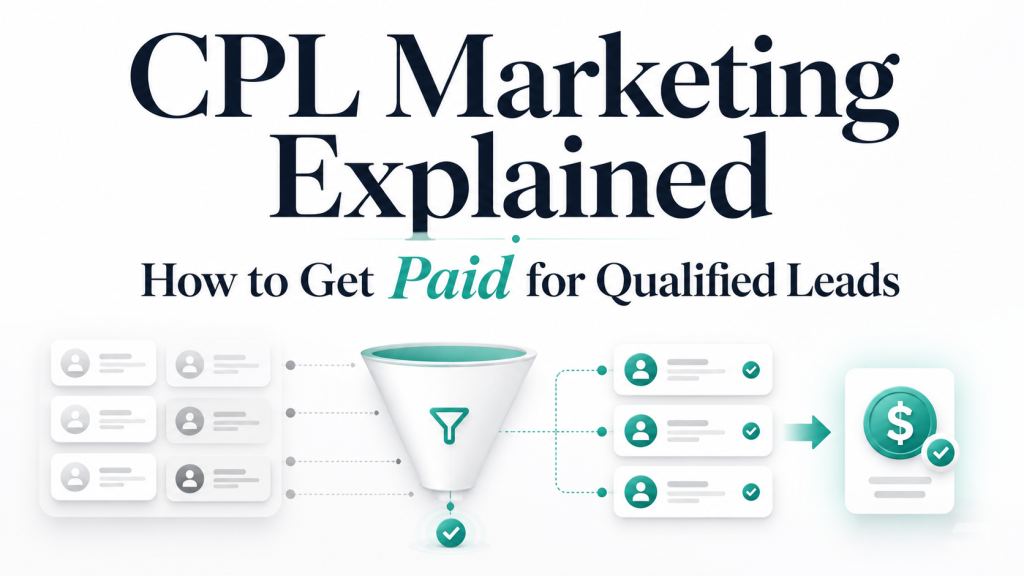
CPL stands for cost per lead. It is a performance-based model where you earn a fixed payout when someone completes a qualifying lead action.
That action might include requesting a quote, booking a consultation, submitting an application, registering interest, or asking for more information. The exact requirement depends on the offer.
You do not need to sell the final product yourself. Your role is to attract the right person, present the offer clearly, and guide them toward the required action.
Companies pay for these leads because each approved submission represents a potential customer. A home-service company may pay for quote requests. A software company may pay for demo bookings. An education provider may pay for course inquiries.
The payout reflects the expected value of the lead. A simple newsletter signup may pay very little, while a qualified insurance or legal inquiry may pay more because the company expects greater revenue from each customer.
However, not every submission earns money. The company may require valid contact details, an eligible location, genuine interest, or specific answers on the form. The lead must meet those conditions before the payout becomes approved.
CPL marketing works because both sides receive something measurable. The company receives a potential customer, and you receive payment for generating that opportunity.
How a Lead Moves From First Click to Approved Payout
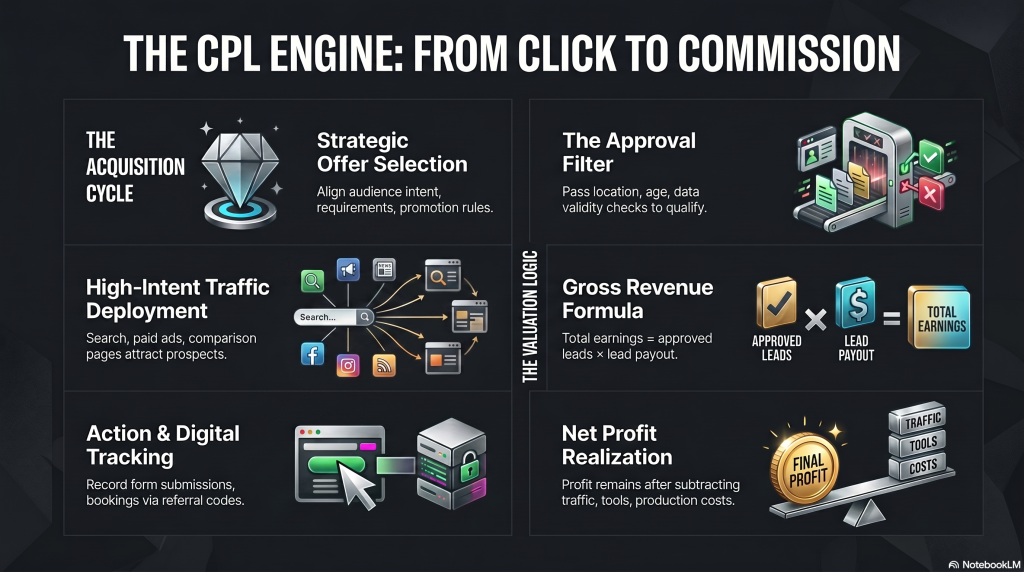
A CPL campaign follows a clear path. You choose an offer, attract the right person, track the referral, and earn when the company approves the lead.
- You choose a CPL offer. Start with an offer that matches your audience, traffic source, and location. Review the payout, lead requirements, allowed promotion methods, and reasons a submission may be rejected.
- You send relevant traffic to the offer. You may use search content, paid ads, email, comparison pages, or another approved channel. The goal is to reach people who already have a reason to consider the service.
- The visitor completes the required action. The person may request a quote, book a consultation, submit an application, or complete a lead form. The offer terms determine which action counts.
- Tracking connects the lead to you. A unique link, tracking code, or platform records where the visitor came from. Without accurate tracking, the system may not credit the lead to your campaign.
- The company reviews the submission. The lead may remain pending while the company checks the contact details, location, customer status, and other qualification rules.
- The approved lead triggers your payout. Once the submission passes review, the platform records it as approved. Your earnings then appear according to the network or program’s payment schedule.
A recorded lead is not always a paid lead. The submission must meet the offer’s conditions before it becomes eligible for payment.
This process makes lead quality more important than raw volume. Ten qualified leads can earn more than fifty weak submissions that fail validation.
What Makes a Lead Worth Paying For
A lead becomes valuable when it gives the company a realistic chance to gain a customer. That is why most CPL offers use qualification rules instead of paying for every form submission.
The contact details must be real
A lead usually needs a valid name, email address, phone number, or other contact information. False details make the submission unusable because the company cannot follow up.
Before you promote an offer, check which fields the person must complete. More detailed forms can reduce conversion volume, but they often improve lead quality.
The person must match the target audience
Many offers only accept leads from specific locations, age groups, industries, income ranges, or business types.
For example, a local roofing company may only pay for leads within its service area. A software offer may only accept inquiries from businesses with a minimum number of employees.
Sending broad traffic can produce more submissions, but many of them may fail these requirements.
The lead usually needs to be new
Companies often reject duplicate leads. A person may not qualify if they already exist in the company’s database or submitted the same form recently.
Duplicate rules vary between offers. Some programs use a short exclusion period, while others only pay for completely new contacts.
The person must show genuine interest
A strong lead has a real reason to consider the product or service. Someone requesting a quote or consultation usually shows more intent than someone entering details only to receive a reward.
Misleading headlines and unrelated incentives may increase form submissions, but they often reduce approval rates. Your message should attract people who understand what they are requesting.
The submission must follow the offer rules
CPL offers may restrict certain traffic sources, promotional claims, devices, locations, or incentives. A lead can look valid and still get rejected if it came through a prohibited method.
Review the campaign terms before sending traffic. Pay close attention to brand bidding rules, email restrictions, approved countries, and whether incentivized traffic is allowed.
The lead may need to pass verification
Some companies verify leads before approving payment. They may confirm an email address, call the phone number, review the form answers, or check whether the person requested the service.
A submitted lead does not always become an approved lead. Your earnings depend on generating people who meet the requirements and provide accurate information.
The goal is not to collect as many forms as possible. The goal is to generate leads that companies can contact, qualify, and potentially convert into customers.

How CPL Earnings and Profit Are Calculated
A CPL offer usually pays a fixed amount for each approved lead. Your total earnings depend on three things: how many leads you generate, how many get approved, and how much the offer pays per lead.
The basic earnings formula is:
Approved leads × payout per lead = gross earnings
For example, if an offer pays $30 per approved lead and you generate 40 approved leads, your gross earnings would be $1,200.
40 × $30 = $1,200
Approval rate affects what you actually earn
You may generate more submissions than the company approves. That difference matters because you only get paid for leads that meet the offer requirements.
You can calculate the approval rate with this formula:
Approved leads ÷ submitted leads × 100 = approval rate
Suppose you generate 50 submitted leads, but only 35 get approved.
35 ÷ 50 × 100 = 70% approval rate
If the payout is $30 per approved lead, your earnings would be:
35 × $30 = $1,050
A high number of submissions can look impressive, but the approval rate shows how much of that traffic produces payable results.
Gross earnings are not the same as profit
Gross earnings show the amount the offer pays you. Profit shows how much remains after you subtract campaign costs.
The profit formula is:
Gross earnings − total campaign costs = profit
Your costs may include paid traffic, hosting, landing-page tools, tracking software, email services, or content production.
For example, suppose you earn $1,050 and spend $650 to generate those leads.
$1,050 − $650 = $400 profit
This is why a high CPL payout does not always mean a better opportunity. An offer that pays $60 per lead may still lose money if the traffic is expensive or the approval rate is low.
Cost per approved lead shows your break-even point
You can also calculate how much it costs you to generate each approved lead.
The formula is:
Total campaign costs ÷ approved leads = cost per approved lead
If you spend $650 and generate 35 approved leads, your cost per approved lead is about $18.57.
$650 ÷ 35 = $18.57
Since the offer pays $30 per lead, the difference between the payout and your cost is about $11.43 per approved lead.
That margin gives you a clearer view of whether the campaign can support more traffic.
Earnings per click helps compare offers
Earnings per click, or EPC, shows how much revenue you generate from each click sent to the offer.
The formula is:
Gross earnings ÷ total clicks = earnings per click
If you earn $1,050 from 2,100 clicks, your EPC is $0.50.
$1,050 ÷ 2,100 = $0.50 EPC
You can compare EPC with your average traffic cost. If you pay $0.35 per click and earn $0.50 per click, the campaign has room for profit before other expenses. If your traffic costs $0.65 per click, the campaign will likely lose money unless performance improves.
The payout is only one part of the calculation. Approval rate, traffic cost, and conversion performance determine whether a CPL campaign produces real profit.
Where to Find Legitimate CPL Offers
You can find CPL offers through networks, direct company programs, lead-generation platforms, and private partnerships.
The best source depends on your traffic, niche, experience, and the types of leads you can generate.
CPA and affiliate networks
Networks connect you with companies that pay for qualified leads. They usually provide tracking links, reporting dashboards, campaign terms, and payment processing.
Before you apply, check:
- Which countries the offer accepts
- What traffic sources are allowed
- How much each approved lead pays
- How long validation takes
- Why leads may get rejected
- How often the network sends payments
A large offer catalog can be useful, but offer quality matters more than quantity. Clear terms and reliable tracking should come before a high advertised payout.
Direct company programs
Some companies manage their own referral or lead-generation programs. Working directly can give you clearer communication, faster feedback, and more control over the relationship.
Direct programs may also offer better terms because there is no network acting as the middle layer. However, they can require stronger traffic history or proof that you can generate useful leads.
Look for partner, referral, affiliate, or lead-generation pages on company websites. You can also contact companies in your niche and ask whether they pay for qualified inquiries.
Specialized lead-generation platforms
Some platforms focus on specific industries, such as insurance, home services, education, software, finance, or legal services.
These platforms may provide more detailed lead requirements than general networks. They may also offer different payment models, such as shared leads, exclusive leads, or higher payouts for stronger qualifications.
Read the terms carefully. A lead may need to meet strict location, service, or customer criteria before it earns a payout.
Private partnerships
As you build experience, you may find opportunities through direct outreach, industry contacts, or referrals.
A private agreement can define:
- The type of lead required
- The payout for each approved lead
- The validation process
- The payment schedule
- The locations or services covered
- Whether the lead is exclusive
Private partnerships can offer better margins, but they also require trust and clear tracking. Put the terms in writing before you start sending leads.
Check the offer before you promote it
A legitimate CPL offer should explain what counts as a valid lead, how tracking works, when payment becomes due, and what promotional methods you can use.
Be cautious when an offer:
- Hides the qualification rules
- Promises unusually high payouts without clear terms
- Refuses to explain rejection reasons
- Changes conditions without notice
- Has weak support or unclear payment history
- Asks you to use misleading claims
Finding an offer is only the first step. The real goal is to find one that matches your audience, accepts your traffic source, and provides enough transparency to judge performance fairly.

How to Generate Leads Without Owning a Product
You do not need to create a product or deliver the final service yourself. Your role is to attract people who already have a relevant need, then connect them with an offer that can solve it.
The strongest CPL campaigns start with intent. Someone searching for a quote, consultation, comparison, or local service is usually more valuable than someone who only shows casual interest.
Search-focused content
Search content can attract people who are already researching a problem or comparing solutions.
You might create pages around topics such as:
- Best software for a specific business need
- Local service costs
- Insurance quote requirements
- Training program comparisons
- Questions to ask before hiring a provider
The content should help the reader make a decision before introducing the lead offer. A useful page builds trust and attracts people who are more likely to complete the required action.
Search traffic can take time to build, but it may continue generating leads after the content begins ranking.
Paid traffic
Paid advertising can send visitors to a CPL offer quickly. Common options include search ads, social ads, native advertising, and other approved platforms.
The main challenge is cost. You need to know how much you can spend before the campaign stops being profitable.
For example, an offer that pays $40 per approved lead may look attractive. However, it can still lose money if it costs $55 to generate each approved lead.
Paid traffic works best when you target people who match the offer’s location, intent, and qualification rules.
Comparison and review pages
Comparison pages help readers evaluate several options before choosing one.
A page might compare service providers, software platforms, training programs, or financial products. It can then direct interested readers toward a quote request, consultation, or information form.
The comparison should remain accurate and useful. Misleading rankings or exaggerated claims may increase clicks, but they can also reduce trust and lead quality.
Email and existing audiences
An email list can generate CPL conversions when the offer matches the audience’s interests.
Someone who subscribed for home-buying advice may respond to a mortgage quote offer. A business audience may show interest in software demos or service consultations.
Do not send unrelated offers simply because the payout looks attractive. Audience fit matters more than list size.
You also need permission to contact subscribers and must follow the offer’s email rules.
Local lead-generation websites
Local websites can connect people with businesses that serve a specific area.
For example, you might build content around roofing, landscaping, legal services, moving companies, or home repairs in a particular city. Visitors can then request a quote or consultation.
This method works because local searches often show strong intent. Someone looking for an emergency plumber in a specific area is closer to taking action than someone reading general plumbing advice.
The website still needs useful content, clear contact forms, accurate location targeting, and reliable tracking.
Social content and communities
Social platforms can generate leads when you understand the audience and the offer fits the conversation.
Educational posts, short videos, demonstrations, and problem-solving content can introduce people to a relevant service. Communities can also reveal the questions and concerns that lead to stronger campaign angles.
Avoid dropping promotional links without context. Useful content usually attracts better leads than aggressive promotion.
No traffic method guarantees results. The best choice depends on the offer, your skills, the target audience, and the cost of reaching them.
The goal is not to send the largest number of visitors. It is to reach people who understand the offer, meet the requirements, and have a genuine reason to complete the action.
How to Tell Whether a CPL Offer Is Worth Promoting
A high payout can make an offer look attractive, but the number alone does not tell you whether the campaign can produce a profit. You need to understand how difficult the lead is to generate, how often submissions get approved, and how much traffic will cost.
Review the payout in context
The payout shows how much you earn for each approved lead. However, a $75 lead is not always better than a $25 lead.
The higher-paying offer may require more form fields, stricter qualifications, or a longer verification process. Those requirements can reduce conversions and increase the cost of generating each approved lead.
Compare the payout with the effort and traffic cost required to earn it.
Check the lead requirements
Read the qualification rules before sending traffic. Look for details such as:
- Required location
- Age or customer criteria
- New customer requirements
- Mandatory form fields
- Verification steps
- Duplicate lead rules
Strict requirements are not automatically a problem. They become a problem when your audience does not match them.
Confirm your traffic source is allowed
An offer may accept search traffic but reject email, social ads, incentives, or brand bidding. Using an unapproved method can cause valid-looking leads to be denied.
Check the terms for every traffic source you plan to use. Ask for clarification when a rule is vague, and keep written confirmation when possible.
Examine the conversion process
Visit the landing page yourself before promoting the offer. Check whether it loads quickly, explains the offer clearly, and works properly on mobile devices.
Pay attention to the number of form fields and steps. A confusing page can reduce conversions even when your traffic is relevant.
You should also check whether the landing page matches the message used to attract the visitor. A large disconnect between the promotion and the form often leads to weak conversion rates and low-quality submissions.
Look at the approval process
An offer may record many leads but approve only a small percentage. That gap can reduce your earnings significantly.
Ask whether the program shares approval rates or common rejection reasons. You should also understand how long validation takes and whether rejected leads can be reviewed.
Transparent approval rules make it easier to improve performance. Unexplained rejections make the campaign difficult to evaluate.
Understand the payment terms
Check how often payments are sent and whether the program uses a minimum payment threshold. Some offers pay weekly, while others pay monthly or after a longer validation period.
Also review whether approved leads can later be reversed. A lead may lose approval if the information proves false, the customer cancels, or the submission violates campaign terms.
Payment reliability matters as much as the advertised payout.
Estimate your potential profit
Before committing a large budget, calculate the maximum amount you can afford to spend on each approved lead.
Suppose an offer pays $40 per lead. If your average cost to generate an approved lead is $28, you have a $12 margin before other expenses.
If the cost rises above $40, the campaign loses money even if the offer converts.
Start with a controlled test and track:
- Clicks
- Submitted leads
- Approved leads
- Traffic costs
- Gross earnings
- Net profit
An offer is worth promoting when the audience fit, approval rules, traffic costs, and payout work together. The strongest opportunity is not always the one with the highest payout. It is the one that produces approved leads at a cost below what you earn.

Why Leads Get Rejected and How to Reduce It
A rejected lead does not earn a payout. That makes rejection rate one of the most important numbers in a CPL campaign.
Most rejections happen because the lead does not meet the offer rules, the information is unusable, or the traffic creates weak intent. You can reduce many of these problems before the visitor reaches the form.
Duplicate submissions
A company may reject a lead when the person already exists in its database or recently submitted the same request.
Duplicate rules vary by offer. Some programs only accept completely new contacts, while others allow the same person to qualify again after a set period.
Review the duplicate policy before promoting the campaign. Offers with strict rules may perform poorly with broad audiences that have already seen similar promotions.
Incorrect or incomplete information
Invalid phone numbers, false email addresses, missing fields, and inconsistent answers can make a lead unusable.
Your promotional message should explain what the person is requesting. This helps discourage people who only want to access an incentive or complete the form without genuine interest.
You can also use clear form instructions and basic validation tools when you control the landing page.
Ineligible locations
Many offers only accept leads from specific countries, states, cities, or service areas.
Traffic outside those locations may still complete the form, but the company can reject the submission. This wastes traffic and lowers your approval rate.
Use location targeting where possible. Your content, ads, and landing pages should also make the eligible area clear before the visitor submits information.
Low-intent leads
A person may provide valid details but have little interest in the product or service. These leads often come from vague promotions, unrelated incentives, or messaging that attracts curiosity rather than genuine need.
Match the promotion closely to the offer. Someone requesting a roofing quote should understand that a roofing company may contact them.
Clear expectations usually produce fewer submissions, but the leads tend to be more useful.
Misleading promotional claims
A lead may get rejected when the promotion promises something the offer does not provide.
Examples include describing a paid service as free, implying guaranteed approval, or hiding important eligibility requirements.
Accurate messaging protects the person completing the form and improves lead quality. It also reduces the risk of account restrictions or unpaid conversions.
Prohibited traffic sources
Some offers do not allow certain traffic methods, such as incentives, email, social ads, pop-ups, or brand bidding.
A lead can meet every customer requirement and still get rejected if it came from an unapproved source.
Read the campaign terms before launching. When a rule is unclear, get written confirmation before spending money or building content around the offer.
Automated or fraudulent activity
Fake accounts, bots, repeated form submissions, and fabricated customer information can trigger fraud filters.
Avoid traffic providers that cannot explain where their visitors come from. Sudden spikes in conversion rate, unusual form patterns, or large volumes from one source may also signal a problem.
Monitor each traffic source separately so you can stop suspicious activity before it damages the full campaign.
How to improve your approval rate
You can reduce rejections by matching your traffic more closely to the offer requirements.
Focus on five areas:
- Review the qualification rules before promotion begins.
- Target the correct location and audience.
- Set clear expectations in the ad or content.
- Track rejection reasons by source and campaign.
- Stop sending traffic that produces repeated quality problems.
A strong approval rate does more than increase earnings. It also helps you identify which offers, audiences, and traffic sources deserve more attention.
CPL vs. CPA: The Difference Comes Down to the Action
CPL and CPA both pay for measurable results, but they do not use the same conversion goal.
CPL pays when you generate a qualified lead. CPA can pay for many different actions, including leads, app installs, account registrations, trial signups, or completed purchases.
| Model | What triggers payment | Typical offers | Conversion difficulty | Common payout structure |
|---|---|---|---|---|
| CPL | A qualified lead | Quotes, consultations, applications, information requests | Usually lower than a sale | Fixed amount per approved lead |
| CPA | Any defined action | Leads, installs, trials, registrations, or sales | Depends on the required action | Fixed amount per approved action |
CPL focuses only on leads
With CPL, your goal is to connect a company with someone who shows genuine interest.
The person usually completes a form, requests a quote, books a consultation, or submits an application. You earn when the company approves that lead.
You do not need to convince the person to complete a purchase. The company handles the next stage, such as contacting the lead, answering questions, and closing the sale.
This can make CPL attractive when the product has a long buying process or requires direct communication before purchase.
CPA covers a wider range of actions
CPA is the broader model. A campaign may pay you when someone:
- Installs an app
- Creates an account
- Starts a free trial
- Submits a lead form
- Makes a purchase
CPL fits inside CPA because a lead is one type of action. However, not every CPA campaign is a CPL campaign.
For example, an offer that pays for a software trial uses CPA pricing but does not necessarily generate a sales lead. An offer that pays for an insurance quote request can qualify as both CPA and CPL.
The required action affects your strategy
CPL campaigns usually depend on reaching people who have a clear need and are willing to share their contact information.
Other CPA offers may require different behavior. App-install campaigns may depend more on mobile traffic, while purchase-based offers often need stronger trust and buying intent.
The deeper the required action sits in the customer journey, the harder it may be to generate. However, more demanding actions often carry higher payouts.
Which model should you choose?
CPL may suit you when you can attract people searching for quotes, services, consultations, or detailed information.
A broader CPA offer may suit you when your audience is more likely to install an app, start a trial, create an account, or make a purchase.
The better choice depends on your traffic source, audience intent, campaign costs, and the amount of effort required to produce an approved conversion.
The main distinction is simple: CPL pays for qualified leads, while CPA can pay for any action defined by the offer.

Pros and Cons of CPL Marketing
CPL marketing can be an accessible way to earn from performance marketing because you do not need to generate the final sale. However, the model still requires careful targeting, reliable tracking, and a clear understanding of the offer rules.
Pros of CPL marketing
You can earn without closing the sale
Your role is to generate a qualified inquiry, not convince the person to make the final purchase.
The company handles the follow-up, sales conversation, and customer service. This can make CPL offers easier to promote than campaigns that only pay after a completed sale.
Lead actions often require less commitment
Requesting a quote, booking a consultation, or asking for more information usually requires less commitment than buying a product.
That can make the conversion easier to achieve, especially when the audience already has a clear need.
CPL works across many industries
You can find lead-based offers in areas such as home services, software, education, insurance, legal services, and finance.
This variety makes it easier to choose an offer that matches your traffic source, content, or audience.
You can measure results clearly
CPL campaigns give you specific numbers to track, including clicks, submitted leads, approved leads, approval rate, earnings, and cost per approved lead.
These metrics help you identify which offers and traffic sources deserve more attention.
You do not need your own product
You can focus on attracting the right audience without building a product, managing inventory, or delivering the final service.
Your main responsibility is generating leads that meet the campaign requirements.
Cons of CPL marketing
Not every submitted lead earns a payout
A form submission may remain pending or get rejected after review.
Duplicate contacts, invalid information, ineligible locations, or weak intent can reduce the number of leads that qualify for payment.
Offer rules can be strict
Some campaigns limit traffic sources, promotional methods, locations, customer types, and form requirements.
A lead may appear valid but still get rejected if it came through an unapproved method.
Approval delays can affect cash flow
Some offers review leads over several days or weeks.
This delay can make it harder to judge a campaign quickly, especially when you are paying for traffic and waiting to confirm your real earnings.
Paid traffic can create losses quickly
A strong payout does not guarantee profit.
If your cost per approved lead rises above the payout, the campaign loses money. Poor targeting or a low approval rate can make that happen faster than expected.
You depend on systems you do not control
Tracking errors, landing-page changes, offer pauses, payout reductions, and revised approval rules can affect your results.
That makes transparent programs and reliable tracking especially important.
CPL marketing works best when you can attract people with genuine intent, follow the offer rules, and track every cost. The main advantage is that you can earn before the final sale. The main limitation is that payment still depends on the quality and approval of each lead.

Common CPL Mistakes That Reduce Earnings
CPL marketing usually fails because of weak targeting, poor tracking, or misunderstood offer rules. The payout may look attractive, but small mistakes can turn a promising campaign into a loss.
Choosing an offer based only on payout
A high payout does not guarantee strong earnings.
An offer that pays $80 per lead may require strict qualifications and approve only a small percentage of submissions. A $25 offer with simpler requirements and a stronger approval rate may produce more profit.
Compare the payout with the conversion process, approval rules, traffic cost, and expected earnings per click.
Ignoring the lead requirements
Every offer defines what counts as a valid lead. Skipping those details can lead to rejected submissions and wasted traffic.
Check the accepted locations, required information, duplicate policy, customer criteria, and allowed traffic sources before launching the campaign.
Your promotion should target people who can meet those conditions.
Sending broad, low-intent traffic
More visitors do not always produce more approved leads.
People who are only curious may complete a form without understanding the service or expecting follow-up. These submissions often convert poorly and may fail the advertiser’s quality checks.
Focus on people actively searching for a quote, consultation, application, or solution.
Creating a mismatch between the promotion and offer
Your ad or content should prepare the visitor for what happens next.
For example, do not promise a free service when the form only requests a paid consultation. Do not describe a quote request as an instant price if the company needs to contact the person first.
A clear message may produce fewer clicks, but it usually attracts stronger leads.
Failing to track approval rates
Submitted leads do not show how much you will earn. You need to know how many submissions become approved leads.
Track approval rates for each offer, page, ad, audience, and traffic source. A source that generates cheap submissions may become expensive once rejected leads enter the calculation.
Treating pending leads as confirmed income
Some offers take time to review leads. A dashboard may show conversions before the company approves them.
Do not scale a campaign based only on pending results. Wait until you have enough approved leads to estimate the real payout, approval rate, and cost per approved lead.
Scaling before proving profitability
A small test can produce good results by chance. Increasing the budget too quickly can expose weaknesses that were not visible at a lower volume.
Confirm that the campaign remains profitable across enough clicks and approved leads. Then increase traffic gradually while monitoring costs and approval rates.
Depending on one offer
CPL offers can pause, change payouts, tighten requirements, or stop accepting certain traffic sources.
Relying on one campaign creates unnecessary risk. Build experience within a focused niche, but test more than one suitable offer when possible.
Ignoring compliance rules
Misleading claims, unapproved incentives, or restricted traffic methods can lead to rejected commissions or account closure.
Read the campaign terms and follow the rules of the platform you use to generate traffic. Accurate promotion protects your earnings and the people submitting their information.
The most expensive mistakes often look harmless at first. Careful offer selection, precise targeting, and consistent tracking help you spot problems before they consume your budget.
Conclusion: Qualified Leads Create the Real Value
CPL marketing gives you a way to earn without owning a product or closing the final sale. Your job is to connect the right person with a company that values the inquiry.
The model looks simple, but strong results depend on more than form submissions. You need to choose suitable offers, attract people with genuine intent, follow the campaign rules, and track how many leads actually get approved.
A high payout can help, but approval rate, traffic cost, and lead quality determine whether the campaign produces profit. That is why careful testing matters more than chasing volume.
When you understand what makes a lead valuable, you can build campaigns that work for both sides. The company receives a real opportunity, and you earn for creating it.
CPL marketing rewards accuracy, relevance, and consistency. The better you become at generating qualified leads, the stronger your earning potential becomes.

Frequently Asked Questions
Can you make money with CPL marketing?
Yes. You earn when the leads you generate meet the offer requirements and receive approval.
Your profit depends on the payout, approval rate, traffic cost, and number of qualified leads. A campaign can generate revenue and still lose money if the cost of producing each approved lead exceeds the payout.
How much do CPL offers pay?
Payouts vary by industry, location, lead requirements, and expected customer value.
Simple signups may pay a small amount, while qualified leads for insurance, legal services, finance, software, or home services may pay more. The highest payout is not always the best offer because stricter requirements can reduce approval rates.
Do you need a website for CPL marketing?
No, but a website can help you attract search traffic, publish comparisons, explain offers, and build trust.
Some programs allow paid ads, email, social media, or other traffic sources. Always check the offer rules before choosing how to promote it.
Where can you find CPL offers?
You can find CPL offers through CPA networks, affiliate programs, specialized lead-generation platforms, and direct company partnerships.
Before promoting an offer, review the qualification rules, accepted traffic sources, payout schedule, validation period, and reasons leads may be rejected.
How long does lead approval take?
Approval times depend on the offer. Some programs validate leads immediately, while others need several days or weeks.
Do not treat pending leads as confirmed earnings. Wait for enough approval data before increasing traffic or campaign spending.
Why do companies reject leads?
Common reasons include duplicate submissions, false contact details, ineligible locations, incomplete forms, prohibited traffic sources, and low-intent inquiries.
Clear targeting and accurate promotional messages can improve your approval rate.
Is CPL easier than earning commissions from sales?
CPL can be easier to convert because the person does not need to complete a purchase. They may only need to request a quote, book a consultation, or submit their information.
However, easier conversion does not mean guaranteed profit. Leads still need to meet the offer rules and pass validation.
Can you use free traffic for CPL marketing?
Yes. Search content, social content, email audiences, communities, and local websites can generate leads without paying for every click.
Free traffic still requires time, content, tools, and consistent work. You should track those costs when judging whether a campaign is worthwhile.

0 Comments