PPC, or pay-per-click advertising, gives businesses a way to pay for targeted visibility across search engines, websites, social platforms, marketplaces, and other digital channels.
The basic idea is simple. An advertiser runs an ad and pays when someone clicks it.
The economics are more important than the click itself.
A campaign that generates inexpensive clicks can still lose money if those visitors do not convert. A more expensive click can be worthwhile when it consistently produces valuable leads or customers.
Understanding PPC therefore requires more than knowing what the acronym means.
This guide explains how pay-per-click advertising works, what determines PPC costs, the major types and platforms, how performance is measured, and when PPC makes sense as part of a digital marketing strategy.
- PPC is an advertising pricing model in which advertisers pay for clicks. It is commonly associated with search advertising, but pay-per-click pricing is also used across other digital advertising environments.
- The click is not the final measure of PPC success. Leads, sales, customer value, acquisition cost, and return on ad spend determine whether paid traffic is economically useful.
- PPC costs are not fixed. Competition, audience value, targeting, bids, ad relevance, landing-page experience, and platform mechanics can all affect what advertisers pay.
- PPC is broader than Google Search Ads. Search engines, social platforms, ecommerce marketplaces, and other advertising networks can support click-based campaigns.
- Strong targeting can improve relevance, but it cannot compensate for a poor offer or landing page. The experience after the click is part of PPC performance.
- PPC metrics need context. A low cost per click or high click-through rate means little if the campaign does not produce valuable actions.
- PPC and SEO serve different acquisition functions. Paid advertising can generate visibility quickly, while SEO focuses on earning visibility in unpaid search results.
Disclaimer: I am an independent Affiliate. The opinions expressed here are my own and are not official statements. If you follow a link and make a purchase, I may earn a commission.
What Is PPC?
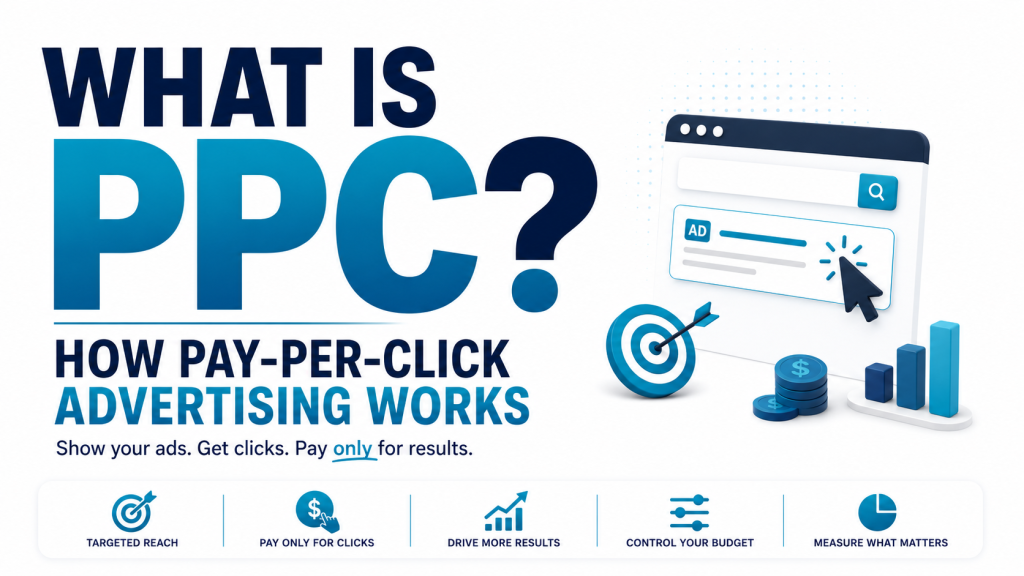
PPC stands for pay-per-click.
It is a digital advertising pricing model in which an advertiser pays when someone clicks an ad.
Google describes cost-per-click bidding as a system where advertisers pay for individual ad clicks and notes that CPC pricing is also known as pay-per-click advertising.
Search advertising is one of the most familiar examples.
A plumbing company might bid to show an advertisement when someone searches for “emergency plumber near me.” If the ad appears but nobody clicks it, a traditional CPC campaign does not generate a click charge. If someone clicks the ad, the advertiser pays for that interaction.
PPC is broader than search advertising, however.
Click-based pricing can also appear in shopping ads, marketplace advertising, social advertising, display campaigns, and other digital advertising environments.
The important distinction is the billing event.
If the advertiser is charged for a click, the campaign is using a pay-per-click or cost-per-click model.
Not every digital advertisement is PPC. Some campaigns are priced according to impressions, video views, conversions, or other events.
PPC vs. CPC
PPC and CPC are closely related, but they describe different things.
PPC describes the advertising model.
CPC describes the cost of a click.
For example, suppose a campaign spends $200 and receives 100 clicks.
The average CPC is:
$200 ÷ 100 = $2 per click
The campaign itself is PPC. The $2 figure is its average cost per click.
Keeping these terms separate becomes useful when evaluating campaign economics.
Disclaimer: I am an independent Affiliate. The opinions expressed here are my own and are not official statements. If you follow a link and make a purchase, I may earn a commission.
How Does PPC Advertising Work?
A PPC campaign connects an advertisement with an audience and then measures what happens when members of that audience interact with it.
The exact setup varies by platform, but the basic process is similar.
- Define the campaign goal. Decide whether the advertising should generate sales, leads, website visits, registrations, or another result.
- Choose where to advertise. Select the platform or network that can reach the relevant audience.
- Define targeting. Depending on the platform, targeting may involve keywords, products, locations, interests, professional attributes, demographics, previous visitors, or other signals.
- Set the budget and bidding approach. Determine how much the campaign can spend and how the platform should compete for advertising opportunities.
- Create the advertisement. The message and format should match the audience and campaign objective.
- Choose the destination. A click may lead to a landing page, product page, app, marketplace listing, or another destination.
- Launch the campaign. The advertising system determines when the ad is eligible to appear.
- Pay for eligible clicks. Under a CPC model, the advertiser incurs a charge when someone clicks.
- Measure what happens afterward. Track whether visitors become leads, customers, subscribers, or complete another valuable action.
- Optimize the campaign. Use performance data to adjust targeting, ads, bids, budgets, or landing pages.
The most important part often occurs after the click.
Google defines a conversion as a valuable action that follows an ad interaction, such as a purchase, newsletter signup, phone call, or download. Its conversion tracking system is designed to connect advertising interactions with those business outcomes.
That is why traffic alone is an incomplete measure of PPC performance.

How Do PPC Ad Auctions Work?
Many PPC platforms use auctions to decide which advertisements receive available placements.
An auction does not necessarily mean that the advertiser willing to pay the most automatically wins.
Google Search Ads provides a useful example.
When a search occurs, Google evaluates eligible ads and calculates Ad Rank. Factors include the advertiser’s bid, ad and landing-page quality, auction competitiveness, search context, thresholds, and the expected impact of ad assets.
This means an advertiser with a higher bid can still lose a position to a competitor with a stronger overall Ad Rank.
Other platforms use their own auction, delivery, and optimization systems, so Google’s exact mechanics should not be applied universally.
The broader principle remains useful:
PPC advertising is usually a competition for valuable opportunities, not simply a fixed-price purchase of clicks.
Why Ad Relevance Matters
Advertising platforms have an incentive to show ads that users are likely to find useful.
In Google Search Ads, relevance and landing-page quality are among the factors incorporated into Ad Rank.
For advertisers, this creates an important connection between:
Targeting → ad message → landing page → conversion
An advertisement promising one thing and sending users to an unrelated or confusing page can weaken the campaign even if the initial targeting is strong.

What Determines the Cost of PPC?
There is no universal price for a PPC click.
One advertiser may pay cents for a click while another pays substantially more.
Several factors influence the economics.
Competition
Advertisers compete for finite opportunities to reach valuable audiences.
When more businesses want the same keywords, placements, or users, competition can increase the price required to participate effectively.
This is particularly noticeable in industries where one customer can be worth a large amount of money.
Search and Audience Intent
Not every click has the same potential value.
Someone searching for “what is accounting software” may be researching.
Someone searching for “buy accounting software for small business” may be much closer to making a purchase.
Advertisers may therefore value those two clicks differently.
The same principle applies outside search. Audiences that are more likely to produce commercially valuable actions can attract greater competition.
Industry and Customer Value
PPC economics depend partly on how much a customer is worth.
A business selling a $15 product cannot usually justify the same acquisition cost as a company that earns thousands of dollars from a new client.
This is why judging CPC without understanding customer economics can be misleading.
Targeting
Geography, professional attributes, audience characteristics, device, schedule, and other targeting criteria can affect available inventory and competition.
A narrowly defined, commercially valuable audience may cost more to reach than a broad audience.
Ad and Landing-Page Quality
On platforms that use quality and relevance signals, the advertisement and destination can influence how efficiently the campaign competes.
Google, for example, considers ad relevance and landing-page experience within its auction calculations.
Bidding Strategy
Advertisers may bid manually or use automated strategies that optimize toward particular campaign outcomes.
The appropriate strategy depends on what the advertiser is trying to accomplish and what conversion data is available.
The central rule is simple:
A high CPC is not automatically bad, and a low CPC is not automatically good.
A $10 click that reliably produces profitable customers can be more valuable than a $0.50 click that produces nothing.
Types of PPC Advertising
PPC can appear across several advertising environments.
Not every campaign within these categories necessarily uses click-based pricing. The billing model depends on the platform, campaign objective, and configuration.
Search Advertising
Search PPC places advertisements around search results when users look for relevant information, products, or services.
Advertisers can target keywords or other signals connected to searches.
Search advertising is particularly useful when the objective is to capture existing demand.
The advertiser does not need to create the initial need. The searcher has already expressed some level of interest through the query.
Shopping Advertising
Shopping advertisements promote individual products using information such as product imagery, pricing, merchant details, and other listing data.
These ads are particularly relevant to ecommerce.
They can connect product visibility directly with shoppers researching or comparing items.
Display Advertising
Display ads appear across websites, applications, or publisher networks.
They can include images, responsive creative, text, and other visual formats.
Display campaigns can use PPC pricing in some circumstances, but impression-based pricing is also common.
Compared with high-intent search traffic, display advertising often reaches people earlier in the decision process.
Social Media Advertising
Social advertising reaches people while they use platforms such as Facebook, Instagram, LinkedIn, Reddit, and others.
Targeting is often built around audience attributes, interests, behaviors, professional information, engagement, or previous interactions rather than explicit search queries.
Some social campaigns use clicks as the billable event, while others optimize and charge around different outcomes.
For example, LinkedIn states that the chargeable event depends on the campaign objective. Its Website Visits objective can charge when someone clicks the website link, while other objectives can use different billable events.
Video Advertising
Video campaigns can appear across video platforms, feeds, websites, and applications.
Depending on the campaign, advertisers may pay for clicks, views, impressions, or another interaction.
This is another reason PPC should not be used as a synonym for every form of online advertising.
Marketplace Advertising
Ecommerce marketplaces also use PPC models.
Amazon Sponsored Products, for example, are cost-per-click advertisements. Advertisers select products to promote, set bids and budgets, and pay when shoppers click the ads.
Marketplace PPC can be particularly valuable because advertisements appear in environments where people are already researching or shopping for products.

Major PPC Platforms
The best PPC platform depends on where the relevant audience spends time and what type of intent the advertiser wants to reach.
Google Ads
Google Ads is strongly associated with PPC because its Search campaigns can use CPC bidding to reach people searching for relevant products, services, or information.
Google also supports advertising beyond traditional search results, including other campaign types and inventory. Not every Google Ads campaign uses the same pricing model.
Microsoft Advertising
Microsoft Advertising provides another major search advertising environment.
Advertisers can create Search campaigns, select keywords and targeting, establish budgets, and enter how much they are willing to spend per click. Microsoft Search ads can appear on Bing and across search partners.
Meta Ads
Meta Ads allows advertisers to reach audiences across Meta’s advertising environment.
Campaigns are built around advertising objectives, and the platform can be used for goals such as traffic, leads, and sales. Because campaign objectives and optimization methods vary, Meta advertising should not universally be described as PPC even though click-focused campaigns are available. Meta’s current training materials continue to organize campaigns around selecting a business objective and measuring the corresponding result.
LinkedIn Ads
LinkedIn is particularly relevant when professional audience attributes matter.
Advertisers can target characteristics such as company, job title, seniority, skills, interests, and other professional information. LinkedIn supports objectives including website visits, engagement, leads, and conversions.
Its billing also illustrates why PPC and paid advertising are not interchangeable terms. The event an advertiser pays for can depend on the campaign objective.
Amazon Ads
Amazon Sponsored Products provides a clear ecommerce example of PPC.
The ads use cost-per-click pricing and can target keywords or products while sending shoppers directly to advertised product detail pages.
Other advertising platforms can also support click-based campaigns.
The important selection question is not simply which platform is largest. It is which environment gives the business access to the audience and level of intent required by the campaign.
Benefits of PPC Advertising
PPC gives advertisers a level of control and measurability that can make it useful across many acquisition strategies.
PPC Can Generate Visibility Quickly
Organic marketing channels often require time before they produce significant reach.
A PPC campaign can begin competing for advertising opportunities once it is configured, approved, and active.
That does not guarantee immediate profitability, but it can provide exposure without waiting for organic visibility to develop.
Advertisers Can Control Who They Try to Reach
Targeting varies by platform.
Possible controls include:
- Search keywords.
- Geographic location.
- Device.
- Audience interests.
- Professional attributes.
- Product categories.
- Previous website visitors.
- Demographics.
- Schedule.
- Marketplace products.
This does not mean every targeted person will be interested.
It means advertisers can reduce some of the waste associated with reaching completely unrestricted audiences.
Spending Can Be Controlled
PPC platforms generally allow advertisers to establish budgets and bidding parameters.
That gives businesses more control over how much they are willing to invest.
Budget control should not be confused with profitability, however. Spending exactly what you planned is not useful if the campaign does not produce enough value in return.
PPC Is Measurable
Clicks can be connected with downstream activity such as:
- Purchases.
- Leads.
- Registrations.
- Calls.
- Downloads.
- Email subscriptions.
Google’s conversion measurement tools, for example, are designed to show which advertising interactions contribute to actions the advertiser has defined as valuable.
This measurement makes it possible to optimize campaigns around business outcomes rather than exposure alone.
PPC Supports Testing
Paid campaigns can help businesses test:
- Advertising messages.
- Offers.
- Landing pages.
- Products.
- Keywords.
- Audiences.
- Geographic markets.
Because traffic can be directed intentionally, advertisers can compare how different approaches perform.
The quality of the conclusion still depends on having enough reliable data.
Search PPC Can Capture Existing Demand
Search advertising has a particular advantage when people are already looking for a solution.
Microsoft describes Search ads as a way to reach people while they search for products, services, or information related to a business.
This is different from advertising that tries to create interest while someone is doing something unrelated.
Both approaches can work, but the starting level of intent is different.

Limitations of PPC Advertising
PPC is not automatically efficient simply because it is measurable.
Several limitations need to be considered.
Traffic Usually Depends on Continued Spending
Paid advertising generally requires continued investment to maintain paid distribution.
When campaign spending stops, that paid source of traffic can decline quickly.
This differs from an organic search ranking, email list, or other marketing asset that may continue producing traffic after the initial work has been completed.
Competitive Traffic Can Be Expensive
High-value audiences attract advertisers.
That competition can make certain keywords or markets difficult for businesses with weak margins or low customer value.
Reducing the CPC is not always the solution.
Sometimes the economics simply do not support that acquisition channel.
Clicks Do Not Guarantee Conversions
PPC buys an advertising interaction.
It does not buy the final business result.
The visitor can still:
- Leave immediately.
- Compare competitors.
- Decide the price is too high.
- Distrust the offer.
- Encounter a poor landing page.
- Abandon the purchase.
- Take no action.
The advertising campaign and the conversion experience need to work together.
Poor Targeting Can Waste Budget
A technically successful campaign can generate many clicks from people who are unlikely to become customers.
That can happen when:
- Keywords are too broad.
- Search intent is misunderstood.
- Geographic targeting is wrong.
- Audience settings are too loose.
- Irrelevant placements are included.
- Exclusions are missing.
Traffic volume is not the same as traffic quality.
PPC Requires Ongoing Management
Campaign conditions change.
Competitors change bids and offers. Search behavior evolves. Creative performance declines. Budgets shift. Landing pages change.
PPC therefore requires monitoring and adjustment rather than a one-time setup.
Measurement Is Not Perfect
Conversion reporting provides valuable evidence, but attribution can be complicated.
People may interact with several marketing channels, use multiple devices, return later through another source, or convert offline.
Privacy restrictions and tracking limitations can also affect the amount of observable data.
PPC measurement should therefore be treated as decision evidence, not as a perfect reconstruction of every customer’s journey.
How to Measure PPC Performance
PPC metrics become useful when they are connected in the correct order.
Impressions
An impression records an opportunity for an advertisement to be shown.
Impressions tell you about exposure.
They do not tell you whether anyone cared enough to interact.
Click-Through Rate
Click-through rate measures how frequently impressions result in clicks.
A higher CTR can indicate that the ad is attracting attention from the audience seeing it.
But a high CTR is not automatically profitable.
An advertisement can attract many curious clicks from people who never convert.
Cost Per Click
CPC tells you how much each click costs on average.
It is useful for understanding traffic acquisition cost at the click level.
It is not enough to determine whether the campaign is successful.
Conversion Rate
Conversion rate measures how frequently eligible advertising interactions produce a defined conversion.
Google calculates conversion rate by dividing conversions by the eligible ad interactions that can be tracked to those conversions.
This connects traffic with outcomes.
Cost Per Acquisition
Cost per acquisition, or CPA, measures how much advertising spend is required to produce a conversion.
If a campaign spends $1,000 and produces 20 customers, its advertising cost per customer is $50.
Whether that is good depends on what each customer is worth.
Return on Ad Spend
ROAS compares conversion value or advertising revenue with ad spend.
For example:
A campaign spends $1,000.
It generates $4,000 in attributable revenue.
Its ROAS is 4:1, or 400 percent.
ROAS provides more business context than CPC because it connects advertising cost with generated value.
It should still be interpreted carefully. Revenue is not the same as profit, and businesses have costs beyond advertising.
Measure the Funnel, Not One Metric
These metrics work together:
Impressions → clicks → conversions → acquisition cost → customer value
A campaign might have:
- High CTR.
- Low CPC.
- High traffic volume.
and still perform poorly because almost nobody converts.
Another campaign may have expensive clicks but remain highly profitable because those clicks consistently produce high-value customers.
The goal is not to optimize every metric independently.
The goal is to improve the economics of the full acquisition process.

What Makes a PPC Campaign Successful?
Strong PPC campaigns align several parts of the system.
A Clear Campaign Goal
The advertiser should know what the campaign is supposed to accomplish before choosing keywords, audiences, or bidding strategies.
“Get more traffic” is often too vague.
A more useful objective might be:
- Generate qualified leads.
- Sell a specific product.
- Increase booked appointments.
- Acquire trial users.
- Drive profitable ecommerce revenue.
The goal determines what should be measured.
Relevant Targeting
Targeting should reflect the people most likely to care about the offer.
In search advertising, that means understanding not only the keyword but the intent behind it.
In audience-based advertising, it means selecting signals that genuinely relate to the customer rather than adding targeting criteria for their own sake.
Strong Ad-to-Page Alignment
The page should fulfill the expectation created by the advertisement.
If the ad promotes a specific service, offer, product, or price, the destination should make that information easy to find.
A disconnect creates friction after the advertiser has already paid for the visit.
Reliable Conversion Tracking
Advertisers need evidence about what happens after the click.
Conversion measurement makes it possible to identify which campaigns, advertisements, keywords, or audiences are contributing to valuable actions.
Without reliable measurement, optimization becomes much more speculative.
Sustainable Acquisition Economics
The campaign ultimately needs to create enough value to justify its cost.
That is the deeper PPC equation.
The question is not:
How cheaply can we buy clicks?
It is:
How much can we afford to pay to acquire the business result we need?
PPC vs. SEO
PPC and SEO can both generate search visibility, but they work differently.
| Factor | PPC | SEO |
|---|---|---|
| Visibility | Paid placement | Unpaid organic visibility |
| Speed | Can generate exposure quickly | Usually takes time to develop |
| Cost structure | Ongoing advertising spend | Investment in content, technical work, authority, and maintenance |
| Targeting control | High campaign-level control | Limited direct control over who sees a ranking |
| Traffic after spending stops | Paid traffic can decline quickly | Existing rankings may continue generating visits |
| Measurement | Advertising platforms provide campaign metrics | Search and analytics tools measure organic performance |
| Primary purpose | Paid audience acquisition | Organic search visibility |
PPC and SEO are not mutually exclusive.
A business can use PPC to reach demand immediately while investing in organic visibility for the longer term.
What should remain clear is that paying for advertising does not buy better organic rankings. Google explicitly states that running online ads has no impact on where a website appears in organic search results.

When Does PPC Make Sense?
PPC is most useful when the business has a clear reason to pay for access to an audience.
It may make sense when:
- People already search for what you sell. Search PPC can capture existing demand.
- A customer is valuable enough to support paid acquisition. Higher customer value creates more room for advertising costs.
- You need traffic quickly. Paid campaigns can generate exposure before slower acquisition channels mature.
- You want to test an offer. Controlled traffic can help evaluate landing pages, products, positioning, or messages.
- You need specific targeting. Paid platforms can provide access to geographic, professional, behavioral, or other audience controls.
- The campaign is time-sensitive. PPC can support promotions, launches, events, and seasonal demand.
- Conversions can be measured. Reliable tracking makes optimization significantly more useful.
PPC becomes much easier to manage when the advertiser knows what one conversion is worth.
When PPC May Not Make Sense
PPC is not the right acquisition channel in every situation.
It can be difficult when:
- Margins are too low. The business may not be able to afford the acquisition costs required to compete.
- The offer has little demand. Search advertising cannot capture demand that does not exist.
- The landing page performs poorly. Paying for more visitors may simply amplify an existing conversion problem.
- Conversion tracking is missing. The advertiser cannot reliably distinguish useful traffic from wasted spend.
- The budget is spread too thinly. Very small amounts distributed across too many campaigns can make useful learning difficult.
- There is no clear campaign objective. Buying clicks without knowing what they should accomplish creates weak decision criteria.
Sometimes improving the product, offer, website, measurement, or sales process should happen before increasing PPC spending.

How to Start a PPC Campaign
A first PPC campaign should be built around a business goal, not around the advertising platform itself.
1. Define the Conversion Goal
Choose the action that matters.
This might be a sale, lead, registration, booked call, trial signup, or another measurable outcome.
2. Choose the Advertising Platform
Select the platform based on audience and intent.
Search platforms are useful for capturing existing demand.
Social and professional platforms can help reach audiences defined by characteristics or behavior.
Marketplace advertising can reach people while they are actively shopping.
3. Define the Audience or Search Intent
Decide who should see the advertisement.
For search campaigns, identify the searches connected to the offer.
For audience campaigns, define the characteristics that meaningfully separate likely customers from everyone else.
4. Set the Budget
Choose an amount the business can use to gather useful data without taking unreasonable financial risk.
A testing budget should be large enough to produce information but controlled enough that weak performance can be corrected.
5. Choose Targeting and Bidding
Select the targeting and bidding approach that aligns with the campaign goal.
Avoid adding complexity without a clear reason.
6. Create the Advertisement
The advertisement should communicate:
- What is being offered.
- Why it matters.
- Who it is for.
- What the user should do next.
Clarity usually matters more than cleverness.
7. Build the Landing Experience
Send the visitor to the page most relevant to the advertisement.
Avoid using the homepage automatically when a specific product, service, or offer page would better match the click.
8. Set Up Conversion Tracking
Tracking should be working before significant spending begins.
Without it, clicks can be measured while business value remains unclear.
9. Launch With Controlled Spending
The first objective is to learn.
Monitor delivery, search terms or audiences, click behavior, conversion activity, and spending.
10. Optimize Based on Business Results
Adjust:
- Keywords.
- Negative keywords.
- Audiences.
- Ads.
- Bids.
- Budgets.
- Landing pages.
- Offers.
Prioritize the changes most likely to improve meaningful outcomes.

Common PPC Mistakes to Avoid
PPC waste often comes from optimizing the wrong part of the system.
Optimizing for Clicks Instead of Results
More clicks are useful only when those visitors have enough value to justify the cost.
A campaign can become more efficient at generating traffic while becoming less efficient at generating customers.
Launching Without Conversion Tracking
Without conversion measurement, advertisers can see spending and clicks but have limited evidence about business impact.
Tracking should not be an afterthought.
Sending Every Ad to the Homepage
A generic homepage often forces visitors to find the information they expected from the ad.
Use the most relevant destination available.
Targeting Too Broadly
Broad targeting can increase reach while reducing relevance.
Start with a reason for each audience or keyword rather than treating maximum reach as the objective.
Ignoring Search Intent
Keywords with similar wording can represent different needs.
For example:
“CRM meaning”
and
“buy CRM software”
both relate to CRM, but the searchers may be at very different stages of the decision process.
Ignoring Negative Keywords
In search campaigns, negative keywords can help prevent ads from appearing for searches that are irrelevant to the offer.
Google specifically recommends more specific keywords and negative keywords as tools that can help improve conversion performance.
Changing Campaigns Too Quickly
Frequent changes can make it difficult to determine why performance improved or declined.
Advertisers need enough data to make useful comparisons.
That does not mean waiting indefinitely when a campaign is clearly wasting money. It means distinguishing evidence-based optimization from constant reaction.
Focusing on CPC Alone
A cheaper click feels efficient because the saving is visible immediately.
The real cost appears later.
If cheap clicks convert poorly, the campaign can have a low CPC and a high cost per customer.
Optimize toward the outcome the business actually needs.
Conclusion
PPC is simple at the transaction level: an advertiser pays when someone clicks an ad.
Building a useful PPC strategy is more complex.
The advertiser needs to reach the right audience, compete effectively for attention, create a relevant message, send visitors to the right destination, measure what happens afterward, and make sure the resulting business value justifies the cost.
That is why PPC should not be evaluated by clicks alone.
A strong campaign connects the entire path from advertisement to business result.
The most useful question is not “How much did the click cost?”
It is “What was that click worth after the visitor arrived?”
Frequently Asked Questions
What Does PPC Stand For?
PPC stands for pay-per-click. It describes an advertising pricing model in which the advertiser pays when someone clicks an advertisement.
How Does PPC Work?
An advertiser creates a campaign, chooses targeting, sets a budget and bidding approach, and runs advertisements through a digital advertising platform. When someone clicks an ad using a PPC pricing model, the advertiser pays for that click. The advertiser then measures whether the visitor completes a valuable action.
What Is the Difference Between PPC and CPC?
PPC describes the advertising model, while CPC describes the amount paid for a click. A PPC campaign might have an average CPC of $1, $5, or another amount depending on its performance and market.
Is Google Ads PPC?
Google Ads supports PPC advertising, particularly through CPC bidding. However, Google Ads contains multiple campaign and bidding options, so not every Google advertising campaign should be described as strictly pay-per-click.
How Much Does PPC Cost?
There is no universal PPC price. Costs depend on competition, platform, industry, audience, keywords, geography, bidding strategy, ad quality, and other campaign factors. Evaluate cost relative to conversions and customer value rather than CPC alone.
Is PPC Better Than SEO?
Neither is universally better. PPC provides paid visibility and greater campaign control, while SEO focuses on earning unpaid search visibility. Businesses can use both depending on their goals, timeline, and resources.
Can Small Businesses Use PPC?
Yes. PPC can work for small businesses when the campaign has focused targeting, measurable goals, suitable customer economics, and a controlled budget. A small business does not need the largest budget, but it does need a realistic path from advertising spend to business value.
What Is a Good PPC Conversion Rate?
There is no universal conversion rate that qualifies as good across every PPC campaign. Performance varies by industry, traffic source, offer, conversion type, audience intent, price, and customer value. Compare conversion rate with your own acquisition costs and business economics.
How Long Does PPC Take to Work?
A PPC campaign can begin generating impressions and clicks relatively quickly after it is approved and launched. Determining whether the campaign is economically successful usually requires enough conversion data to evaluate performance and make informed adjustments.

0 Comments