Introduction
One of the biggest challenges in network marketing is simple: finding people who are genuinely interested in what you offer. Many new distributors join a company excited about the products or opportunity, but quickly realize that success depends on a steady flow of new prospects.
Without prospecting, a network marketing business eventually stalls. Sales slow down, team growth stops, and momentum disappears. That is why experienced distributors often say that prospecting is the lifeblood of network marketing.
Prospecting is the process of identifying and starting conversations with people who might benefit from your product or business opportunity. Done well, it creates a natural path for sharing information, building relationships, and growing your organization over time.
In this guide, you’ll learn what prospecting means in network marketing, the main methods distributors use to find prospects, and how to approach people in a way that feels natural rather than pushy.
- Prospecting is the process of finding and connecting with potential customers or team members.
- Successful network marketers treat prospecting as a consistent daily activity, not an occasional task.
- The three main prospecting styles are warm market, cold market, and attraction-based prospecting.
- Effective prospecting focuses on conversations and relationships, not aggressive sales pitches.
- Avoiding common mistakes, such as pitching too quickly, can significantly improve results.
Disclaimer: I am an independent Affiliate. The opinions expressed here are my own and are not official statements. If you follow a link and make a purchase, I may earn a commission.

What Prospecting Means in Network Marketing
In network marketing, prospecting refers to the process of identifying and connecting with people who may be interested in your products or business opportunity. These individuals are known as prospects because they represent potential future customers or team members.
Unlike traditional advertising, prospecting in network marketing usually happens through personal interactions and relationship-building. The goal is not simply to promote a product, but to start conversations that help determine whether someone might benefit from what you offer.
The Purpose of Prospecting
The main purpose of prospecting is to create a steady flow of new opportunities. Every successful network marketing business relies on consistently meeting new people and sharing information about the products or the business model.
Without prospecting, growth becomes difficult. Even the best product or compensation plan cannot succeed if there are no new prospects entering the process.
Prospecting vs Selling
One of the most common misunderstandings is that prospecting is the same as selling. In reality, the two activities are different.
Prospecting focuses on starting conversations and identifying interest, while selling involves presenting a product or opportunity in more detail.
Effective prospecting is about discovering whether someone might be open to learning more. When done correctly, it creates a natural transition to sharing information rather than forcing a sales pitch.
Prospecting as an Ongoing Activity
Successful network marketers treat prospecting as a consistent daily habit rather than something they do occasionally.
This might include:
- Meeting new people
- Starting conversations about goals or interests
- Connecting with individuals through social media
- Following up with previous contacts
Over time, these interactions create a growing network of potential customers and business partners.
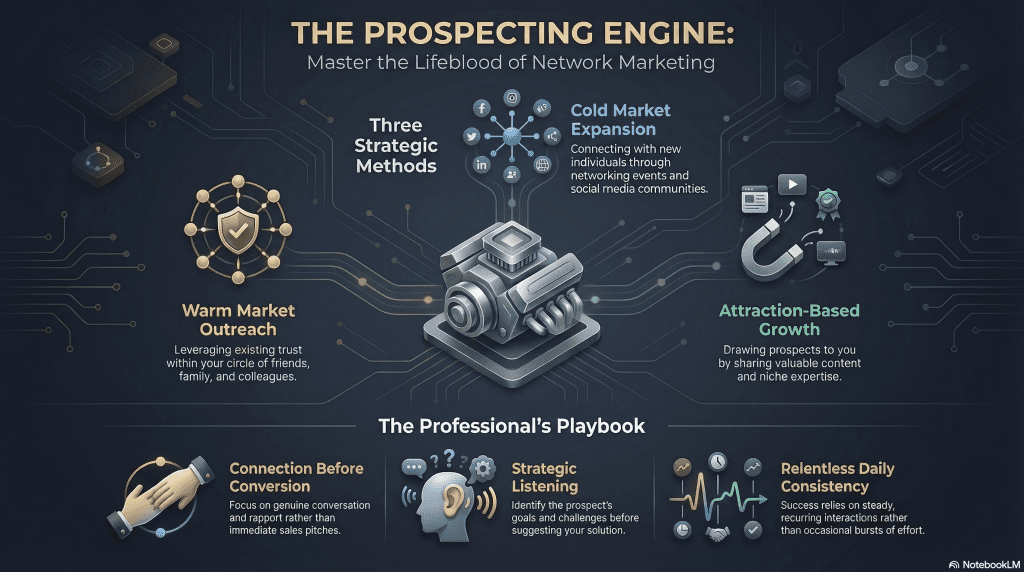
Why Prospecting Is the Lifeblood of Network Marketing
Every network marketing business depends on a steady flow of new people entering the process. Without new prospects, even the most enthusiastic distributor eventually runs out of customers and potential team members. This is why prospecting is often described as the lifeblood of network marketing.
It Keeps Your Business Growing
Growth in network marketing comes from two main activities: selling products and expanding your team. Both of these require people who are learning about the opportunity for the first time.
Prospecting ensures that new individuals are continuously introduced to your products or business model. When this activity stops, growth usually stops as well.
It Creates New Opportunities
Not everyone you speak with will become a customer or join your business. That is normal. Prospecting is a numbers game that focuses on finding the right people, not convincing everyone.
By consistently meeting new prospects, you increase the chances of finding individuals who are genuinely interested in what you offer.
It Builds a Larger Network
Network marketing is built on relationships. The more people you meet and connect with, the larger your potential network becomes.
Over time, consistent prospecting can lead to:
- More product customers
- New team members
- Referrals from satisfied clients
- Expanded reach through personal connections
Each new relationship has the potential to introduce you to additional prospects.
It Creates Long-Term Momentum
Successful distributors rarely rely on short bursts of activity. Instead, they develop a habit of prospecting regularly.
When prospecting becomes part of a daily routine, it creates momentum. New conversations lead to presentations, presentations lead to decisions, and some of those decisions turn into new customers or business partners.
In this way, prospecting acts as the engine that keeps a network marketing business moving forward.

The Three Main Prospecting Methods in Network Marketing
Not all prospecting happens the same way. Over time, network marketers have developed several approaches for finding and connecting with new prospects. While strategies may vary, most prospecting methods fall into three main categories.
Understanding these approaches helps you choose the style that fits your personality, audience, and business goals.
Warm Market Prospecting
Warm market prospecting involves reaching out to people you already know. These individuals may include friends, family members, coworkers, or acquaintances within your existing social circles.
Because there is already some level of trust, warm market conversations often feel more natural than approaching strangers.
Common warm market prospects include:
- Friends and family
- Former colleagues
- Classmates or alumni
- Members of local communities or clubs
The key to warm market prospecting is avoiding pressure. Instead of immediately presenting a business opportunity, successful distributors usually focus on starting conversations and identifying whether the person might be open to learning more.
Cold Market Prospecting
Cold market prospecting means connecting with people who do not know you yet. These prospects are outside your existing network and may be encountered through various channels.
Examples of cold market prospecting include:
- Networking events
- Online communities
- Social media connections
- Industry meetups
- Everyday conversations with new people
Cold prospecting allows you to reach a much larger audience than your personal network alone. However, it often requires stronger communication skills because trust has not yet been established.
The goal is to build rapport first before discussing products or business opportunities.
Attraction-Based Prospecting
Attraction-based prospecting is a more modern approach that focuses on drawing prospects toward you rather than actively pursuing them.
Instead of initiating direct outreach, distributors create content or share valuable information that attracts people who are already interested in the topic.
Examples include:
- Posting helpful content on social media
- Sharing fitness or lifestyle tips
- Creating educational videos
- Writing blog posts related to your niche
When prospects discover your content and find it valuable, they may start conversations themselves. This approach often feels less intrusive and can help build credibility over time.
These three methods are not mutually exclusive. Many successful network marketers combine warm market conversations, cold outreach, and attraction-based strategies to maintain a steady flow of new prospects.

How to Approach Prospects Naturally
One of the biggest concerns in network marketing is how to approach prospects without sounding pushy or overly sales-focused. Many people hesitate to start conversations because they worry about being rejected or damaging relationships.
The key is to treat prospecting as a conversation, not a pitch.
Focus on Genuine Conversations
Instead of immediately talking about your business or products, begin with normal conversation. Ask questions about the other person’s interests, goals, or experiences.
For example, you might discuss:
- Health and fitness goals
- Work or career interests
- Lifestyle changes they are considering
- Personal development topics
These conversations help build rapport and make the interaction feel natural.
Listen Before You Share
Effective prospecting involves listening carefully to what the other person says. When you understand their goals or challenges, it becomes easier to determine whether your product or business might be relevant.
If there is no clear connection, it is often better to simply maintain the relationship rather than forcing the topic.
Introduce the Opportunity Naturally
If the conversation reveals a genuine interest or need, you can mention what you are working on in a casual way.
For example:
- Sharing that you recently started a new business
- Mentioning a product that helped you personally
- Talking about a project you are excited about
This approach allows the prospect to ask questions if they are interested rather than feeling pressured.
Respect the Prospect’s Decision
Not everyone will be interested, and that is normal. The goal of prospecting is not to convince everyone but to find people who are open to learning more.
When someone declines or shows little interest, the best approach is to respect their decision and keep the relationship positive.
Follow Up Thoughtfully
Sometimes a prospect may not be ready immediately but could become interested later. A simple follow-up conversation in the future can keep the relationship active without being intrusive.
Consistent and respectful communication often leads to better long-term results than aggressive selling.

Common Prospecting Mistakes in Network Marketing
Prospecting is essential for building a network marketing business, but many distributors struggle because of avoidable mistakes. These mistakes often discourage prospects and make conversations feel uncomfortable or forced.
Recognizing these common problems can help you approach prospecting more effectively.
Pitching Too Early
One of the most common mistakes is introducing the business opportunity too quickly. When the conversation immediately turns into a sales pitch, prospects may feel pressured or defensive.
Instead, focus on building a natural conversation first. When people feel comfortable, they are more open to learning about what you do.
Treating Everyone as a Prospect
Not every person you meet is a good fit for your products or business opportunity. Some individuals may simply have no interest in entrepreneurship, health products, or the type of solution you offer.
Successful network marketers focus on finding the right prospects, not convincing everyone.
Being Too Aggressive
Aggressive recruiting tactics can damage relationships and create negative impressions. Messaging people repeatedly, pushing for quick decisions, or applying pressure often leads to rejection.
A better approach is to respect each person’s pace and level of interest.
Failing to Follow Up
Another common mistake is giving up after the first conversation. Many prospects need time to think, research, or evaluate their situation before making a decision.
Thoughtful follow-up conversations can keep the relationship active without being intrusive.
Lack of Consistency
Prospecting works best when it becomes a regular habit. Some distributors prospect intensively for a short period and then stop completely.
In network marketing, consistent daily activity usually produces better results than occasional bursts of effort.

Simple Prospecting Scripts You Can Use
Most people in network marketing do not struggle because they have nothing to say. They struggle because they do not know how to open the conversation without making it awkward.
That is where simple scripts help.
A good script is not something you memorize word for word. It is a starting point. Its job is to help you introduce the topic naturally, see whether the other person is open, and keep the conversation low pressure.
The scripts below work best when they sound like your normal voice. Adjust the wording so it feels natural to you.
Script 1: When Someone Asks What You Have Been Doing
This is one of the easiest prospecting moments because the opening is already there. The other person has invited you to share.
You could say:
“I’ve been working on a side project in the wellness space recently. It’s been a really interesting learning experience.”
Or:
“I’ve been building something on the side outside of work. It’s introduced me to a lot of people in the health and wellness world.”
Why this works:
It answers the question without turning into a pitch. It gives the other person room to ask more if they are curious.
Script 2: When a Conversation Naturally Touches a Problem You Help Solve
Sometimes prospecting starts because the other person mentions something relevant, such as wanting extra income, getting healthier, or looking for more flexibility.
You could say:
“That’s actually part of what got me interested in what I’m doing now.”
Or:
“I can relate to that. It’s one of the reasons I started looking into this in the first place.”
If they want to know more, you can add:
“I started working with a wellness company on the side, and it’s been a good fit for me so far.”
Why this works:
You are connecting to something they already said. That makes the conversation feel relevant instead of forced.
Script 3: When You Want to Reconnect With Someone You Already Know
This works well with old friends, former coworkers, or casual acquaintances.
You could say:
“Hey, it’s been a while. I saw your post the other day and wanted to check in. How have things been going for you?”
Then later, if the conversation flows naturally:
“A lot has changed on my side too. I’ve been working on something in the wellness space that’s opened up some interesting opportunities.”
Why this works:
It starts as a real reconnection, not a disguised sales message. That matters. If the first message feels like bait, trust disappears fast.
Script 4: When You Are Messaging Someone on Social Media
Social media prospecting works best when you respond to something real instead of sending cold, generic outreach.
You could say:
“I saw your post about getting back into fitness. How has that been going?”
Or:
“You mentioned wanting more flexibility in your schedule. That stood out to me because it’s something I’ve been working toward too.”
If the exchange develops naturally, you can say:
“That’s part of why I started exploring a side business in the wellness space.”
Why this works:
It shows attention and relevance. You are starting with them, not with your opportunity.
Script 5: When You Want to Test for Interest Without Pushing
Once the topic is open, the next step is not to explain everything. The next step is to see if they are even interested.
You could say:
“If you’re curious, I can show you what I’ve been working on.”
Or:
“If that’s something you’d ever want to look at, I’d be happy to send you more information.”
Or:
“No pressure at all, but if you want, I can share a quick overview.”
Why this works:
It protects the relationship. You are offering, not pressuring.
Script 6: When Someone Is Not Interested
This script matters just as much as the others.
You could say:
“No worries at all. I just thought I’d mention it.”
Or:
“Totally fine. I appreciate you letting me know.”
Why this works:
Good prospecting is not just about opening conversations. It is also about ending them well. People remember whether they felt respected.
How to Use These Scripts Well
A script is useful when it helps you stay clear and relaxed. It becomes a problem when it makes you sound robotic.
A few simple rules make these scripts work better:
- Use them as a guide, not a performance.
- Keep your first mention brief.
- Let curiosity pull the conversation forward.
- Do not explain the whole business too early.
- Respect a weak response as much as a strong one.
The goal of prospecting is not to control the conversation. It is to create a natural opening and see whether interest is there.
Conclusion
Prospecting is one of the most important activities in network marketing because it keeps your business moving forward. Without a steady flow of new prospects, it becomes difficult to maintain momentum, attract new customers, or grow a team.
At its core, prospecting is about starting conversations and identifying people who may benefit from what you offer. It is not about convincing everyone you meet. Instead, the goal is to find individuals who are open to learning more about your products or business opportunity.
Successful network marketers usually approach prospecting as a consistent habit rather than a one-time effort. By meeting new people, building relationships, and staying open to conversations, they gradually expand their network and create more opportunities over time.
When prospecting is done with authenticity and respect, it becomes less about selling and more about connecting with people who share similar goals or interests.

FAQs About Prospecting in Network Marketing
What is prospecting in network marketing?
Prospecting in network marketing is the process of identifying and connecting with people who may be interested in your products or business opportunity. These individuals are called prospects because they represent potential future customers or team members.
Why is prospecting important in network marketing?
Prospecting is important because it introduces new people to your business. Without consistently finding new prospects, it becomes difficult to grow your customer base or expand your team.
What are the main ways to prospect in network marketing?
Most network marketers use three main prospecting approaches:
- Warm market prospecting (people you already know)
- Cold market prospecting (people outside your personal network)
- Attraction-based prospecting (drawing prospects through content or value)
Is prospecting the same as selling?
No. Prospecting focuses on identifying people who may be interested in learning more. Selling happens later in the process when you present your product or opportunity in more detail.
How many people should you prospect each day?
The exact number varies, but many experienced network marketers recommend making prospecting a daily activity. Consistency is usually more important than trying to contact a large number of people at once.
What is the biggest mistake in network marketing prospecting?
One of the most common mistakes is trying to present the business opportunity too quickly. Successful prospecting usually begins with normal conversations and gradually introduces the opportunity when the person shows genuine interest.

0 Comments